 Add to Chrome
 Add to Firefox
 Add to Edge
A Survey on Patients Privacy Protection with Stganography and Visual Encryption
Jan 23, 2022
In this survey, thirty models for steganography and visual encryption methods have been discussed to provide patients privacy protection.

A Comprehensive Survey on Federated Learning: Concept and Applications
Jan 23, 2022

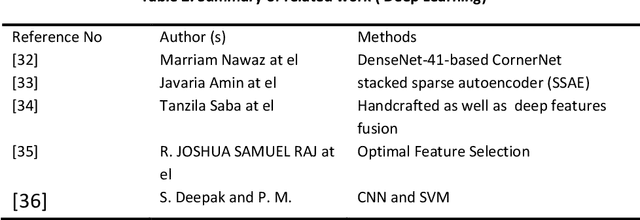

This paper provides a comprehensive study of Federated Learning (FL) with an emphasis on components, challenges, applications and FL environment. FL can be applicable in multiple fields and domains in real-life models. in the medical system, the privacy of patients records and their medical condition is critical data, therefore collaborative learning or federated learning comes into the picture. On other hand build an intelligent system assist the medical staff without sharing the data lead into the FL concept and one of the applications that are used is a brain tumor diagnosis intelligent system based on AI methods that can efficiently work in a collaborative environment.this paper will introduce some of the applications and related work in the medical field and work under the FL concept then summarize them to introduce the main limitations of their work.
Cluster-Based Information Retrieval by using (K-means)- Hierarchical Parallel Genetic Algorithms Approach
Aug 01, 2020

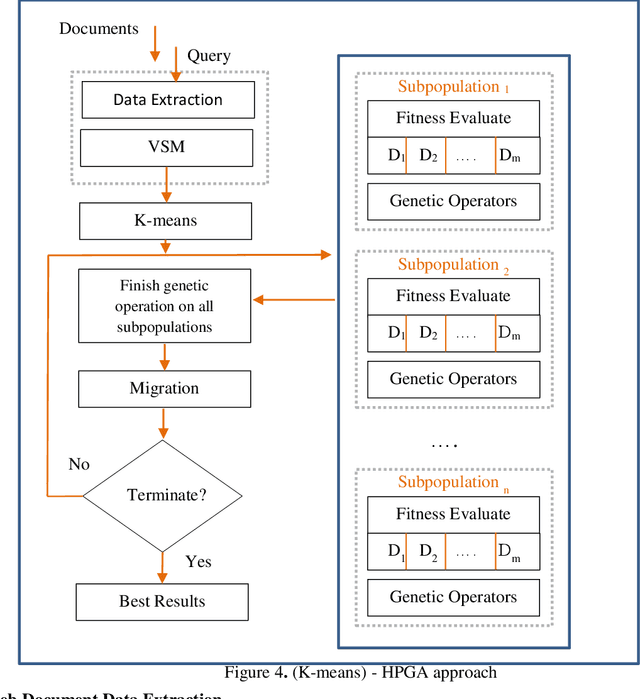
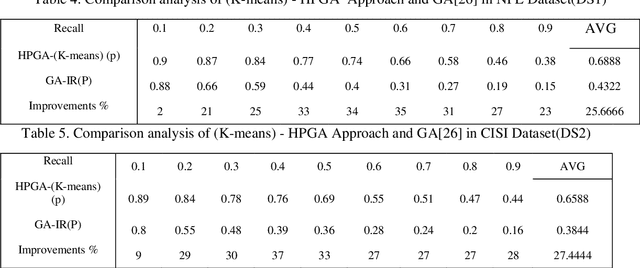
Cluster-based information retrieval is one of the Information retrieval(IR) tools that organize, extract features and categorize the web documents according to their similarity. Unlike traditional approaches, cluster-based IR is fast in processing large datasets of document. To improve the quality of retrieved documents, increase the efficiency of IR and reduce irrelevant documents from user search. in this paper, we proposed a (K-means) - Hierarchical Parallel Genetic Algorithms Approach (HPGA) that combines the K-means clustering algorithm with hybrid PG of multi-deme and master/slave PG algorithms. K-means uses to cluster the population to k subpopulations then take most clusters relevant to the query to manipulate in a parallel way by the two levels of genetic parallelism, thus, irrelevant documents will not be included in subpopulations, as a way to improve the quality of results. Three common datasets (NLP, CISI, and CACM) are used to compute the recall, precision, and F-measure averages. Finally, we compared the precision values of three datasets with Genetic-IR and classic-IR. The proposed approach precision improvements with IR-GA were 45% in the CACM, 27% in the CISI, and 25% in the NLP. While, by comparing with Classic-IR, (k-means)-HPGA got 47% in CACM, 28% in CISI, and 34% in NLP.
Palm Vein Identification based on hybrid features selection model
Jul 31, 2020


Palm vein identification (PVI) is a modern biometric security technique used for increasing security and authentication systems. The key characteristics of palm vein patterns include, its uniqueness to each individual, unforgettable, non-intrusive and cannot be taken by an unauthorized person. However, the extracted features from the palm vein pattern are huge with high redundancy. In this paper, we propose a combine model of two-Dimensional Discrete Wavelet Transform, Principal Component Analysis (PCA), and Particle Swarm Optimization (PSO) (2D-DWTPP) to enhance prediction of vein palm patterns. The 2D-DWT Extracts features from palm vein images, PCA reduces the redundancy in palm vein features. The system has been trained in selecting high reverent features based on the wrapper model. The PSO feeds wrapper model by an optimal subset of features. The proposed system uses four classifiers as an objective function to determine VPI which include Support Vector Machine (SVM), K Nearest Neighbor (KNN), Decision Tree (DT) and Na\"ive Bayes (NB). The empirical result shows the proposed system Iit satisfied best results with SVM. The proposed 2D-DWTPP model has been evaluated and the results shown remarkable efficiency in comparison with Alexnet and classifier without feature selection. Experimentally, our model has better accuracy reflected by (98.65) while Alexnet has (63.5) and applied classifier without feature selection has (78.79).