 Add to Chrome
 Add to Firefox
 Add to Edge
Efficient compressive sensing for machinery vibration signals
Mar 26, 2026
Mechanical vibration monitoring often requires high sampling rates and generates large data volumes, posing challenges for storage, transmission, and power efficiency. Compressive Sensing (CS) offers a promising approach to overcome these constraints by exploiting signal sparsity to enable sub-Nyquist acquisition and efficient reconstruction. This study presents a comprehensive comparative analysis of the key components of the CS framework: sparse basis, measurement matrix, and reconstruction algorithm for machinery vibration signals. In addition, a hardware-efficient measurement matrix, the Wang matrix, originally developed for image compression, is introduced and evaluated for the first time in this context. Experimental assessment using the HUMS2023 and the CETIM gearbox datasets demonstrates that this matrix achieves superior reconstruction quality, with higher SNR, compared to conventional Gaussian and Bernoulli matrices, especially at high compression ratios.

Differentiable short-time Fourier transform with respect to the hop length
Jul 26, 2023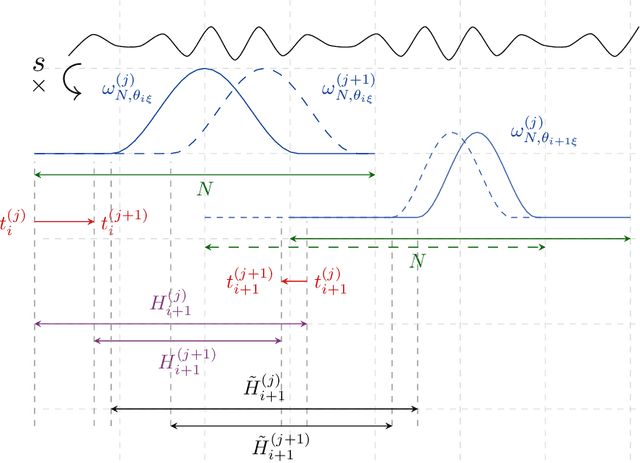
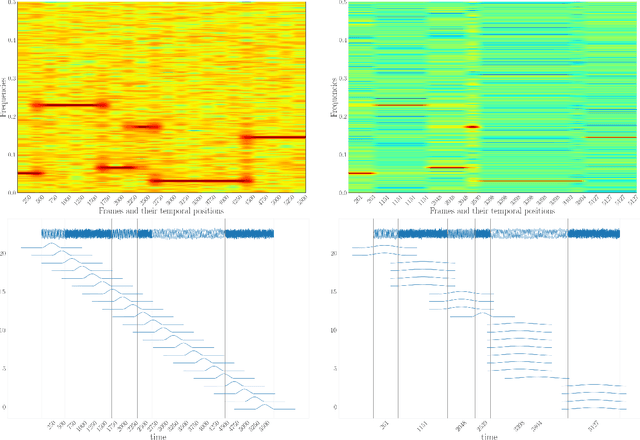
In this paper, we propose a differentiable version of the short-time Fourier transform (STFT) that allows for gradient-based optimization of the hop length or the frame temporal position by making these parameters continuous. Our approach provides improved control over the temporal positioning of frames, as the continuous nature of the hop length allows for a more finely-tuned optimization. Furthermore, our contribution enables the use of optimization methods such as gradient descent, which are more computationally efficient than conventional discrete optimization methods. Our differentiable STFT can also be easily integrated into existing algorithms and neural networks. We present a simulated illustration to demonstrate the efficacy of our approach and to garner interest from the research community.
Differentiable adaptive short-time Fourier transform with respect to the window length
Jul 26, 2023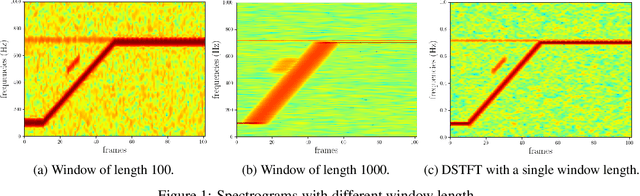
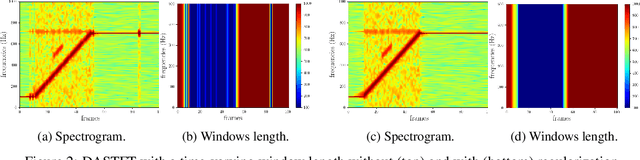
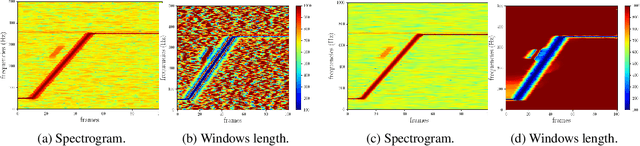
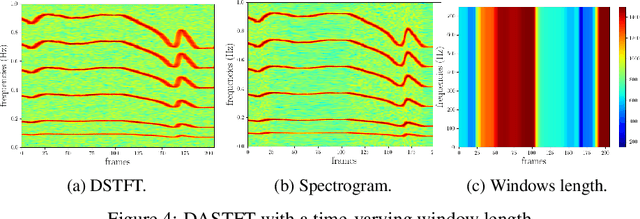
This paper presents a gradient-based method for on-the-fly optimization for both per-frame and per-frequency window length of the short-time Fourier transform (STFT), related to previous work in which we developed a differentiable version of STFT by making the window length a continuous parameter. The resulting differentiable adaptive STFT possesses commendable properties, such as the ability to adapt in the same time-frequency representation to both transient and stationary components, while being easily optimized by gradient descent. We validate the performance of our method in vibration analysis.