 Add to Chrome
 Add to Firefox
 Add to Edge
Blink: CPU-Free LLM Inference by Delegating the Serving Stack to GPU and SmartNIC
Apr 08, 2026
Large Language Model (LLM) inference is rapidly becoming a core datacenter service, yet current serving stacks keep the host CPU on the critical path for orchestration and token-level control. This makes LLM performance sensitive to CPU interference, undermining application colocation and forcing operators to reserve CPU headroom, leaving substantial capacity unutilized. We introduce Blink, an end-to-end serving architecture that removes the host CPU from the steady-state inference path by redistributing responsibilities across a SmartNIC and a GPU. Blink offloads request handling to the SmartNIC, which delivers inputs directly into GPU memory via RDMA, and replaces host-driven scheduling with a persistent GPU kernel that performs batching, scheduling, and KV-cache management without CPU involvement. Evaluated against TensorRT-LLM, vLLM, and SGLang, Blink outperforms all baselines even in isolation, reducing pre-saturation P99 TTFT by up to 8.47$\times$ and P99 TPOT by up to 3.40$\times$, improving decode throughput by up to 2.1$\times$, and reducing energy per token by up to 48.6$\%$. Under CPU interference, Blink maintains stable performance, while existing systems degrade by up to two orders of magnitude.

Priority-Aware Preemptive Scheduling for Mixed-Priority Workloads in MoE Inference
Mar 12, 2025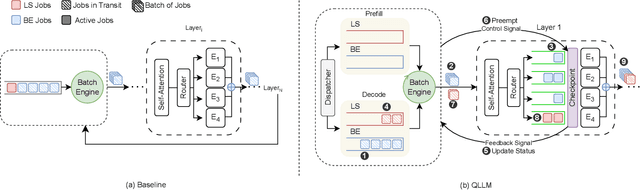
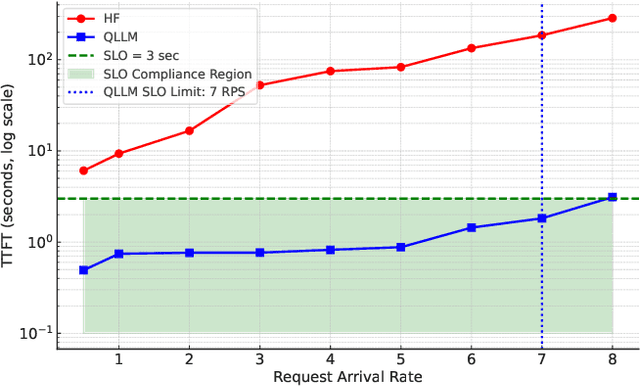
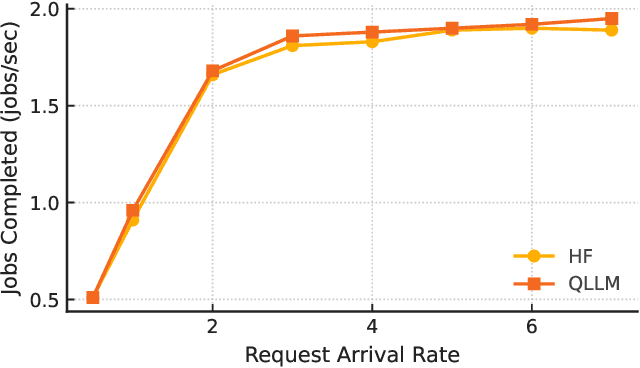
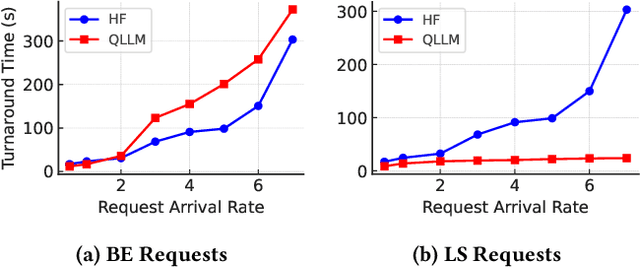
Large Language Models have revolutionized natural language processing, yet serving them efficiently in data centers remains challenging due to mixed workloads comprising latency-sensitive (LS) and best-effort (BE) jobs. Existing inference systems employ iteration-level first-come-first-served scheduling, causing head-of-line blocking when BE jobs delay LS jobs. We introduce QLLM, a novel inference system designed for Mixture of Experts (MoE) models, featuring a fine-grained, priority-aware preemptive scheduler. QLLM enables expert-level preemption, deferring BE job execution while minimizing LS time-to-first-token (TTFT). Our approach removes iteration-level scheduling constraints, enabling the scheduler to preempt jobs at any layer based on priority. Evaluations on an Nvidia A100 GPU show that QLLM significantly improves performance. It reduces LS TTFT by an average of $65.5\times$ and meets the SLO at up to $7$ requests/sec, whereas the baseline fails to do so under the tested workload. Additionally, it cuts LS turnaround time by up to $12.8\times$ without impacting throughput. QLLM is modular, extensible, and seamlessly integrates with Hugging Face MoE models.