 Add to Chrome
 Add to Firefox
 Add to Edge
NPNet: A Non-Parametric Network with Adaptive Gaussian-Fourier Positional Encoding for 3D Classification and Segmentation
Jan 31, 2026
We present NPNet, a fully non-parametric approach for 3D point-cloud classification and part segmentation. NPNet contains no learned weights; instead, it builds point features using deterministic operators such as farthest point sampling, k-nearest neighbors, and pooling. Our key idea is an adaptive Gaussian-Fourier positional encoding whose bandwidth and Gaussian-cosine mixing are chosen from the input geometry, helping the method remain stable across different scales and sampling densities. For segmentation, we additionally incorporate fixed-frequency Fourier features to provide global context alongside the adaptive encoding. Across ModelNet40/ModelNet-R, ScanObjectNN, and ShapeNetPart, NPNet achieves strong performance among non-parametric baselines, and it is particularly effective in few-shot settings on ModelNet40. NPNet also offers favorable memory use and inference time compared to prior non-parametric methods

Enhancing 3D Point Cloud Classification with ModelNet-R and Point-SkipNet
Sep 05, 2025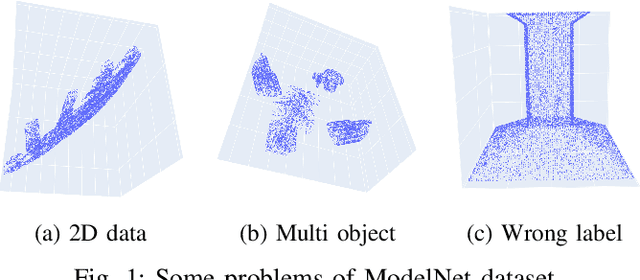
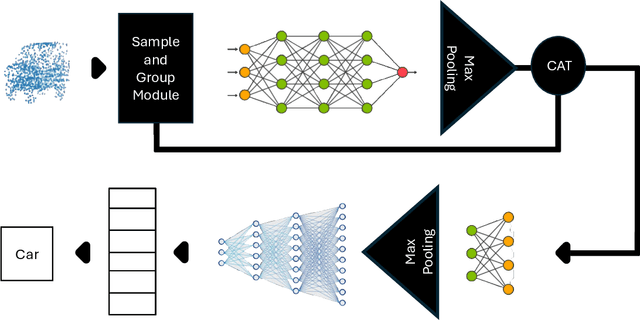
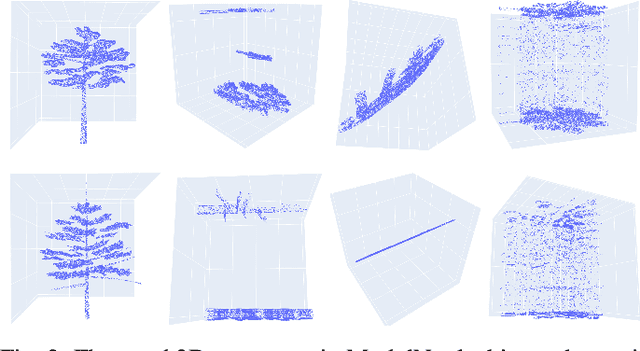
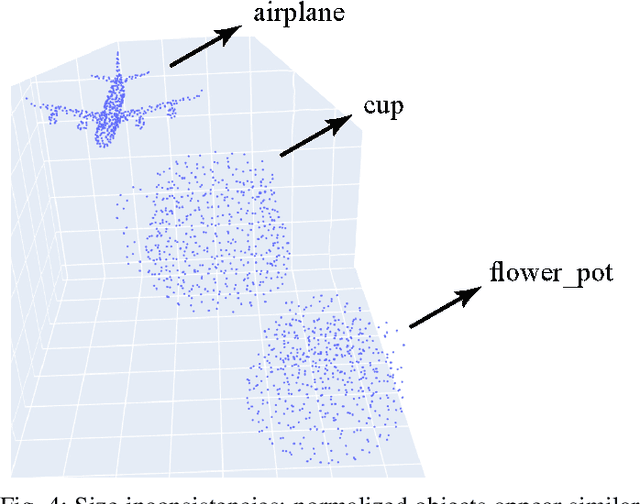
The classification of 3D point clouds is crucial for applications such as autonomous driving, robotics, and augmented reality. However, the commonly used ModelNet40 dataset suffers from limitations such as inconsistent labeling, 2D data, size mismatches, and inadequate class differentiation, which hinder model performance. This paper introduces ModelNet-R, a meticulously refined version of ModelNet40 designed to address these issues and serve as a more reliable benchmark. Additionally, this paper proposes Point-SkipNet, a lightweight graph-based neural network that leverages efficient sampling, neighborhood grouping, and skip connections to achieve high classification accuracy with reduced computational overhead. Extensive experiments demonstrate that models trained in ModelNet-R exhibit significant performance improvements. Notably, Point-SkipNet achieves state-of-the-art accuracy on ModelNet-R with a substantially lower parameter count compared to contemporary models. This research highlights the crucial role of dataset quality in optimizing model efficiency for 3D point cloud classification. For more details, see the code at: https://github.com/m-saeid/ModeNetR_PointSkipNet.