 Add to Chrome
 Add to Firefox
 Add to Edge
ELSAA: Efficient Low-Rank and Sparse Attention Approximation for Training Transformers
Jul 22, 2026
The quadratic $N\times N$ attention score matrix remains a central obstacle to extending Transformers to longer input lengths. Existing efficient attention methods usually reduce this bottleneck by either imposing sparsity, so that each query attends to only a small subset of keys, or by using low-rank/kernel sketches, so that global interactions are compressed into a lower-dimensional representation. We propose \emph{ELSAA}, an efficient low-rank and sparse approximation of attention. Importantly, ELSAA does \emph{not} decompose the learned projection or output matrices of the Transformer into sparse and low-rank factors. Instead, after dense projections produce $Q,K,V$, ELSAA approximates the induced attention score operator itself: a sparse branch captures selected high-similarity interactions, while a low-rank branch summarizes diffuse global interactions. Since the two branches can be normalized over supports with very different denominator mass, ELSAA introduces a denominator-aware fusion term that scales the sparse branch according to its estimated attention mass relative to the low-rank branch. This gives a practical framework for constructing low-rank and sparse attention outputs without materializing the full quadratic score matrix, aiming to enable longer-context training while preserving both sharp token-level interactions and broad contextual mixing.

EvoFed: Leveraging Evolutionary Strategies for Communication-Efficient Federated Learning
Nov 13, 2023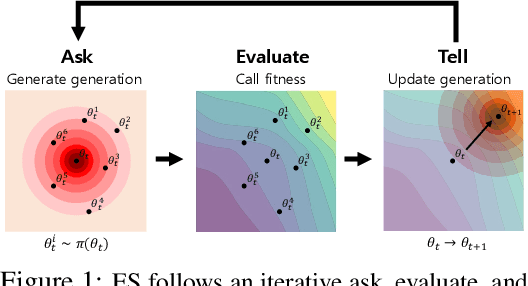
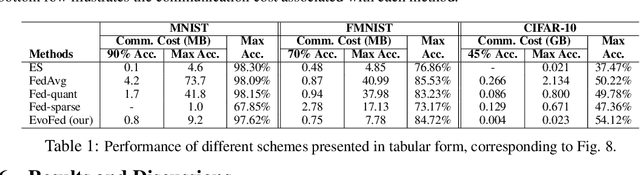
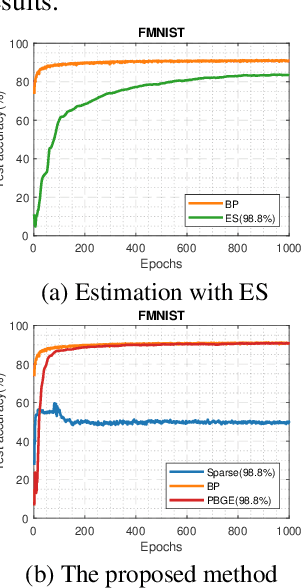

Federated Learning (FL) is a decentralized machine learning paradigm that enables collaborative model training across dispersed nodes without having to force individual nodes to share data. However, its broad adoption is hindered by the high communication costs of transmitting a large number of model parameters. This paper presents EvoFed, a novel approach that integrates Evolutionary Strategies (ES) with FL to address these challenges. EvoFed employs a concept of 'fitness-based information sharing', deviating significantly from the conventional model-based FL. Rather than exchanging the actual updated model parameters, each node transmits a distance-based similarity measure between the locally updated model and each member of the noise-perturbed model population. Each node, as well as the server, generates an identical population set of perturbed models in a completely synchronized fashion using the same random seeds. With properly chosen noise variance and population size, perturbed models can be combined to closely reflect the actual model updated using the local dataset, allowing the transmitted similarity measures (or fitness values) to carry nearly the complete information about the model parameters. As the population size is typically much smaller than the number of model parameters, the savings in communication load is large. The server aggregates these fitness values and is able to update the global model. This global fitness vector is then disseminated back to the nodes, each of which applies the same update to be synchronized to the global model. Our analysis shows that EvoFed converges, and our experimental results validate that at the cost of increased local processing loads, EvoFed achieves performance comparable to FedAvg while reducing overall communication requirements drastically in various practical settings.