 Add to Chrome
 Add to Firefox
 Add to Edge
ARIQA-3DS: A Stereoscopic Image Quality Assessment Dataset for Realistic Augmented Reality
Apr 03, 2026
As Augmented Reality (AR) technologies advance towards immersive consumer adoption, the need for rigorous Quality of Experience (QoE) assessment becomes critical. However, existing datasets often lack ecological validity, relying on monocular viewing or simplified backgrounds that fail to capture the complex perceptual interplay, termed visual confusion, between real and virtual layers. To address this gap, we present ARIQA-3DS, the first large stereoscopic AR Image Quality Assessment dataset. Comprising 1,200 AR viewports, the dataset fuses high-resolution stereoscopic omnidirectional captures of real-world scenes with diverse augmented foregrounds under controlled transparency and degradation conditions. We conducted a comprehensive subjective study with 36 participants using a video see-through head-mounted display, collecting both quality ratings and simulator-sickness indicators. Our analysis reveals that perceived quality is primarily driven by foreground degradations and modulated by transparency levels, while oculomotor and disorientation symptoms show a progressive but manageable increase during viewing. ARIQA-3DS will be publicly released to serve as a comprehensive benchmark for developing next-generation AR quality assessment models.

Multi-Feature Fusion Approach for Generative AI Images Detection
Mar 31, 2026The rapid evolution of Generative AI (GenAI) models has led to synthetic images of unprecedented realism, challenging traditional methods for distinguishing them from natural photographs. While existing detectors often rely on single-feature spaces, such as statistical regularities, semantic embeddings, or texture patterns, these approaches tend to lack robustness when confronted with diverse and evolving generative models. In this work, we investigate and systematically evaluate a multi-feature fusion framework that combines complementary cues from three distinct spaces: (1) Mean Subtracted Contrast Normalized (MSCN) features capturing low-level statistical deviations; (2) CLIP embeddings encoding high-level semantic coherence; and (3) Multi-scale Local Binary Patterns (MLBP) characterizing mid-level texture anomalies. Through extensive experiments on four benchmark datasets covering a wide range of generative models, we show that individual feature spaces exhibit significant performance variability across different generators. Crucially, the fusion of all three representations yields superior and more consistent performance, particularly in a challenging mixed-model scenario. Compared to state-of-the-art methods, the proposed framework yields consistently improved performance across all evaluated datasets. Overall, this work highlights the importance of hybrid representations for robust GenAI image detection and provides a principled framework for integrating complementary visual cues.
Embedding Similarity Guided License Plate Super Resolution
Jan 08, 2025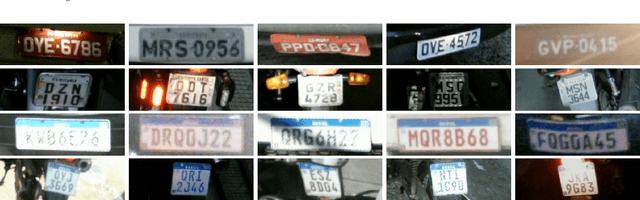
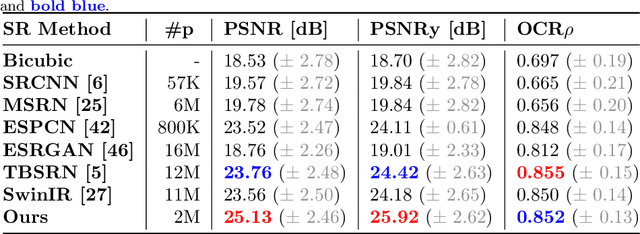
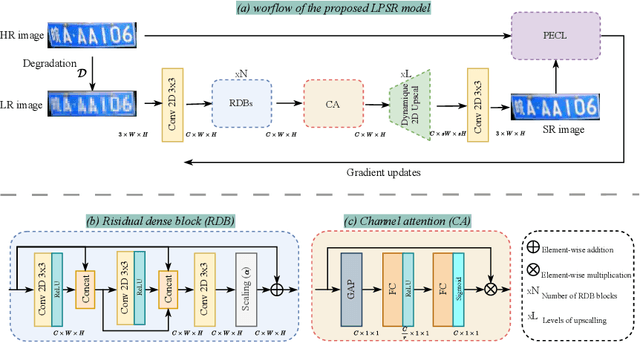
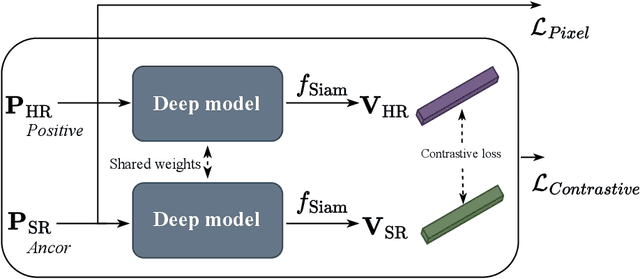
Super-resolution (SR) techniques play a pivotal role in enhancing the quality of low-resolution images, particularly for applications such as security and surveillance, where accurate license plate recognition is crucial. This study proposes a novel framework that combines pixel-based loss with embedding similarity learning to address the unique challenges of license plate super-resolution (LPSR). The introduced pixel and embedding consistency loss (PECL) integrates a Siamese network and applies contrastive loss to force embedding similarities to improve perceptual and structural fidelity. By effectively balancing pixel-wise accuracy with embedding-level consistency, the framework achieves superior alignment of fine-grained features between high-resolution (HR) and super-resolved (SR) license plates. Extensive experiments on the CCPD dataset validate the efficacy of the proposed framework, demonstrating consistent improvements over state-of-the-art methods in terms of PSNR_RGB, PSNR_Y and optical character recognition (OCR) accuracy. These results highlight the potential of embedding similarity learning to advance both perceptual quality and task-specific performance in extreme super-resolution scenarios.
A Two-Fold Patch Selection Approach for Improved 360-Degree Image Quality Assessment
Dec 17, 2024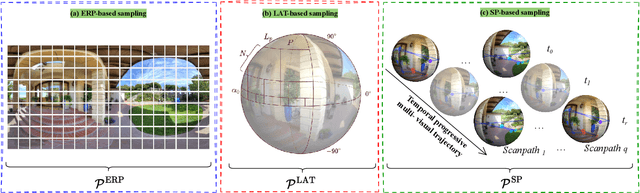

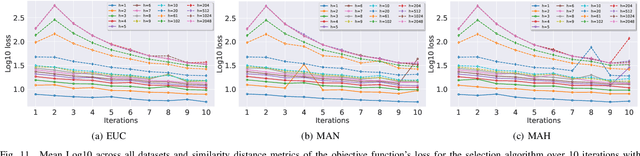

This article presents a novel approach to improving the accuracy of 360-degree perceptual image quality assessment (IQA) through a two-fold patch selection process. Our methodology combines visual patch selection with embedding similarity-based refinement. The first stage focuses on selecting patches from 360-degree images using three distinct sampling methods to ensure comprehensive coverage of visual content for IQA. The second stage, which is the core of our approach, employs an embedding similarity-based selection process to filter and prioritize the most informative patches based on their embeddings similarity distances. This dual selection mechanism ensures that the training data is both relevant and informative, enhancing the model's learning efficiency. Extensive experiments and statistical analyses using three distance metrics across three benchmark datasets validate the effectiveness of our selection algorithm. The results highlight its potential to deliver robust and accurate 360-degree IQA, with performance gains of up to 4.5% in accuracy and monotonicity of quality score prediction, while using only 40% to 50% of the training patches. These improvements are consistent across various configurations and evaluation metrics, demonstrating the strength of the proposed method. The code for the selection process is available at: https://github.com/sendjasni/patch-selection-360-image-quality.
Enhancing Content Representation for AR Image Quality Assessment Using Knowledge Distillation
Dec 08, 2024

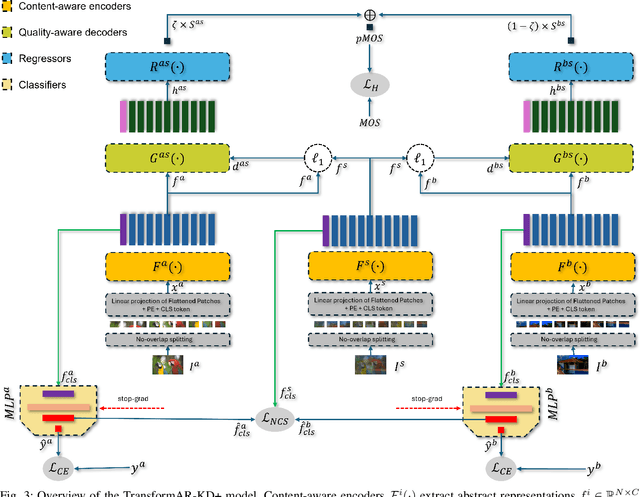

Augmented Reality (AR) is a major immersive media technology that enriches our perception of reality by overlaying digital content (the foreground) onto physical environments (the background). It has far-reaching applications, from entertainment and gaming to education, healthcare, and industrial training. Nevertheless, challenges such as visual confusion and classical distortions can result in user discomfort when using the technology. Evaluating AR quality of experience becomes essential to measure user satisfaction and engagement, facilitating the refinement necessary for creating immersive and robust experiences. Though, the scarcity of data and the distinctive characteristics of AR technology render the development of effective quality assessment metrics challenging. This paper presents a deep learning-based objective metric designed specifically for assessing image quality for AR scenarios. The approach entails four key steps, (1) fine-tuning a self-supervised pre-trained vision transformer to extract prominent features from reference images and distilling this knowledge to improve representations of distorted images, (2) quantifying distortions by computing shift representations, (3) employing cross-attention-based decoders to capture perceptual quality features, and (4) integrating regularization techniques and label smoothing to address the overfitting problem. To validate the proposed approach, we conduct extensive experiments on the ARIQA dataset. The results showcase the superior performance of our proposed approach across all model variants, namely TransformAR, TransformAR-KD, and TransformAR-KD+ in comparison to existing state-of-the-art methods.