 Add to Chrome
 Add to Firefox
 Add to Edge
TemporalDoRA: Temporal PEFT for Robust Surgical Video Question Answering
Mar 10, 2026
Surgical Video Question Answering (VideoQA) requires accurate temporal grounding while remaining robust to natural variation in how clinicians phrase questions, where linguistic bias can arise. Standard Parameter Efficient Fine Tuning (PEFT) methods adapt pretrained projections without explicitly modeling frame-to-frame interactions within the adaptation pathway, limiting their ability to exploit sparse temporal evidence. We introduce TemporalDoRA, a video-specific PEFT formulation that extends Weight-Decomposed Low-Rank Adaptation by (i) inserting lightweight temporal Multi-Head Attention (MHA) inside the low-rank bottleneck of the vision encoder and (ii) selectively applying weight decomposition only to the trainable low-rank branch rather than the full adapted weight. This design enables temporally-aware updates while preserving a frozen backbone and stable scaling. By mixing information across frames within the adaptation subspace, TemporalDoRA steers updates toward temporally consistent visual cues and improves robustness with minimal parameter overhead. To benchmark this setting, we present REAL-Colon-VQA, a colonoscopy VideoQA dataset with 6,424 clip--question pairs, including paired rephrased Out-of-Template questions to evaluate sensitivity to linguistic variation. TemporalDoRA improves Out-of-Template performance, and ablation studies confirm that temporal mixing inside the low-rank branch is the primary driver of these gains. We also validate on EndoVis18-VQA adapted to short clips and observe consistent improvements on the Out-of-Template split. Code and dataset available at~\href{https://anonymous.4open.science/r/TemporalDoRA-BFC8/}{Anonymous GitHub}.

EndoSfM3D: Learning to 3D Reconstruct Any Endoscopic Surgery Scene using Self-supervised Foundation Model
Oct 25, 2025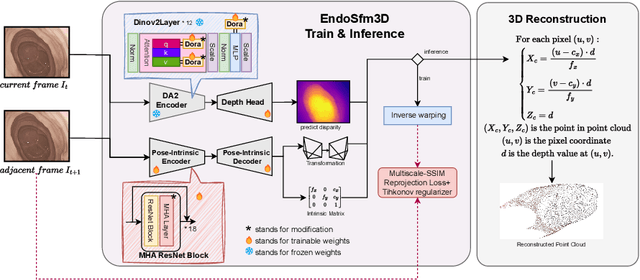
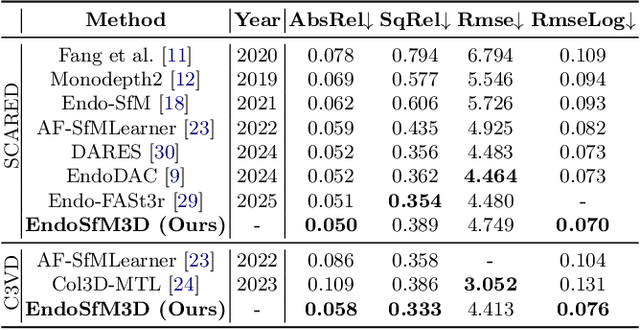
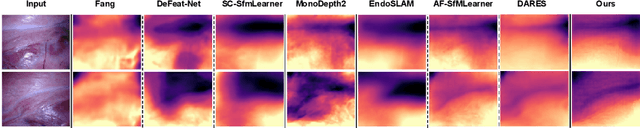

3D reconstruction of endoscopic surgery scenes plays a vital role in enhancing scene perception, enabling AR visualization, and supporting context-aware decision-making in image-guided surgery. A critical yet challenging step in this process is the accurate estimation of the endoscope's intrinsic parameters. In real surgical settings, intrinsic calibration is hindered by sterility constraints and the use of specialized endoscopes with continuous zoom and telescope rotation. Most existing methods for endoscopic 3D reconstruction do not estimate intrinsic parameters, limiting their effectiveness for accurate and reliable reconstruction. In this paper, we integrate intrinsic parameter estimation into a self-supervised monocular depth estimation framework by adapting the Depth Anything V2 (DA2) model for joint depth, pose, and intrinsics prediction. We introduce an attention-based pose network and a Weight-Decomposed Low-Rank Adaptation (DoRA) strategy for efficient fine-tuning of DA2. Our method is validated on the SCARED and C3VD public datasets, demonstrating superior performance compared to recent state-of-the-art approaches in self-supervised monocular depth estimation and 3D reconstruction. Code and model weights can be found in project repository: https://github.com/MOYF-beta/EndoSfM3D.