 Add to Chrome
 Add to Firefox
 Add to Edge
Pretraining large language models with MXFP4
May 11, 2026
Why does full-pipeline FP4 training of large language models often diverge, even when forward activations and activation gradients remain stable? We address this question through a controlled study of MXFP4 quantization in transformer training, progressively enabling FP4 across forward propagation (Fprop), activation gradients (Dgrad), and weight gradients (Wgrad) while holding all other factors fixed. In full pretraining of Llama 3.1-8B on the C4 dataset, we observe that quantizing Wgrad is the primary driver of convergence degradation, whereas FP4 in Fprop and Dgrad alone introduces only modest additional token requirements. To interpret this behavior, we evaluate both structured and stochastic interventions under a controlled experimental setting. We find that stochastic rounding and randomized Hadamard rotations fail to stabilize training once Wgrad is quantized, whereas deterministic Hadamard rotations consistently restore stable optimization. These results suggest that FP4 training instability is driven by structured micro-scaling errors along sensitive gradient paths, rather than by insufficient stochasticity. We run experiments with native MXFP4 support on AMD Instinct MI355X GPUs, enabling controlled investigation of these effects without reliance on software emulation.

MLPerf Power: Benchmarking the Energy Efficiency of Machine Learning Systems from μWatts to MWatts for Sustainable AI
Oct 15, 2024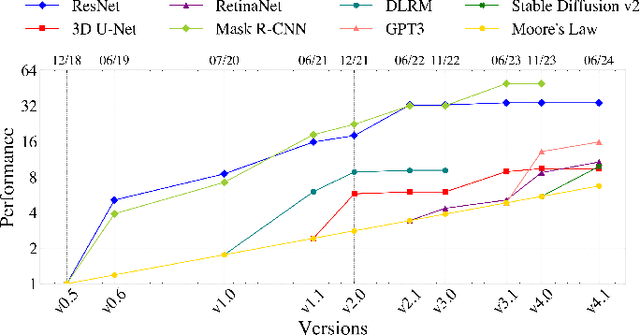
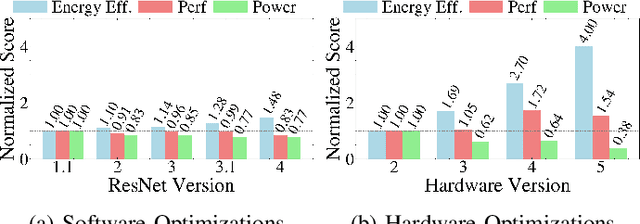
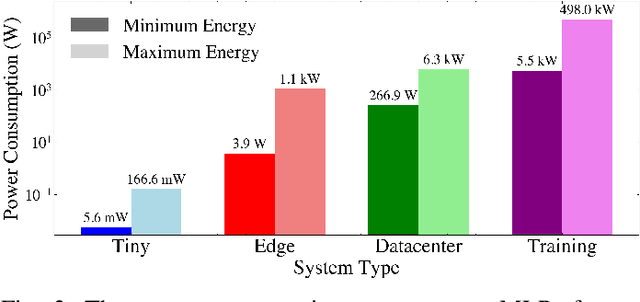
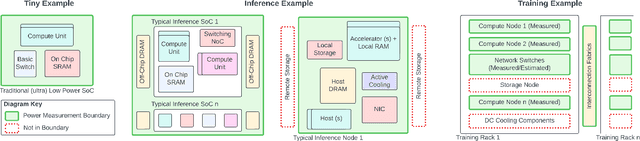
Rapid adoption of machine learning (ML) technologies has led to a surge in power consumption across diverse systems, from tiny IoT devices to massive datacenter clusters. Benchmarking the energy efficiency of these systems is crucial for optimization, but presents novel challenges due to the variety of hardware platforms, workload characteristics, and system-level interactions. This paper introduces MLPerf Power, a comprehensive benchmarking methodology with capabilities to evaluate the energy efficiency of ML systems at power levels ranging from microwatts to megawatts. Developed by a consortium of industry professionals from more than 20 organizations, MLPerf Power establishes rules and best practices to ensure comparability across diverse architectures. We use representative workloads from the MLPerf benchmark suite to collect 1,841 reproducible measurements from 60 systems across the entire range of ML deployment scales. Our analysis reveals trade-offs between performance, complexity, and energy efficiency across this wide range of systems, providing actionable insights for designing optimized ML solutions from the smallest edge devices to the largest cloud infrastructures. This work emphasizes the importance of energy efficiency as a key metric in the evaluation and comparison of the ML system, laying the foundation for future research in this critical area. We discuss the implications for developing sustainable AI solutions and standardizing energy efficiency benchmarking for ML systems.