 Add to Chrome
 Add to Firefox
 Add to Edge
Measuring What Matters: A Unified Evaluation Framework for GNN Explainability
Jul 06, 2026
Graph eXplainable AI (G-XAI) is increasingly important for making Graph Neural Networks interpretable and accountable. While a growing number of explainers are available, choosing the right method and assessing the trustworthiness of its outputs remains unclear. Consistent evaluation practices and actionable guidance are still missing, hindering practical adoption. In this paper, we introduce a unified, quantitative benchmarking framework for G-XAI that requires no ground-truth assumptions. We formalize tabular explainability metrics for graph data, evaluating topological structure and node features as independent components. Our large-scale benchmarking study identifies explainers that consistently lie on the Pareto front across metric pairs and tasks, establishing robustly non-dominated solutions - while confirming that no single explainer achieves universal superiority. We distill our findings into actionable G-XAI usability guidelines to support Machine Learning practitioners in evaluating and deploying trustworthy GNN-based pipelines.

AA-SGAN: Adversarially Augmented Social GAN with Synthetic Data
Dec 23, 2024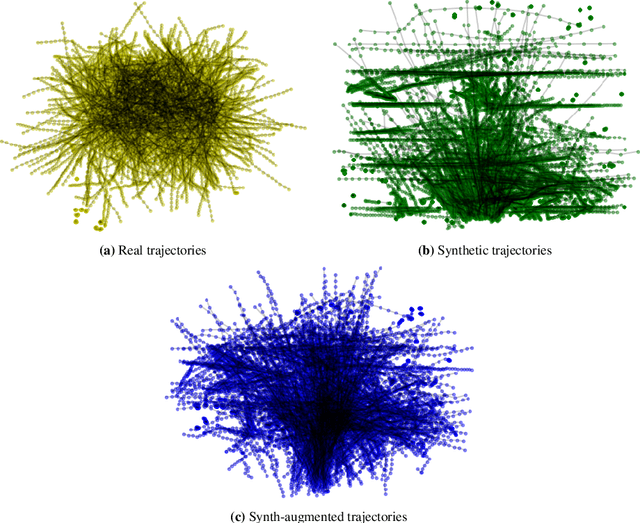
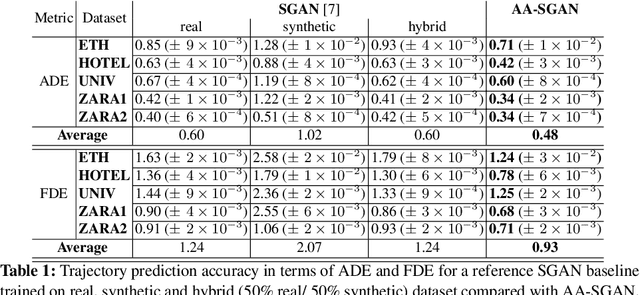
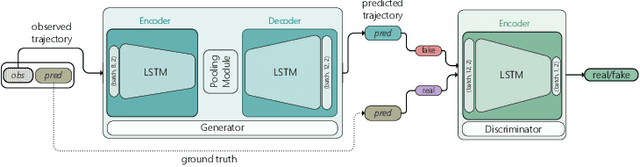

Accurately predicting pedestrian trajectories is crucial in applications such as autonomous driving or service robotics, to name a few. Deep generative models achieve top performance in this task, assuming enough labelled trajectories are available for training. To this end, large amounts of synthetically generated, labelled trajectories exist (e.g., generated by video games). However, such trajectories are not meant to represent pedestrian motion realistically and are ineffective at training a predictive model. We propose a method and an architecture to augment synthetic trajectories at training time and with an adversarial approach. We show that trajectory augmentation at training time unleashes significant gains when a state-of-the-art generative model is evaluated over real-world trajectories.