 Add to Chrome
 Add to Firefox
 Add to Edge
Learning Spatial Structure from Pre-Beamforming Per-Antenna Range-Doppler Radar Data via Visibility-Aware Cross-Modal Supervision
Apr 02, 2026
Automotive radar perception pipelines commonly construct angle-domain representations via beamforming before applying learning-based models. This work instead investigates a representational question: can meaningful spatial structure be learned directly from pre-beamforming per-antenna range-Doppler (RD) measurements? Experiments are conducted on a 6-TX x 8-RX (48 virtual antennas) commodity automotive radar employing an A/B chirp-sequence frequency-modulated continuous-wave (CS-FMCW) transmit scheme, in which the effective transmit aperture varies between chirps (single-TX vs. multi-TX), enabling controlled analysis of chirp-dependent transmit configurations. We operate on pre-beamforming per-antenna RD tensors using a dual-chirp shared-weight encoder trained in an end-to-end, fully data-driven manner, and evaluate spatial recoverability using bird's-eye-view (BEV) occupancy as a geometric probe rather than a performance-driven objective. Supervision is visibility-aware and cross-modal, derived from LiDAR with explicit modeling of the radar field-of-view and occlusion-aware LiDAR observability via ray-based visibility. Through chirp ablations (A-only, B-only, A+B), range-band analysis, and physics-aligned baselines, we assess how transmit configurations affect geometric recoverability. The results indicate that spatial structure can be learned directly from pre-beamforming per-antenna RD tensors without explicit angle-domain construction or hand-crafted signal-processing stages.

Dynamics-Decoupled Trajectory Alignment for Sim-to-Real Transfer in Reinforcement Learning for Autonomous Driving
Nov 10, 2025Reinforcement learning (RL) has shown promise in robotics, but deploying RL on real vehicles remains challenging due to the complexity of vehicle dynamics and the mismatch between simulation and reality. Factors such as tire characteristics, road surface conditions, aerodynamic disturbances, and vehicle load make it infeasible to model real-world dynamics accurately, which hinders direct transfer of RL agents trained in simulation. In this paper, we present a framework that decouples motion planning from vehicle control through a spatial and temporal alignment strategy between a virtual vehicle and the real system. An RL agent is first trained in simulation using a kinematic bicycle model to output continuous control actions. Its behavior is then distilled into a trajectory-predicting agent that generates finite-horizon ego-vehicle trajectories, enabling synchronization between virtual and real vehicles. At deployment, a Stanley controller governs lateral dynamics, while longitudinal alignment is maintained through adaptive update mechanisms that compensate for deviations between virtual and real trajectories. We validate our approach on a real vehicle and demonstrate that the proposed alignment strategy enables robust zero-shot transfer of RL-based motion planning from simulation to reality, successfully decoupling high-level trajectory generation from low-level vehicle control.
Knowledge Distillation for Semantic Segmentation: A Label Space Unification Approach
Feb 26, 2025An increasing number of datasets sharing similar domains for semantic segmentation have been published over the past few years. But despite the growing amount of overall data, it is still difficult to train bigger and better models due to inconsistency in taxonomy and/or labeling policies of different datasets. To this end, we propose a knowledge distillation approach that also serves as a label space unification method for semantic segmentation. In short, a teacher model is trained on a source dataset with a given taxonomy, then used to pseudo-label additional data for which ground truth labels of a related label space exist. By mapping the related taxonomies to the source taxonomy, we create constraints within which the model can predict pseudo-labels. Using the improved pseudo-labels we train student models that consistently outperform their teachers in two challenging domains, namely urban and off-road driving. Our ground truth-corrected pseudo-labels span over 12 and 7 public datasets with 388.230 and 18.558 images for the urban and off-road domains, respectively, creating the largest compound datasets for autonomous driving to date.
Collision Probability Distribution Estimation via Temporal Difference Learning
Jul 29, 2024We introduce CollisionPro, a pioneering framework designed to estimate cumulative collision probability distributions using temporal difference learning, specifically tailored to applications in robotics, with a particular emphasis on autonomous driving. This approach addresses the demand for explainable artificial intelligence (XAI) and seeks to overcome limitations imposed by model-based approaches and conservative constraints. We formulate our framework within the context of reinforcement learning to pave the way for safety-aware agents. Nevertheless, we assert that our approach could prove beneficial in various contexts, including a safety alert system or analytical purposes. A comprehensive examination of our framework is conducted using a realistic autonomous driving simulator, illustrating its high sample efficiency and reliable prediction capabilities for previously unseen collision events. The source code is publicly available.
Survey on Datasets for Perception in Unstructured Outdoor Environments
Apr 29, 2024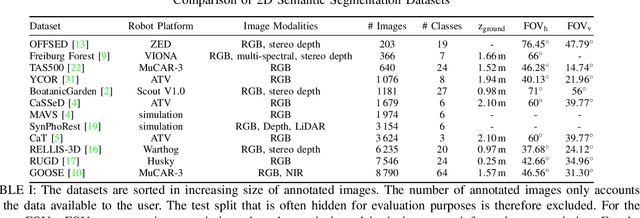

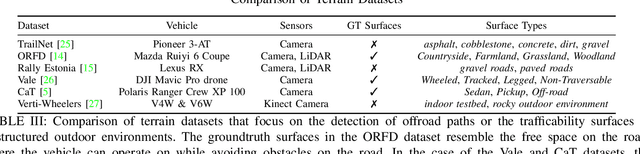
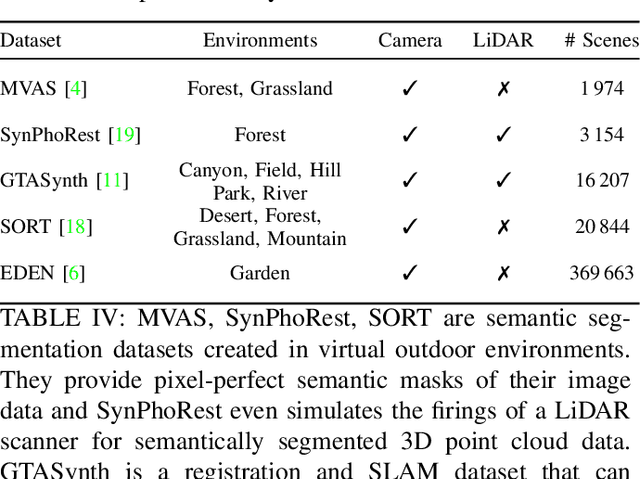
Perception is an essential component of pipelines in field robotics. In this survey, we quantitatively compare publicly available datasets available in unstructured outdoor environments. We focus on datasets for common perception tasks in field robotics. Our survey categorizes and compares available research datasets. This survey also reports on relevant dataset characteristics to help practitioners determine which dataset fits best for their own application. We believe more consideration should be taken in choosing compatible annotation policies across the datasets in unstructured outdoor environments.