 Add to Chrome
 Add to Firefox
 Add to Edge
When Should LLMs Search? Counterfactual Supervision for Search Routing
Jul 07, 2026
Search-augmented language models can use external evidence to compensate for limitations in parametric knowledge, but search is not uniformly beneficial: models may call search for questions they can already answer, or rely on noisy evidence when correction, clarification, or abstention would be more appropriate. We formulate this as an instance-level search-routing problem: deciding whether search is needed to improve task success relative to a no-search execution. To derive supervision, we compare no-search and forced-search outcomes for the same question and construct an oracle over NO SEARCH, SEARCH, and UNSOLVED based on task-specific success. Using this oracle as both an evaluation criterion and a learning signal, we train search-routing policies with supervised fine-tuning and preference optimization, improving routing macro-F1 on oracle-eligible examples from 0.7082 to 0.8235 for Gemma E2B and from 0.7053 to 0.8365 for Qwen3.5-4B. Further analysis shows that the learned policies reduce model-specific routing failures: Gemma primarily learns no-search restraint, while Qwen further reduces missed search; residual UNSOLVED cases reveal heterogeneous bottlenecks involving model capacity, retrieval budget, evidence use, and policy behavior.

LatentSwap: An Efficient Latent Code Mapping Framework for Face Swapping
Mar 02, 2024
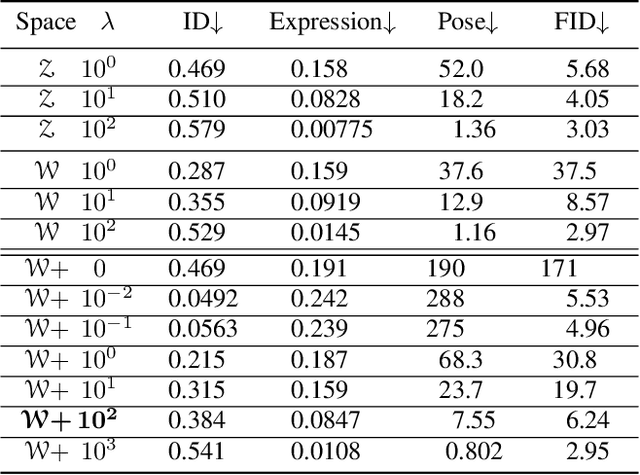

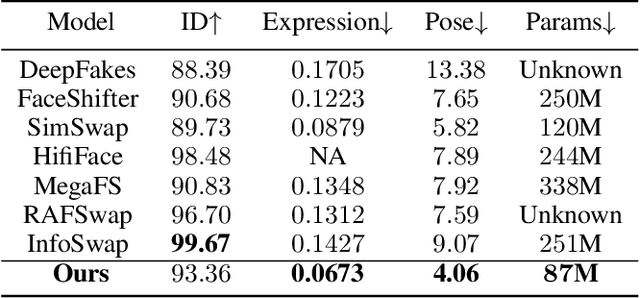
We propose LatentSwap, a simple face swapping framework generating a face swap latent code of a given generator. Utilizing randomly sampled latent codes, our framework is light and does not require datasets besides employing the pre-trained models, with the training procedure also being fast and straightforward. The loss objective consists of only three terms, and can effectively control the face swap results between source and target images. By attaching a pre-trained GAN inversion model independent to the model and using the StyleGAN2 generator, our model produces photorealistic and high-resolution images comparable to other competitive face swap models. We show that our framework is applicable to other generators such as StyleNeRF, paving a way to 3D-aware face swapping and is also compatible with other downstream StyleGAN2 generator tasks. The source code and models can be found at \url{https://github.com/usingcolor/LatentSwap}.
Developing High Quality Training Samples for Deep Learning Based Local Climate Classification in Korea
Nov 03, 2020
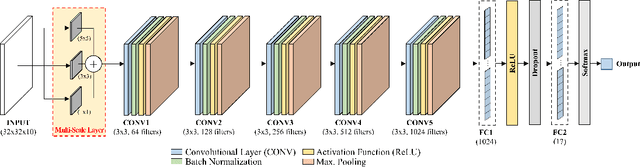
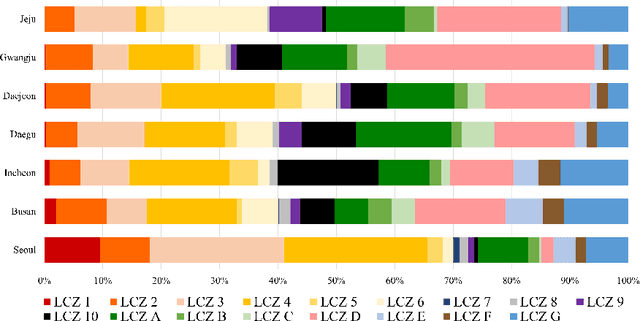
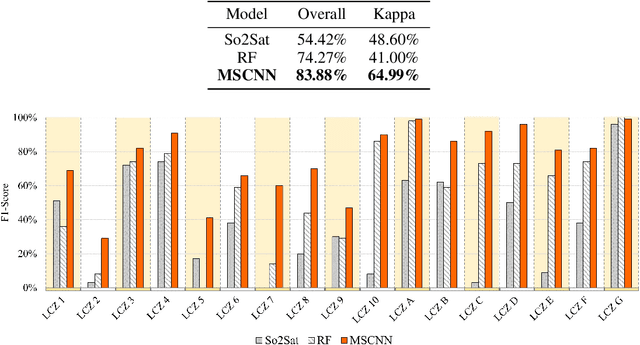
Two out of three people will be living in urban areas by 2050, as projected by the United Nations, emphasizing the need for sustainable urban development and monitoring. Common urban footprint data provide high-resolution city extents but lack essential information on the distribution, pattern, and characteristics. The Local Climate Zone (LCZ) offers an efficient and standardized framework that can delineate the internal structure and characteristics of urban areas. Global-scale LCZ mapping has been explored, but are limited by low accuracy, variable labeling quality, or domain adaptation challenges. Instead, this study developed a custom LCZ data to map key Korean cities using a multi-scale convolutional neural network. Results demonstrated that using a novel, custom LCZ data with deep learning can generate more accurate LCZ map results compared to conventional community-based LCZ mapping with machine learning as well as transfer learning of the global So2Sat dataset.