 Add to Chrome
 Add to Firefox
 Add to Edge
Latent Abstraction for Retrieval-Augmented Generation
Apr 20, 2026
Retrieval-Augmented Generation (RAG) has become a standard approach for enhancing large language models (LLMs) with external knowledge, mitigating hallucinations, and improving factuality. However, existing systems rely on generating natural language queries at each hop and maintaining a strict architectural separation between retriever and generator, preventing them from leveraging the full representational capacity of the LLM. We propose \textbf{LAnR} (Latent Abstraction for RAG), a unified framework in which a single LLM jointly performs encoding, retrieval, and generation entirely within its own latent space. Rather than generating textual queries, LAnR produces dense retrieval vectors from the hidden states of a designated \texttt{[PRED]} token and uses them to match against encoded document representations from the same model. Furthermore, LAnR adaptively decides when sufficient evidence has been retrieved using a lightweight MLP control head over those same hidden states, eliminating both the separate retriever and explicit token-level stopping reasoning. This design is motivated by our empirical observation that answer token entropy reliably signals retrieval sufficiency. Extensive experiments on six QA benchmarks spanning single-hop and multi-hop settings demonstrate that LAnR outperforms existing RAG methods, while achieving improved inference efficiency through reduced number of retrieval calls and tighter model integration.

VLegal-Bench: Cognitively Grounded Benchmark for Vietnamese Legal Reasoning of Large Language Models
Dec 24, 2025The rapid advancement of large language models (LLMs) has enabled new possibilities for applying artificial intelligence within the legal domain. Nonetheless, the complexity, hierarchical organization, and frequent revisions of Vietnamese legislation pose considerable challenges for evaluating how well these models interpret and utilize legal knowledge. To address this gap, the Vietnamese Legal Benchmark (VLegal-Bench) is introduced, the first comprehensive benchmark designed to systematically assess LLMs on Vietnamese legal tasks. Informed by Bloom's cognitive taxonomy, VLegal-Bench encompasses multiple levels of legal understanding through tasks designed to reflect practical usage scenarios. The benchmark comprises 10,450 samples generated through a rigorous annotation pipeline, where legal experts label and cross-validate each instance using our annotation system to ensure every sample is grounded in authoritative legal documents and mirrors real-world legal assistant workflows, including general legal questions and answers, retrieval-augmented generation, multi-step reasoning, and scenario-based problem solving tailored to Vietnamese law. By providing a standardized, transparent, and cognitively informed evaluation framework, VLegal-Bench establishes a solid foundation for assessing LLM performance in Vietnamese legal contexts and supports the development of more reliable, interpretable, and ethically aligned AI-assisted legal systems. To facilitate access and reproducibility, we provide a public landing page for this benchmark at https://vilegalbench.cmcai.vn/.
JEPA4Rec: Learning Effective Language Representations for Sequential Recommendation via Joint Embedding Predictive Architecture
Apr 10, 2025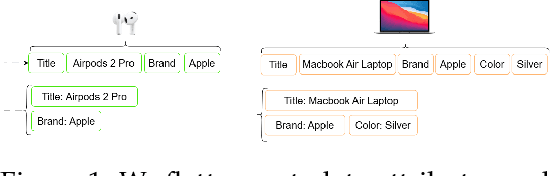
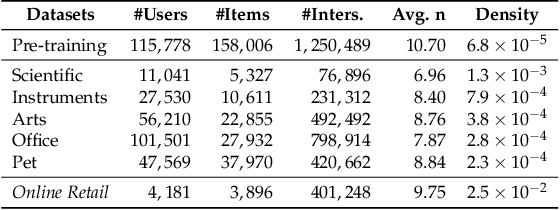
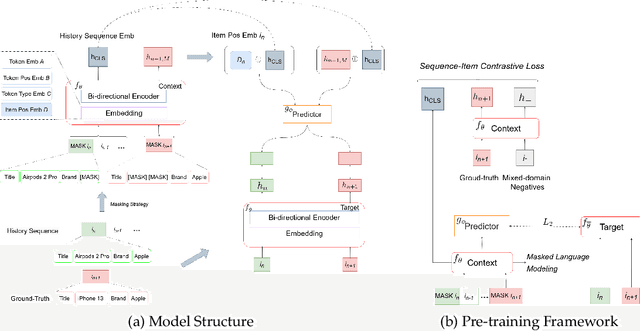
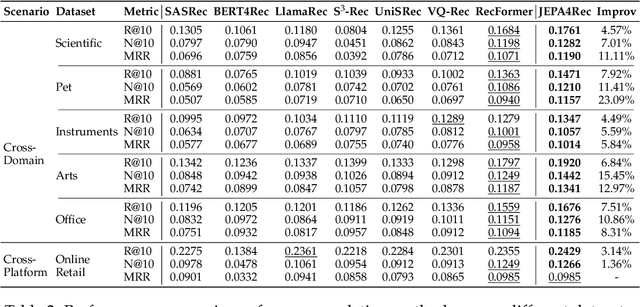
Language representation learning has emerged as a promising approach for sequential recommendation, thanks to its ability to learn generalizable representations. However, despite its advantages, this approach still struggles with data sparsity and a limited understanding of common-sense user preferences. To address these limitations, we propose $\textbf{JEPA4Rec}$, a framework that combines $\textbf{J}$oint $\textbf{E}$mbedding $\textbf{P}$redictive $\textbf{A}$rchitecture with language modeling of item textual descriptions. JEPA4Rec captures semantically rich and transferable representations, improving recommendation performance and reducing reliance on large-scale pre-training data. Specifically, JEPA4Rec represents items as text sentences by flattening descriptive information such as $\textit{title, category}$, and other attributes. To encode these sentences, we employ a bidirectional Transformer encoder with modified embedding layers tailored for capturing item information in recommendation datasets. We apply masking to text sentences and use them to predict the representations of the unmasked sentences, helping the model learn generalizable item embeddings. To further improve recommendation performance and language understanding, we employ a two-stage training strategy incorporating self-supervised learning losses. Experiments on six real-world datasets demonstrate that JEPA4Rec consistently outperforms state-of-the-art methods, particularly in cross-domain, cross-platform, and low-resource scenarios.