 Add to Chrome
 Add to Firefox
 Add to Edge
Track the Noise, Move the World:3D-Grounded Motion-Consistent Noise for Controllable Video Generation
Jul 02, 2026
Modern image-and-text-to-video diffusion models can synthesize highly realistic videos by iteratively denoising an initial Gaussian noise tensor conditioned on reference image and text inputs. However, existing approaches still lack precise and unified controllability over both object motion and camera motion within a single generation process. We present UniCaMo, a unified framework that enables simultaneous control of object trajectories and camera viewpoints by directly constructing the input noise of the diffusion model. Specifically, UniCaMo builds a shared 3D-grounded motion-consistent noise space across latent video frames. Sparse 3D point tracks are used to warp the Gaussian noise of the reference frame along desired object trajectories, while a virtual spherical noise representation provides globally consistent noise values for newly revealed scene regions under camera motion. By combining local track-guided noise warping with global sphere-based noise sampling, UniCaMo maintains geometric and temporal consistency under both object movement and viewpoint changes. Because UniCaMo modifies only the input noise, it requires no auxiliary adapters, control branches, or architectural changes to the underlying video diffusion model. With lightweight LoRA fine-tuning on large pretrained video diffusion models, including Wan 2.1 (14B), UniCaMo achieves state-of-the-art results in both video quality and motion controllability on standard controllable video generation benchmarks.

Crowd Transformer Network
Apr 04, 2019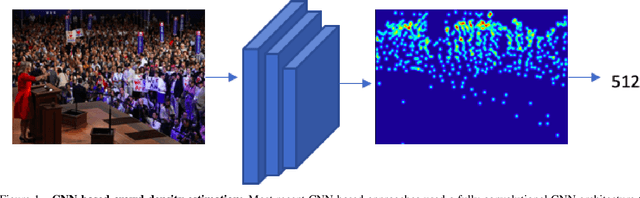
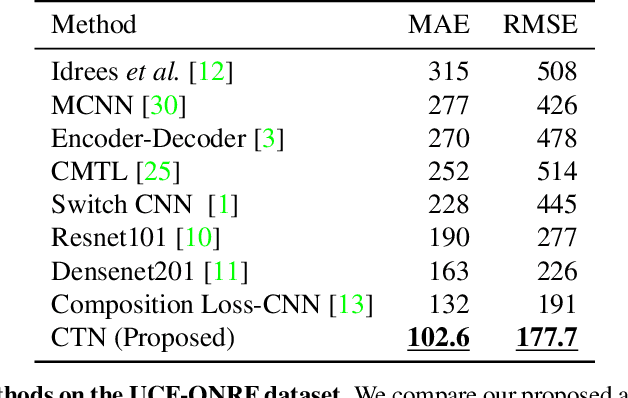
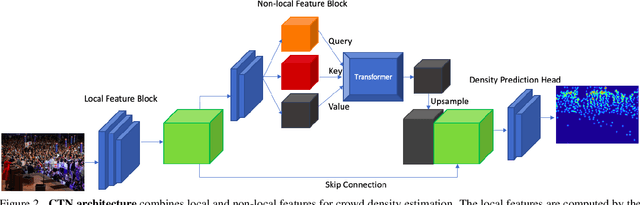
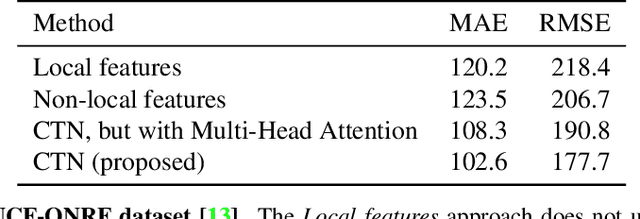
In this paper, we tackle the problem of Crowd Counting, and present a crowd density estimation based approach for obtaining the crowd count. Most of the existing crowd counting approaches rely on local features for estimating the crowd density map. In this work, we investigate the usefulness of combining local with non-local features for crowd counting. We use convolution layers for extracting local features, and a type of self-attention mechanism for extracting non-local features. We combine the local and the non-local features, and use it for estimating crowd density map. We conduct experiments on three publicly available Crowd Counting datasets, and achieve significant improvement over the previous approaches.