 Add to Chrome
 Add to Firefox
 Add to Edge
XMatchAD: A Cross-Modal Matching Perspective on Reconstruction-based Anomaly Detection
Jul 26, 2026
The remarkable success of reconstruction-based methods in Unsupervised Anomaly Detection (UAD) lies in their ability to identify and localize anomalies by modeling discrepancies between input images and their reconstructed counterparts. However, these approaches often struggle to capture subtle anomalies and tend to produce blurred anomaly boundaries, which significantly limits their effectiveness, particularly in complex multi-class scenarios. To address these issues, we present XMatchAD, a novel UAD framework that reinterprets the task from a pseudo cross-modal matching perspective. Specifically, the input and reconstructed images are treated as two complementary modalities and their matching relationships are precisely exploited for anomaly detection. First, a pre-trained feature extractor is employed to encode discriminative representations. Second, an attention-guided cross-modal matching mechanism is introduced to match local inter-modal anomaly-related patterns while mutually refining the features. This enhances the sensitivity to anomalies with diverse shapes and subtle deviations and significantly improves the precision of anomaly detection and localization. Third, we design an adaptive frequency-aware fusion module that further delineates sharp anomaly boundaries through the coupling of high-frequency components from cross-modal multi-scale representations. Comprehensive evaluations on MVTec-AD, VisA, and MPDD benchmarks demonstrate that our method consistently achieves superior performance, outperforming state-of-the-art methods in multi-class anomaly detection and localization. The code will be released at https://github.com/Mingxiu-Cai/XMatchAD.

RAID: Retrieval-Augmented Anomaly Detection
Feb 23, 2026Unsupervised Anomaly Detection (UAD) aims to identify abnormal regions by establishing correspondences between test images and normal templates. Existing methods primarily rely on image reconstruction or template retrieval but face a fundamental challenge: matching between test images and normal templates inevitably introduces noise due to intra-class variations, imperfect correspondences, and limited templates. Observing that Retrieval-Augmented Generation (RAG) leverages retrieved samples directly in the generation process, we reinterpret UAD through this lens and introduce \textbf{RAID}, a retrieval-augmented UAD framework designed for noise-resilient anomaly detection and localization. Unlike standard RAG that enriches context or knowledge, we focus on using retrieved normal samples to guide noise suppression in anomaly map generation. RAID retrieves class-, semantic-, and instance-level representations from a hierarchical vector database, forming a coarse-to-fine pipeline. A matching cost volume correlates the input with retrieved exemplars, followed by a guided Mixture-of-Experts (MoE) network that leverages the retrieved samples to adaptively suppress matching noise and produce fine-grained anomaly maps. RAID achieves state-of-the-art performance across full-shot, few-shot, and multi-dataset settings on MVTec, VisA, MPDD, and BTAD benchmarks. \href{https://github.com/Mingxiu-Cai/RAID}{https://github.com/Mingxiu-Cai/RAID}.
CostFilter-AD: Enhancing Anomaly Detection through Matching Cost Filtering
May 02, 2025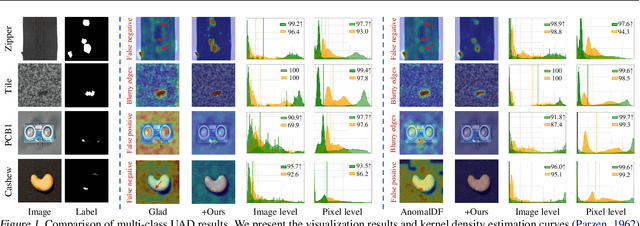
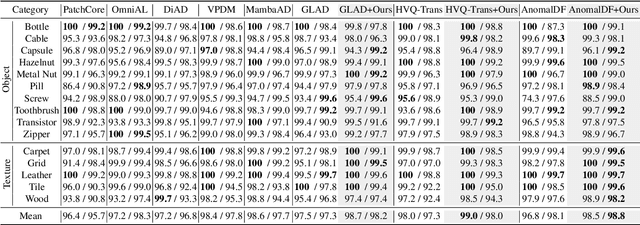
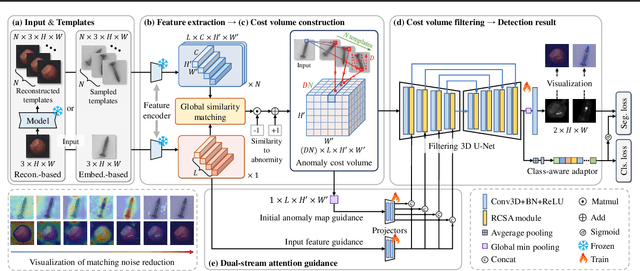
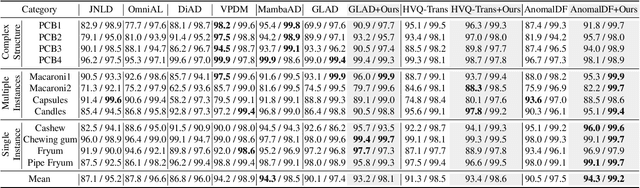
Unsupervised anomaly detection (UAD) seeks to localize the anomaly mask of an input image with respect to normal samples. Either by reconstructing normal counterparts (reconstruction-based) or by learning an image feature embedding space (embedding-based), existing approaches fundamentally rely on image-level or feature-level matching to derive anomaly scores. Often, such a matching process is inaccurate yet overlooked, leading to sub-optimal detection. To address this issue, we introduce the concept of cost filtering, borrowed from classical matching tasks, such as depth and flow estimation, into the UAD problem. We call this approach {\em CostFilter-AD}. Specifically, we first construct a matching cost volume between the input and normal samples, comprising two spatial dimensions and one matching dimension that encodes potential matches. To refine this, we propose a cost volume filtering network, guided by the input observation as an attention query across multiple feature layers, which effectively suppresses matching noise while preserving edge structures and capturing subtle anomalies. Designed as a generic post-processing plug-in, CostFilter-AD can be integrated with either reconstruction-based or embedding-based methods. Extensive experiments on MVTec-AD and VisA benchmarks validate the generic benefits of CostFilter-AD for both single- and multi-class UAD tasks. Code and models will be released at https://github.com/ZHE-SAPI/CostFilter-AD.