 Add to Chrome
 Add to Firefox
 Add to Edge
Which Site, and When: A Free-Satellite-Data Test of Himalayan Glacial Lake Bursts, Landslides, and Ice Floods
Aug 12, 2026
Two free satellite signals carry real information about glacial-lake outburst risk in the Nepal Himalaya: radar interferometry sees a moraine dam slowly sagging, and satellite weather marks the weeks when a primed lake is under stress. A companion feasibility study found that deformation indicates which lake is destabilizing and weather indicates when it is at risk, but proposed no predictive model. To address this gap, we propose and evaluate models that predict which site is susceptible and when a trigger arrives. We test three related hazards on free data alone: large moraine- and ice-dammed bursts, rainfall-triggered landslides, and smaller floods from ponds on and around a glacier. Each hazard gets two questions, never blended. Using 589 dated outbursts from HMAGLOFDB and several thousand catalogued landslides, we match each event against similar but unfailed sites, and hold every model to a strong simple baseline under spatial cross-validation that withholds whole map tiles, so no model succeeds by recognising a trained-on neighbourhood. Antecedent weather times the trigger at ROC 0.73 for big bursts, 0.83 for landslides, and 0.82 for small floods. Terrain ranks susceptibility only in part: scored naively it appears near 0.9, largely because catalogued failures cluster in wetter ranges; matched against comparable nearby sites the honest figures are 0.76, 0.71, and 0.54 (no better than chance). The burst signal holds within single regions, reaching 0.89 in Nepal alone. Five deep-learning models do not decisively beat a simple gradient-boosted baseline. Three score marginally higher on landslides, a hint too small to confirm. For the lake hazards the baseline wins outright, reproduced by a three-rule decision tree on ruggedness and monsoon rainfall. We close with a ranked Nepal watchlist, a prioritisation aid, not a prediction, and note where free data reaches its limits.

Skin Cancer Machine Learning Model Tone Bias
Oct 08, 2024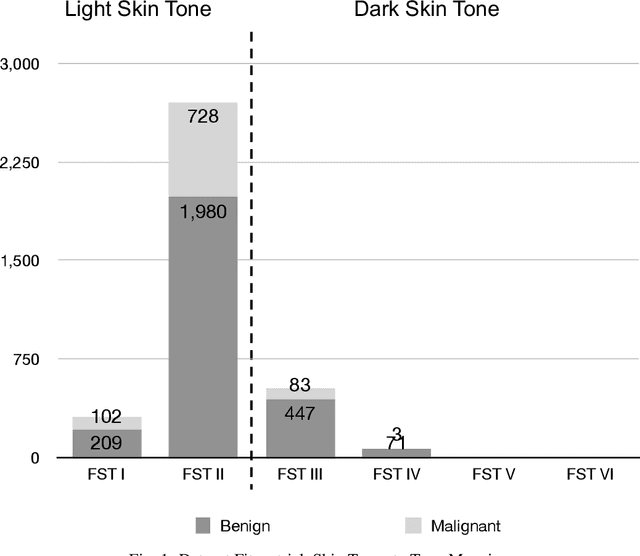
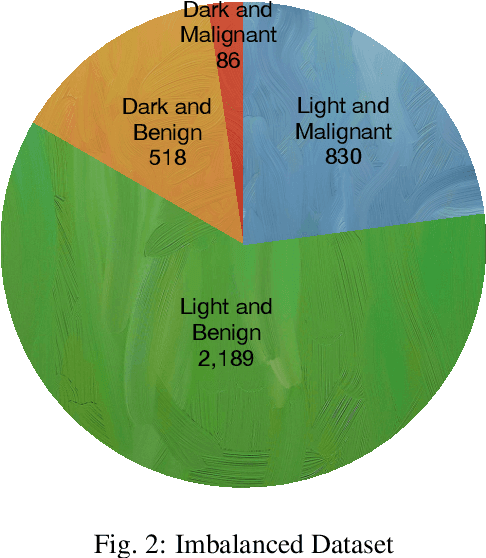
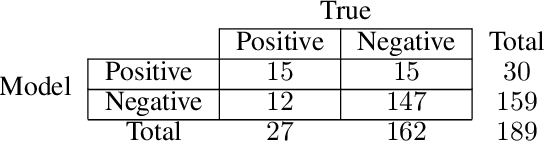
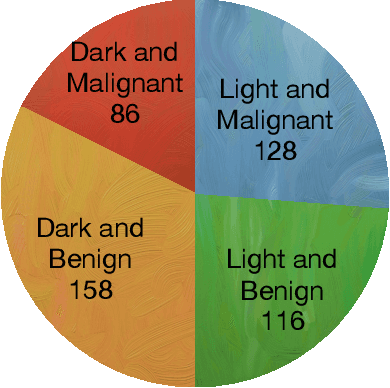
Background: Many open-source skin cancer image datasets are the result of clinical trials conducted in countries with lighter skin tones. Due to this tone imbalance, machine learning models derived from these datasets can perform well at detecting skin cancer for lighter skin tones. Any tone bias in these models could introduce fairness concerns and reduce public trust in the artificial intelligence health field. Methods: We examine a subset of images from the International Skin Imaging Collaboration (ISIC) archive that provide tone information. The subset has a significant tone imbalance. These imbalances could explain a model's tone bias. To address this, we train models using the imbalanced dataset and a balanced dataset to compare against. The datasets are used to train a deep convolutional neural network model to classify the images as malignant or benign. We then evaluate the models' disparate impact, based on selection rate, relative to dark or light skin tone. Results: Using the imbalanced dataset, we found that the model is significantly better at detecting malignant images in lighter tone resulting in a disparate impact of 0.577. Using the balanced dataset, we found that the model is also significantly better at detecting malignant images in lighter versus darker tones with a disparate impact of 0.684. Using the imbalanced or balanced dataset to train the model still results in a disparate impact well below the standard threshold of 0.80 which suggests the model is biased with respect to skin tone. Conclusion: The results show that typical skin cancer machine learning models can be tone biased. These results provide evidence that diagnosis or tone imbalance is not the cause of the bias. Other techniques will be necessary to identify and address the bias in these models, an area of future investigation.