 Add to Chrome
 Add to Firefox
 Add to Edge
Mechanics of Bias and Reasoning: Interpreting the Impact of Chain-of-Thought Prompting on Gender Bias in LLMs
May 19, 2026
Large language models (LLMs) are increasingly deployed in socially sensitive settings despite substantial documentation that they encode gender biases. Chain-of-Thought (CoT) prompting has been proposed as a bias-mitigation approach. However, existing evaluations primarily focus on changes in LLM benchmark performance, providing limited insight into whether apparent bias reductions reflect meaningful changes in a model's internal mechanisms. In this work, we investigate how CoT prompting affects gender bias in LLMs, combining benchmark-based evaluation with mechanistic interpretability techniques and reasoning chain failure analysis. Our results confirm a stereotypical bias present in LLM outputs across benchmarks, showing that CoT prompting does not consistently reduce the bias gap. Mechanistic analyses reveal that although CoT balances biased behavior in certain attention head clusters, gender bias remains embedded in hidden representations, indicating only superficial mitigation. Inspection of reasoning chains further suggests that these improvements stem from memorization and familiarity with the dataset rather than genuine understanding of bias.

Understanding Intrinsic Socioeconomic Biases in Large Language Models
May 28, 2024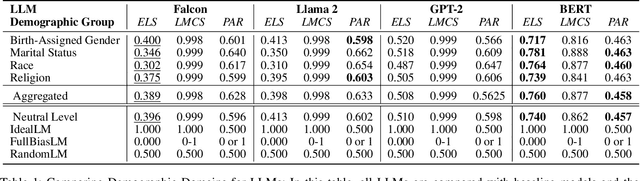
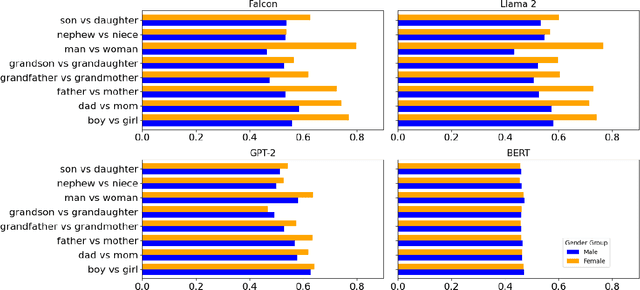
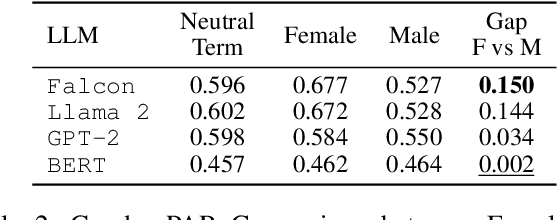

Large Language Models (LLMs) are increasingly integrated into critical decision-making processes, such as loan approvals and visa applications, where inherent biases can lead to discriminatory outcomes. In this paper, we examine the nuanced relationship between demographic attributes and socioeconomic biases in LLMs, a crucial yet understudied area of fairness in LLMs. We introduce a novel dataset of one million English sentences to systematically quantify socioeconomic biases across various demographic groups. Our findings reveal pervasive socioeconomic biases in both established models such as GPT-2 and state-of-the-art models like Llama 2 and Falcon. We demonstrate that these biases are significantly amplified when considering intersectionality, with LLMs exhibiting a remarkable capacity to extract multiple demographic attributes from names and then correlate them with specific socioeconomic biases. This research highlights the urgent necessity for proactive and robust bias mitigation techniques to safeguard against discriminatory outcomes when deploying these powerful models in critical real-world applications.