 Add to Chrome
 Add to Firefox
 Add to Edge
Robotic System for Chemical Experiment Automation with Dual Demonstration of End-effector and Jig Operations
Jun 13, 2025
While robotic automation has demonstrated remarkable performance, such as executing hundreds of experiments continuously over several days, it is challenging to design a program that synchronizes the robot's movements with the experimental jigs to conduct an experiment. We propose a concept that enables the automation of experiments by utilizing dual demonstrations of robot motions and jig operations by chemists in an experimental environment constructed to be controlled by a robot. To verify this concept, we developed a chemical-experiment-automation system consisting of jigs to assist the robot in experiments, a motion-demonstration interface, a jig-control interface, and a mobile manipulator. We validate the concept through polymer-synthesis experiments, focusing on critical liquid-handling tasks such as pipetting and dilution. The experimental results indicate high reproducibility of the demonstrated motions and robust task-success rates. This comprehensive concept not only simplifies the robot programming process for chemists but also provides a flexible and efficient solution to accommodate a wide range of experimental conditions, contributing significantly to the field of chemical experiment automation.

Study of Deep Generative Models for Inorganic Chemical Compositions
Oct 25, 2019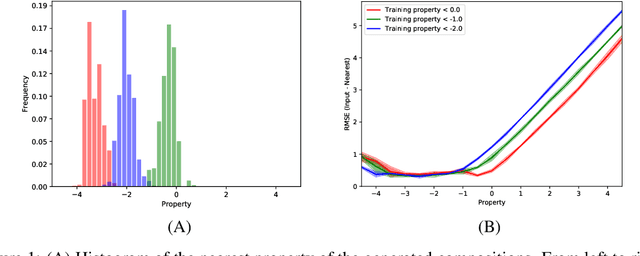
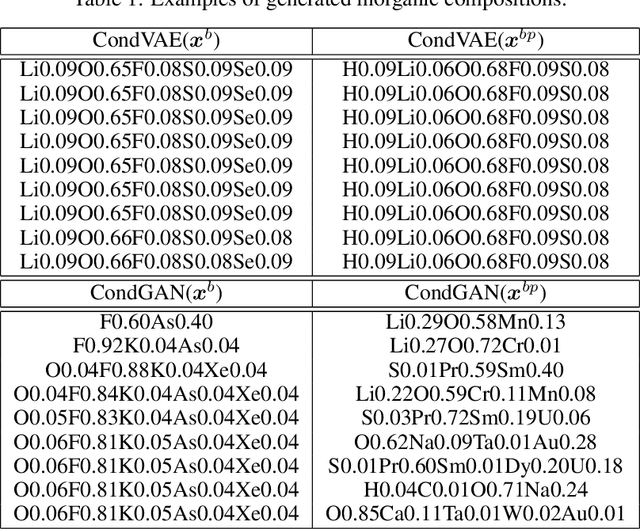
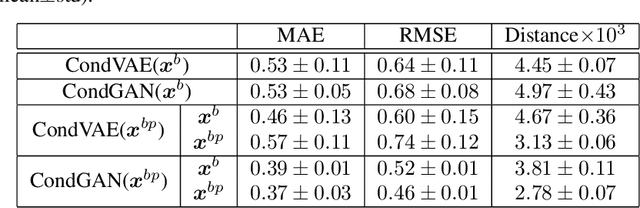
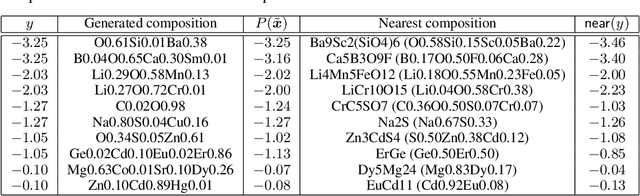
Generative models based on generative adversarial networks (GANs) and variational autoencoders (VAEs) have been widely studied in the fields of image generation, speech generation, and drug discovery, but, only a few studies have focused on the generation of inorganic materials. Such studies use the crystal structures of materials, but material researchers rarely store this information. Thus, we generate chemical compositions without using crystal information. We use a conditional VAE (CondVAE) and a conditional GAN (CondGAN) and show that CondGAN using the bag-of-atom representation with physical descriptors generates better compositions than other generative models. Also, we evaluate the effectiveness of the Metropolis-Hastings-based atomic valency modification and the extrapolation performance, which is important to material discovery.