 Add to Chrome
 Add to Firefox
 Add to Edge
Image Complexity-Aware Adaptive Retrieval for Efficient Vision-Language Models
Dec 17, 2025
Vision transformers in vision-language models apply uniform computational effort across all images, expending 175.33 GFLOPs (ViT-L/14) whether analysing a straightforward product photograph or a complex street scene. We propose ICAR (Image Complexity-Aware Retrieval), which enables vision transformers to use less compute for simple images whilst processing complex images through their full network depth. The key challenge is maintaining cross-modal alignment: embeddings from different processing depths must remain compatible for text matching. ICAR solves this through dual-path training that produces compatible embeddings from both reduced-compute and full-compute processing. This maintains compatibility between image representations and text embeddings in the same semantic space, whether an image exits early or processes fully. Unlike existing two-stage approaches that require expensive reranking, ICAR enables direct image-text matching without additional overhead. To determine how much compute to use, we develop ConvNeXt-IC, which treats image complexity assessment as a classification task. By applying modern classifier backbones rather than specialised architectures, ConvNeXt-IC achieves state-of-the-art performance with 0.959 correlation with human judgement (Pearson) and 4.4x speedup. Evaluated on standard benchmarks augmented with real-world web data, ICAR achieves 20% practical speedup while maintaining category-level performance and 95% of instance-level performance, enabling sustainable scaling of vision-language systems.

FiCo-ITR: bridging fine-grained and coarse-grained image-text retrieval for comparative performance analysis
Jul 29, 2024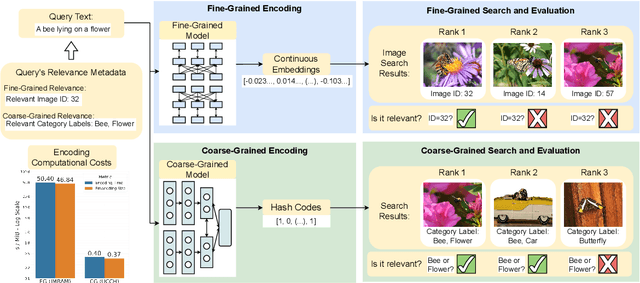
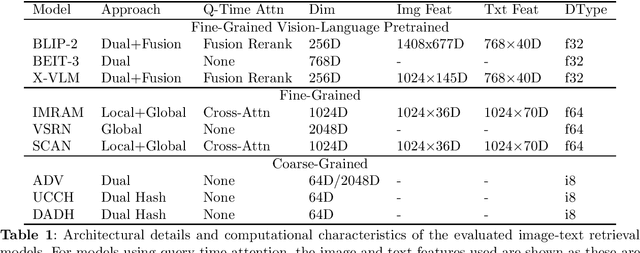

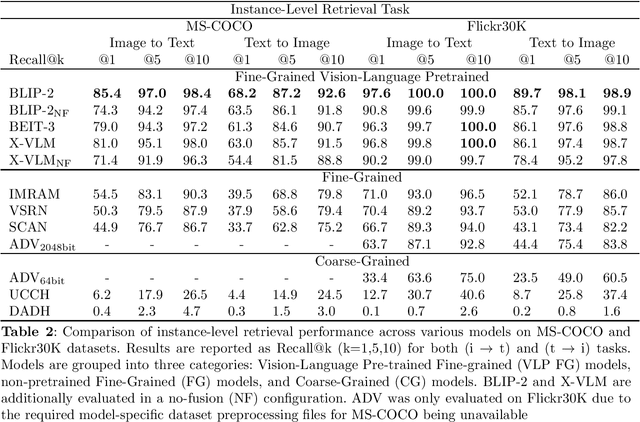
In the field of Image-Text Retrieval (ITR), recent advancements have leveraged large-scale Vision-Language Pretraining (VLP) for Fine-Grained (FG) instance-level retrieval, achieving high accuracy at the cost of increased computational complexity. For Coarse-Grained (CG) category-level retrieval, prominent approaches employ Cross-Modal Hashing (CMH) to prioritise efficiency, albeit at the cost of retrieval performance. Due to differences in methodologies, FG and CG models are rarely compared directly within evaluations in the literature, resulting in a lack of empirical data quantifying the retrieval performance-efficiency tradeoffs between the two. This paper addresses this gap by introducing the \texttt{FiCo-ITR} library, which standardises evaluation methodologies for both FG and CG models, facilitating direct comparisons. We conduct empirical evaluations of representative models from both subfields, analysing precision, recall, and computational complexity across varying data scales. Our findings offer new insights into the performance-efficiency trade-offs between recent representative FG and CG models, highlighting their respective strengths and limitations. These findings provide the foundation necessary to make more informed decisions regarding model selection for specific retrieval tasks and highlight avenues for future research into hybrid systems that leverage the strengths of both FG and CG approaches.