 Add to Chrome
 Add to Firefox
 Add to Edge
Fourier Splatting: Generalized Fourier encoded primitives for scalable radiance fields
Mar 20, 2026
Novel view synthesis has recently been revolutionized by 3D Gaussian Splatting (3DGS), which enables real-time rendering through explicit primitive rasterization. However, existing methods tie visual fidelity strictly to the number of primitives: quality downscaling is achieved only through pruning primitives. We propose the first inherently scalable primitive for radiance field rendering. Fourier Splatting employs scalable primitives with arbitrary closed shapes obtained by parameterizing planar surfels with Fourier encoded descriptors. This formulation allows a single trained model to be rendered at varying levels of detail simply by truncating Fourier coefficients at runtime. To facilitate stable optimization, we employ a straight-through estimator for gradient extension beyond the primitive boundary, and introduce HYDRA, a densification strategy that decomposes complex primitives into simpler constituents within the MCMC framework. Our method achieves state-of-the-art rendering quality among planar-primitive frameworks and comparable perceptual metrics compared to leading volumetric representations on standard benchmarks, providing a versatile solution for bandwidth-constrained high-fidelity rendering.

RT-GS2: Real-Time Generalizable Semantic Segmentation for 3D Gaussian Representations of Radiance Fields
May 28, 2024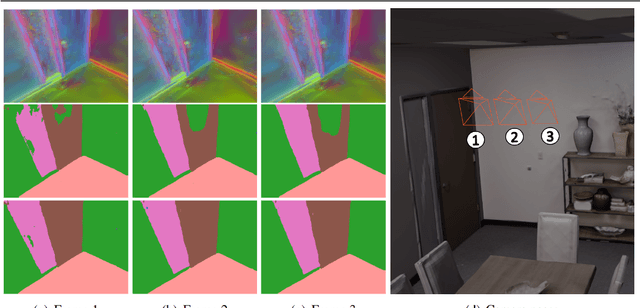
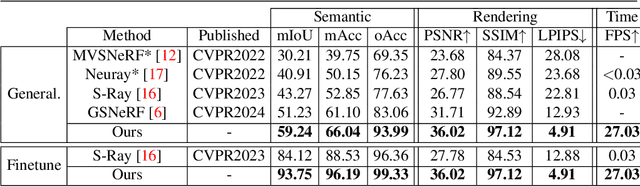

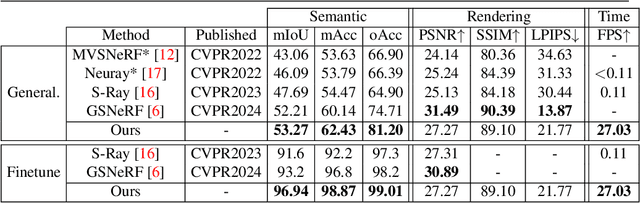
Gaussian Splatting has revolutionized the world of novel view synthesis by achieving high rendering performance in real-time. Recently, studies have focused on enriching these 3D representations with semantic information for downstream tasks. In this paper, we introduce RT-GS2, the first generalizable semantic segmentation method employing Gaussian Splatting. While existing Gaussian Splatting-based approaches rely on scene-specific training, RT-GS2 demonstrates the ability to generalize to unseen scenes. Our method adopts a new approach by first extracting view-independent 3D Gaussian features in a self-supervised manner, followed by a novel View-Dependent / View-Independent (VDVI) feature fusion to enhance semantic consistency over different views. Extensive experimentation on three different datasets showcases RT-GS2's superiority over the state-of-the-art methods in semantic segmentation quality, exemplified by a 8.01% increase in mIoU on the Replica dataset. Moreover, our method achieves real-time performance of 27.03 FPS, marking an astonishing 901 times speedup compared to existing approaches. This work represents a significant advancement in the field by introducing, to the best of our knowledge, the first real-time generalizable semantic segmentation method for 3D Gaussian representations of radiance fields.