 Add to Chrome
 Add to Firefox
 Add to Edge
On Strengths and Limitations of Single-Vector Embeddings
Mar 31, 2026
Recent work (Weller et al., 2025) introduced a naturalistic dataset called LIMIT and showed empirically that a wide range of popular single-vector embedding models suffer substantial drops in retrieval quality, raising concerns about the reliability of single-vector embeddings for retrieval. Although (Weller et al., 2025) proposed limited dimensionality as the main factor contributing to this, we show that dimensionality alone cannot explain the observed failures. We observe from results in (Alon et al., 2016) that $2k+1$-dimensional vector embeddings suffice for top-$k$ retrieval. This result points to other drivers of poor performance. Controlling for tokenization artifacts and linguistic similarity between attributes yields only modest gains. In contrast, we find that domain shift and misalignment between embedding similarities and the task's underlying notion of relevance are major contributors; finetuning mitigates these effects and can improve recall substantially. Even with finetuning, however, single-vector models remain markedly weaker than multi-vector representations, pointing to fundamental limitations. Moreover, finetuning single-vector models on LIMIT-like datasets leads to catastrophic forgetting (performance on MSMARCO drops by more than 40%), whereas forgetting for multi-vector models is minimal. To better understand the gap between performance of single-vector and multi-vector models, we study the drowning in documents paradox (Reimers \& Gurevych, 2021; Jacob et al., 2025): as the corpus grows, relevant documents are increasingly "drowned out" because embedding similarities behave, in part, like noisy statistical proxies for relevance. Through experiments and mathematical calculations on toy mathematical models, we illustrate why single-vector models are more susceptible to drowning effects compared to multi-vector models.

Spatially Regularized Graph Attention Autoencoder Framework for Detecting Rainfall Extremes
Nov 12, 2024


We introduce a novel Graph Attention Autoencoder (GAE) with spatial regularization to address the challenge of scalable anomaly detection in spatiotemporal rainfall data across India from 1990 to 2015. Our model leverages a Graph Attention Network (GAT) to capture spatial dependencies and temporal dynamics in the data, further enhanced by a spatial regularization term ensuring geographic coherence. We construct two graph datasets employing rainfall, pressure, and temperature attributes from the Indian Meteorological Department and ERA5 Reanalysis on Single Levels, respectively. Our network operates on graph representations of the data, where nodes represent geographic locations, and edges, inferred through event synchronization, denote significant co-occurrences of rainfall events. Through extensive experiments, we demonstrate that our GAE effectively identifies anomalous rainfall patterns across the Indian landscape. Our work paves the way for sophisticated spatiotemporal anomaly detection methodologies in climate science, contributing to better climate change preparedness and response strategies.
UATTA-EB: Uncertainty-Aware Test-Time Augmented Ensemble of BERTs for Classifying Common Mental Illnesses on Social Media Posts
Apr 10, 2023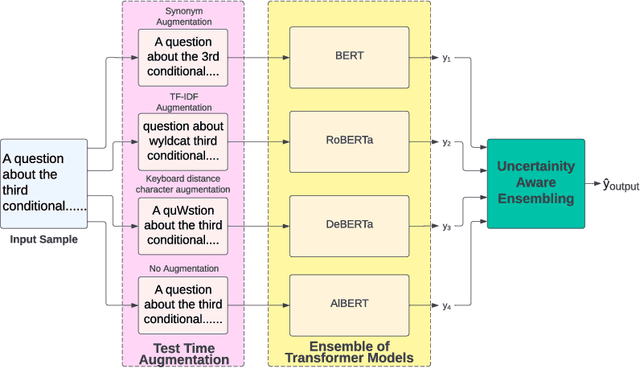
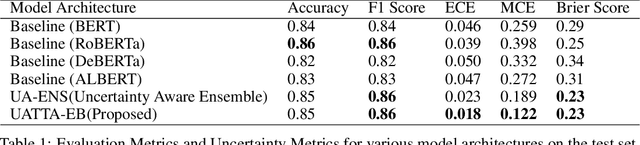
Given the current state of the world, because of existing situations around the world, millions of people suffering from mental illnesses feel isolated and unable to receive help in person. Psychological studies have shown that our state of mind can manifest itself in the linguistic features we use to communicate. People have increasingly turned to online platforms to express themselves and seek help with their conditions. Deep learning methods have been commonly used to identify and analyze mental health conditions from various sources of information, including social media. Still, they face challenges, including a lack of reliability and overconfidence in predictions resulting in the poor calibration of the models. To solve these issues, We propose UATTA-EB: Uncertainty-Aware Test-Time Augmented Ensembling of BERTs for producing reliable and well-calibrated predictions to classify six possible types of mental illnesses- None, Depression, Anxiety, Bipolar Disorder, ADHD, and PTSD by analyzing unstructured user data on Reddit.