 Add to Chrome
 Add to Firefox
 Add to Edge
Attention mechanisms and transfer learning for robust peach leaf damage classification under domain shift
Jun 01, 2026
Artificial intelligence provides a practical framework for crop damage assessment from imagery data, supporting early decision-making in agricultural management. In peach orchards, climate change increases abiotic stress and biotic pressures, including pests and diseases, which often produce visually similar foliar symptoms. This overlap makes manual diagnosis difficult, especially across multiple fields with varying environmental conditions, highlighting the need for automated models with strong generalization ability. We propose an image-based classification approach for peach leaf damage detection. A benchmark dataset was created through manual annotation of publicly available images, consisting of 1,366 peach leaves across six damage categories. Several deep learning architectures were evaluated. EfficientNet models achieved the best results, with EfficientNetB0 reaching 92.9 percent accuracy, EfficientNetB3 achieving 91.5 percent, and EfficientNetB5 showing the strongest performance on minority classes. DenseNet121 reached 92.6 percent accuracy. The integration of the Convolutional Block Attention Module (CBAM) improved performance in several backbones, particularly EfficientNetB5 and InceptionV3, while showing limited or negative impact in others. The CBAM-enhanced EfficientNetB5 achieved the best overall accuracy of 93.3 percent. To evaluate robustness under realistic conditions, a local dataset of 180 images across four classes was collected, and transfer learning strategies were applied to address domain shift. Three fine-tuning strategies were tested. EfficientNetB3 combined with CBAM achieved the best performance in the local domain, reaching a 93 percent macro F1-score after transfer. Overall, attention-based models showed improved robustness for minority classes and better generalization across different field conditions.

Advancing Towards a Marine Digital Twin Platform: Modeling the Mar Menor Coastal Lagoon Ecosystem in the South Western Mediterranean
Sep 16, 2024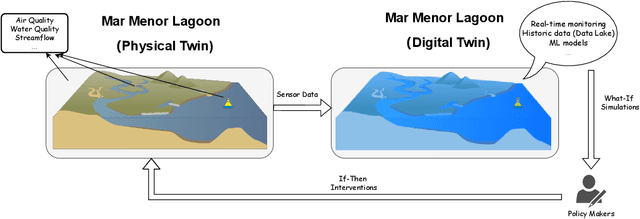


Coastal marine ecosystems face mounting pressures from anthropogenic activities and climate change, necessitating advanced monitoring and modeling approaches for effective management. This paper pioneers the development of a Marine Digital Twin Platform aimed at modeling the Mar Menor Coastal Lagoon Ecosystem in the Region of Murcia. The platform leverages Artificial Intelligence to emulate complex hydrological and ecological models, facilitating the simulation of what-if scenarios to predict ecosystem responses to various stressors. We integrate diverse datasets from public sources to construct a comprehensive digital representation of the lagoon's dynamics. The platform's modular design enables real-time stakeholder engagement and informed decision-making in marine management. Our work contributes to the ongoing discourse on advancing marine science through innovative digital twin technologies.