 Add to Chrome
 Add to Firefox
 Add to Edge
Mitosis Detection in the Wild: Multi-Tumor and Context-Aware Generalization in the MIDOG 2025 Challenge
Jun 05, 2026
Automated mitosis detection is a well-established task in computational pathology. While previous benchmarks focused on scanner-induced domain shift, clinical "real-world" application requires models to be robust across the vast variance to be expected in the histological landscape. The MItosis DOmain Generalization (MIDOG) 2025 challenge was designed to evaluate algorithmic performance across unprecedented biological and contextual diversity. We curated a test dataset of 365 cases, encompassing 12 distinct human, canine and feline tumor types, digitized across multiple scanning platforms. Moving beyond hand-selected hotspots, the challenge required detection also in random tissue areas (representative of the whole slide detection situation) and challenging areas (areas rich in hard negatives). In the second track, we introduced the classification of atypical mitotic figures (AMFs). There were 18 teams submitting to the detection track, with F1 scores ranging up to 0.740. In the AMF detection track, we had 21 submissions with balanced accuracy values up to 0.908. Our analysis reveals that while most models perform reliably in traditional hotspots, significant performance degradation occurs in challenging ROIs, where false positive rates tripled. Furthermore, performance varied significantly across the 12 tumor types, highlighting "blind spots" in current state-of-the-art architectures when encountering rare or highly pleomorphic malignancies. Moreover, we evaluated the effectiveness of ensembling and found a mean increases of 1.5 and 1.3 percentage points in F1 score and balanced accuracy, respectively. In contrast, TTA showed no relevant improvement. MIDOG 2025 demonstrates that "in the wild" mitosis detection remains a significant hurdle. The transition from hotspot-only evaluation to a multi-contextual framework provides a more realistic proxy for clinical reliability.

Comprehensive Pathological Image Segmentation via Teacher Aggregation for Tumor Microenvironment Analysis
Jan 06, 2025


The tumor microenvironment (TME) plays a crucial role in cancer progression and treatment response, yet current methods for its comprehensive analysis in H&E-stained tissue slides face significant limitations in the diversity of tissue cell types and accuracy. Here, we present PAGET (Pathological image segmentation via AGgrEgated Teachers), a new knowledge distillation approach that integrates multiple segmentation models while considering the hierarchical nature of cell types in the TME. By leveraging a unique dataset created through immunohistochemical restaining techniques and existing segmentation models, PAGET enables simultaneous identification and classification of 14 key TME components. We demonstrate PAGET's ability to perform rapid, comprehensive TME segmentation across various tissue types and medical institutions, advancing the quantitative analysis of tumor microenvironments. This method represents a significant step forward in enhancing our understanding of cancer biology and supporting precise clinical decision-making from large-scale histopathology images.
Pathology Foundation Models
Jul 31, 2024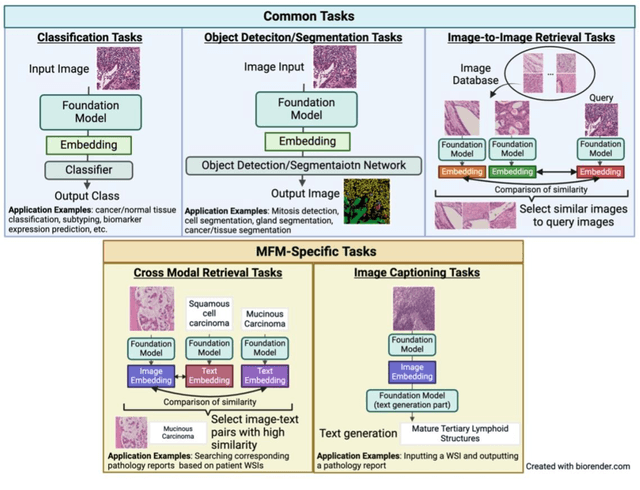
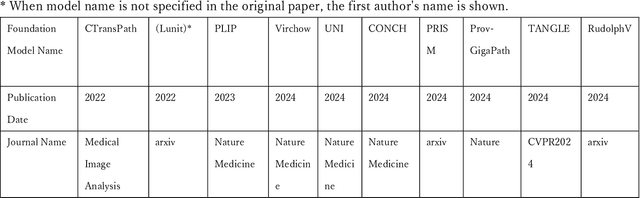
Pathology has played a crucial role in the diagnosis and evaluation of patient tissue samples obtained from surgeries and biopsies for many years. The advent of Whole Slide Scanners and the development of deep learning technologies have significantly advanced the field, leading to extensive research and development in pathology AI (Artificial Intelligence). These advancements have contributed to reducing the workload of pathologists and supporting decision-making in treatment plans. Recently, large-scale AI models known as Foundation Models (FMs), which are more accurate and applicable to a wide range of tasks compared to traditional AI, have emerged, and expanded their application scope in the healthcare field. Numerous FMs have been developed in pathology, and there are reported cases of their application in various tasks, such as disease diagnosis, rare cancer diagnosis, patient survival prognosis prediction, biomarker expression prediction, and the scoring of immunohistochemical expression intensity. However, several challenges remain for the clinical application of FMs, which healthcare professionals, as users, must be aware of. Research is ongoing to address these challenges. In the future, it is expected that the development of Generalist Medical AI, which integrates pathology FMs with FMs from other medical domains, will progress, leading to the effective utilization of AI in real clinical settings to promote precision and personalized medicine.