 Add to Chrome
 Add to Firefox
 Add to Edge
AI Agents Under EU Law
Apr 06, 2026
AI agents - i.e. AI systems that autonomously plan, invoke external tools, and execute multi-step action chains with reduced human involvement - are being deployed at scale across enterprise functions ranging from customer service and recruitment to clinical decision support and critical infrastructure management. The EU AI Act (Regulation 2024/1689) regulates these systems through a risk-based framework, but it does not operate in isolation: providers face simultaneous obligations under the GDPR, the Cyber Resilience Act, the Digital Services Act, the Data Act, the Data Governance Act, sector-specific legislation, the NIS2 Directive, and the revised Product Liability Directive. This paper provides the first systematic regulatory mapping for AI agent providers integrating (a) draft harmonised standards under Standardisation Request M/613 to CEN/CENELEC JTC 21 as of January 2026, (b) the GPAI Code of Practice published in July 2025, (c) the CRA harmonised standards programme under Mandate M/606 accepted in April 2025, and (d) the Digital Omnibus proposals of November 2025. We present a practical taxonomy of nine agent deployment categories mapping concrete actions to regulatory triggers, identify agent-specific compliance challenges in cybersecurity, human oversight, transparency across multi-party action chains, and runtime behavioral drift. We propose a twelve-step compliance architecture and a regulatory trigger mapping connecting agent actions to applicable legislation. We conclude that high-risk agentic systems with untraceable behavioral drift cannot currently satisfy the AI Act's essential requirements, and that the provider's foundational compliance task is an exhaustive inventory of the agent's external actions, data flows, connected systems, and affected persons.

PartisanLens: A Multilingual Dataset of Hyperpartisan and Conspiratorial Immigration Narratives in European Media
Jan 07, 2026Detecting hyperpartisan narratives and Population Replacement Conspiracy Theories (PRCT) is essential to addressing the spread of misinformation. These complex narratives pose a significant threat, as hyperpartisanship drives political polarisation and institutional distrust, while PRCTs directly motivate real-world extremist violence, making their identification critical for social cohesion and public safety. However, existing resources are scarce, predominantly English-centric, and often analyse hyperpartisanship, stance, and rhetorical bias in isolation rather than as interrelated aspects of political discourse. To bridge this gap, we introduce \textsc{PartisanLens}, the first multilingual dataset of \num{1617} hyperpartisan news headlines in Spanish, Italian, and Portuguese, annotated in multiple political discourse aspects. We first evaluate the classification performance of widely used Large Language Models (LLMs) on this dataset, establishing robust baselines for the classification of hyperpartisan and PRCT narratives. In addition, we assess the viability of using LLMs as automatic annotators for this task, analysing their ability to approximate human annotation. Results highlight both their potential and current limitations. Next, moving beyond standard judgments, we explore whether LLMs can emulate human annotation patterns by conditioning them on socio-economic and ideological profiles that simulate annotator perspectives. At last, we provide our resources and evaluation, \textsc{PartisanLens} supports future research on detecting partisan and conspiratorial narratives in European contexts.
Are LLMs Enough for Hyperpartisan, Fake, Polarized and Harmful Content Detection? Evaluating In-Context Learning vs. Fine-Tuning
Sep 09, 2025
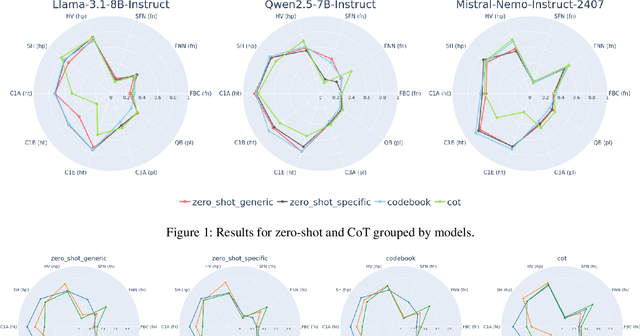
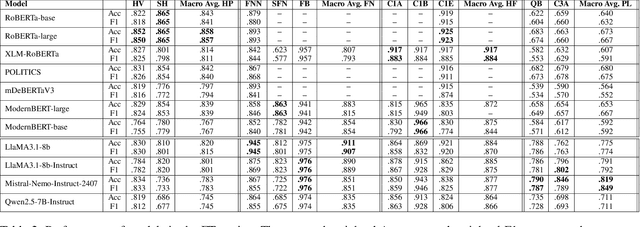
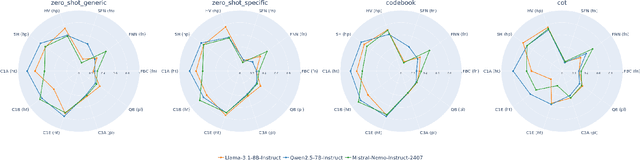
The spread of fake news, polarizing, politically biased, and harmful content on online platforms has been a serious concern. With large language models becoming a promising approach, however, no study has properly benchmarked their performance across different models, usage methods, and languages. This study presents a comprehensive overview of different Large Language Models adaptation paradigms for the detection of hyperpartisan and fake news, harmful tweets, and political bias. Our experiments spanned 10 datasets and 5 different languages (English, Spanish, Portuguese, Arabic and Bulgarian), covering both binary and multiclass classification scenarios. We tested different strategies ranging from parameter efficient Fine-Tuning of language models to a variety of different In-Context Learning strategies and prompts. These included zero-shot prompts, codebooks, few-shot (with both randomly-selected and diversely-selected examples using Determinantal Point Processes), and Chain-of-Thought. We discovered that In-Context Learning often underperforms when compared to Fine-Tuning a model. This main finding highlights the importance of Fine-Tuning even smaller models on task-specific settings even when compared to the largest models evaluated in an In-Context Learning setup - in our case LlaMA3.1-8b-Instruct, Mistral-Nemo-Instruct-2407 and Qwen2.5-7B-Instruct.