 Add to Chrome
 Add to Firefox
 Add to Edge
Using large language models to probe the limits of atom-centered structural descriptors
Jul 29, 2026
Mapping an atomic structure to a compact set of geometric descriptors is an essential step in any machine-learning application to atomic-scale modeling. A powerful and widely-used approach can be understood as a discretization of the histogram of pair distances, triangles, etc., that results in a hierarchy of symmetry-invariant atom-centered descriptors. Unfortunately, the lower rungs on this hierarchy (two, three, four-neighbor clusters) were found to be incomplete, with symmetry-unrelated pairs of structures having exactly the same descriptors. However, all the ``descriptor degeneracies'' reported so far are resolved by considering larger clusters of neighbors to build the descriptors. We report examples of 3D structures that are indistinguishable even if one considers clusters of up to seven neighbors, and to arbitrary order when considering a practical level of discretization of the descriptors, discovered with the assistance of large language models. The key ingredients in their construction can be traced to results that have been known for decades in different communities; the model was able to find the references and recognize their significance for the problem at hand. We believe this experiment exposes an extremely fruitful usage pattern for AI in science: translating results between different communities and application domains, accelerating the process by which serendipitous discoveries in a field become paradigm-shifting breakthroughs in another.

How unconstrained machine-learning models learn physical symmetries
Mar 25, 2026The requirement of generating predictions that exactly fulfill the fundamental symmetry of the corresponding physical quantities has profoundly shaped the development of machine-learning models for physical simulations. In many cases, models are built using constrained mathematical forms that ensure that symmetries are enforced exactly. However, unconstrained models that do not obey rotational symmetries are often found to have competitive performance, and to be able to \emph{learn} to a high level of accuracy an approximate equivariant behavior with a simple data augmentation strategy. In this paper, we introduce rigorous metrics to measure the symmetry content of the learned representations in such models, and assess the accuracy by which the outputs fulfill the equivariant condition. We apply these metrics to two unconstrained, transformer-based models operating on decorated point clouds (a graph neural network for atomistic simulations and a PointNet-style architecture for particle physics) to investigate how symmetry information is processed across architectural layers and is learned during training. Based on these insights, we establish a rigorous framework for diagnosing spectral failure modes in ML models. Enabled by this analysis, we demonstrate that one can achieve superior stability and accuracy by strategically injecting the minimum required inductive biases, preserving the high expressivity and scalability of unconstrained architectures while guaranteeing physical fidelity.
Representing spherical tensors with scalar-based machine-learning models
May 08, 2025
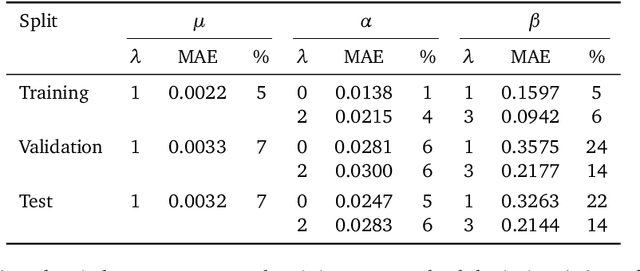
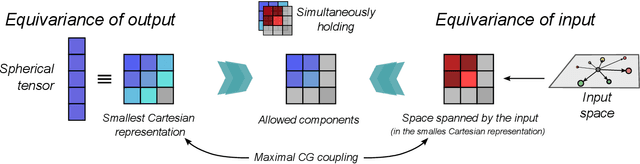
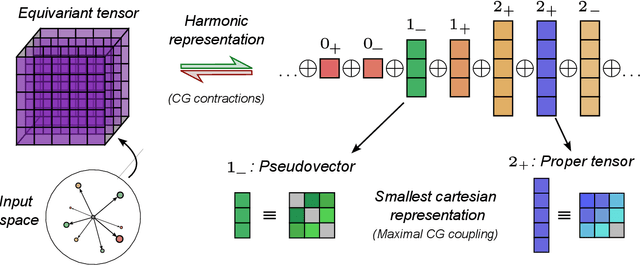
Rotational symmetry plays a central role in physics, providing an elegant framework to describe how the properties of 3D objects -- from atoms to the macroscopic scale -- transform under the action of rigid rotations. Equivariant models of 3D point clouds are able to approximate structure-property relations in a way that is fully consistent with the structure of the rotation group, by combining intermediate representations that are themselves spherical tensors. The symmetry constraints however make this approach computationally demanding and cumbersome to implement, which motivates increasingly popular unconstrained architectures that learn approximate symmetries as part of the training process. In this work, we explore a third route to tackle this learning problem, where equivariant functions are expressed as the product of a scalar function of the point cloud coordinates and a small basis of tensors with the appropriate symmetry. We also propose approximations of the general expressions that, while lacking universal approximation properties, are fast, simple to implement, and accurate in practical settings.