 Add to Chrome
 Add to Firefox
 Add to Edge
A Policy Decomposition Framework for Dynamic Order Fulfillment Operations
Jul 04, 2026
Modern supply chains span diverse operational environments, ranging from e-commerce distribution networks to customized production-to-order manufacturing lines. Across these settings, operational efficiency depends on coordinating two highly interdependent stages: order preparation and downstream delivery. Although these stages are traditionally managed in isolation, real-world fulfillment systems must satisfy stringent delivery expectations under dynamic stochastic order arrivals. To bridge this gap, we introduce the Dynamic Order Fulfillment Problem (DOFP), a new problem class unifying logistical challenges previously studied separately. We model DOFP as a Markov decision process whose state and decision spaces are partitioned into preparation and delivery sub-spaces, linked by synchronization constraints. While recent approaches attempt to optimize both fulfillment stages simultaneously over myopic rolling horizons, our framework isolates and optimizes the downstream delivery policy, treating preparation strictly as a state-level constraint filter. To solve this, we develop the Decomposition-Driven Framework with Value Function Approximation (DDF-VFA), which utilizes a novel policy-level decomposition. This design partitions the search into a delivery-stage master problem and a preparation-stage compatibility subproblem, iteratively refined via feedback loops. DDF-VFA executes this strategy by combining a large-neighborhood search over partial delivery decisions with a neural-network value function approximation for the cost-to-go. Numerical illustrations on two example variants using real-world datasets show that DDF-VFA consistently outperforms benchmarks that optimize the two stages independently or jointly without decomposition. Finally, the framework naturally scales to accommodate additional real-world complexities such as batched or multi-stage preparation.

The Restaurant Meal Delivery Problem with Ghost Kitchens
Aug 14, 2024
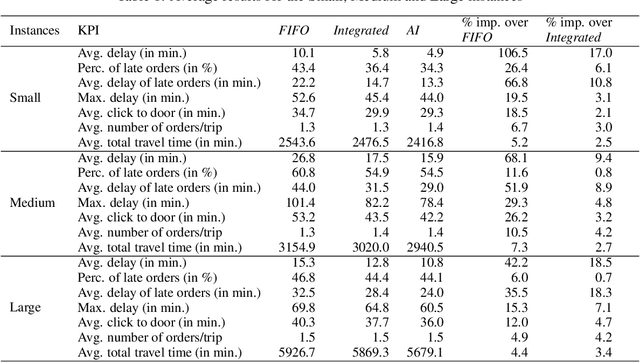

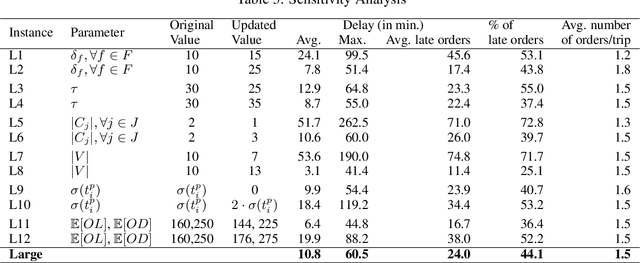
Restaurant meal delivery has been rapidly growing in the last few years. The main challenges in operating it are the temporally and spatially dispersed stochastic demand that arrives from customers all over town as well as the customers' expectation of timely and fresh delivery. To overcome these challenges a new business concept emerged, "Ghost kitchens". This concept proposes synchronized food preparation of several restaurants in a central complex, exploiting consolidation benefits. However, dynamically scheduling food preparation and delivery is challenging and we propose operational strategies for the effective operations of ghost kitchens. We model the problem as a sequential decision process. For the complex, combinatorial decision space of scheduling order preparations, consolidating orders to trips, and scheduling trip departures, we propose a large neighborhood search procedure based on partial decisions and driven by analytical properties. Within the large neighborhood search, decisions are evaluated via a value function approximation, enabling anticipatory and real-time decision making. We show the effectiveness of our method and demonstrate the value of ghost kitchens compared to conventional meal delivery systems. We show that both integrated optimization of cook scheduling and vehicle dispatching, as well as anticipation of future demand and decisions, are essential for successful operations. We further derive several managerial insights, amongst others, that companies should carefully consider the trade-off between fast delivery and fresh food.