 Add to Chrome
 Add to Firefox
 Add to Edge
Unsupervised Segmentation of Micro-CT Scans of Polyurethane Structures By Combining Hidden-Markov-Random Fields and a U-Net
Nov 14, 2025
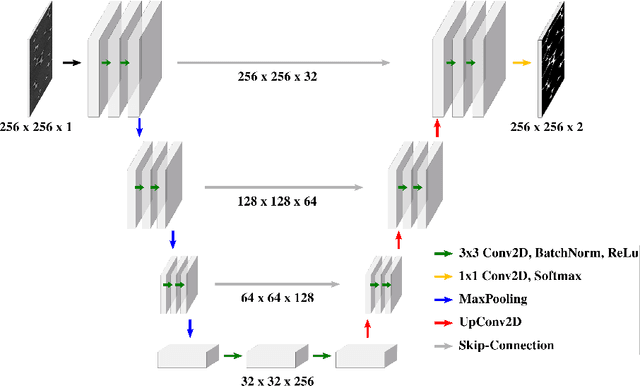
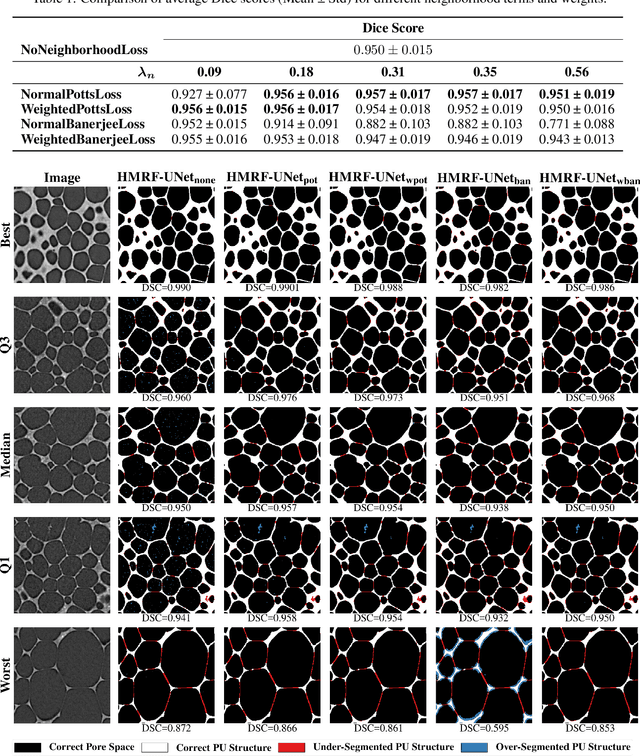
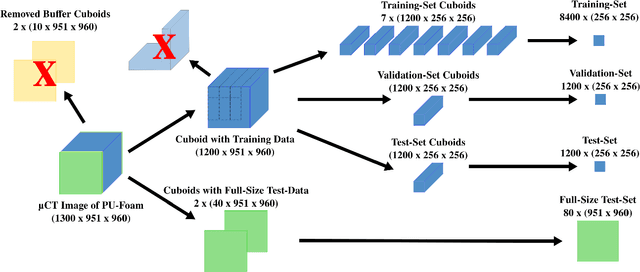
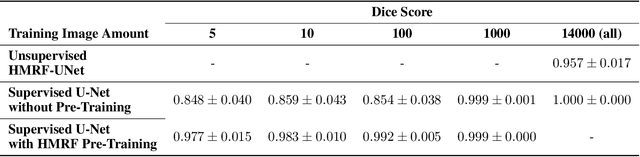
Extracting digital material representations from images is a necessary prerequisite for a quantitative analysis of material properties. Different segmentation approaches have been extensively studied in the past to achieve this task, but were often lacking accuracy or speed. With the advent of machine learning, supervised convolutional neural networks (CNNs) have achieved state-of-the-art performance for different segmentation tasks. However, these models are often trained in a supervised manner, which requires large labeled datasets. Unsupervised approaches do not require ground-truth data for learning, but suffer from long segmentation times and often worse segmentation accuracy. Hidden Markov Random Fields (HMRF) are an unsupervised segmentation approach that incorporates concepts of neighborhood and class distributions. We present a method that integrates HMRF theory and CNN segmentation, leveraging the advantages of both areas: unsupervised learning and fast segmentation times. We investigate the contribution of different neighborhood terms and components for the unsupervised HMRF loss. We demonstrate that the HMRF-UNet enables high segmentation accuracy without ground truth on a Micro-Computed Tomography ($μ$CT) image dataset of Polyurethane (PU) foam structures. Finally, we propose and demonstrate a pre-training strategy that considerably reduces the required amount of ground-truth data when training a segmentation model.

Explainable artificial intelligence for mechanics: physics-informing neural networks for constitutive models
May 20, 2021


(Artificial) neural networks have become increasingly popular in mechanics as means to accelerate computations with model order reduction techniques and as universal models for a wide variety of materials. However, the major disadvantage of neural networks remains: their numerous parameters are challenging to interpret and explain. Thus, neural networks are often labeled as black boxes, and their results often elude human interpretation. In mechanics, the new and active field of physics-informed neural networks attempts to mitigate this disadvantage by designing deep neural networks on the basis of mechanical knowledge. By using this a priori knowledge, deeper and more complex neural networks became feasible, since the mechanical assumptions could be explained. However, the internal reasoning and explanation of neural network parameters remain mysterious. Complementary to the physics-informed approach, we propose a first step towards a physics-informing approach, which explains neural networks trained on mechanical data a posteriori. This novel explainable artificial intelligence approach aims at elucidating the black box of neural networks and their high-dimensional representations. Therein, the principal component analysis decorrelates the distributed representations in cell states of RNNs and allows the comparison to known and fundamental functions. The novel approach is supported by a systematic hyperparameter search strategy that identifies the best neural network architectures and training parameters. The findings of three case studies on fundamental constitutive models (hyperelasticity, elastoplasticity, and viscoelasticity) imply that the proposed strategy can help identify numerical and analytical closed-form solutions to characterize new materials.