 Add to Chrome
 Add to Firefox
 Add to Edge
A Critical Analysis of Trustworthy AI Tools, Mark Frameworks, and the Implementation Chasms
Jul 16, 2026
As artificial intelligence (AI) systems increasingly impact society, ensuring their ethical and trustworthy deployment has become a global priority. While a myriad of high-level ethical guidelines have emerged, criticism persists that these frameworks remain abstract and lack concrete mechanisms for implementation. This paper conducts a critical analysis of tools and trust mark frameworks intended to operationalize trustworthy AI (TAI), drawing on a comprehensive dataset from the OECD. Through empirical mapping and descriptive comparative analysis, we identify significant asymmetries in ethical focus, lifecycle coverage, stakeholder targeting, and tool typology. Our findings show a strong emphasis on fairness, transparency, and robustness, with comparatively little attention paid to explainability, digital security, and environmental sustainability. Moreover, most tools and certifications concentrate on post-development stages, with limited guidance for early design or data collection phases. Educational initiatives and policy engagement are notably underdeveloped, suggesting that current TAI efforts are dominated by technical and procedural measures within industry contexts. We argue that bridging the persistent chasm between AI principles and practice requires expanding ethical objectives, embedding ethics across the AI lifecycle, and fostering broader multi-stakeholder participation. This study provides both a diagnosis of existing implementation gaps and actionable recommendations for advancing more holistic, inclusive, and enforceable AI governance

AI Act Evaluation Benchmark: An Open, Transparent, and Reproducible Evaluation Dataset for NLP and RAG Systems
Mar 10, 2026The rapid rollout of AI in heterogeneous public and societal sectors has subsequently escalated the need for compliance with regulatory standards and frameworks. The EU AI Act has emerged as a landmark in the regulatory landscape. The development of solutions that elicit the level of AI systems' compliance with such standards is often limited by the lack of resources, hindering the semi-automated or automated evaluation of their performance. This generates the need for manual work, which is often error-prone, resource-limited or limited to cases not clearly described by the regulation. This paper presents an open, transparent, and reproducible method of creating a resource that facilitates the evaluation of NLP models with a strong focus on RAG systems. We have developed a dataset that contain the tasks of risk-level classification, article retrieval, obligation generation, and question-answering for the EU AI Act. The dataset files are in a machine-to-machine appropriate format. To generate the files, we utilise domain knowledge as an exegetical basis, combining with the processing and reasoning power of large language models to generate scenarios along with the respective tasks. Our methodology demonstrates a way to harness language models for grounded generation with high document relevancy. Besides, we overcome limitations such as navigating the decision boundaries of risk-levels that are not explicitly defined within the EU AI Act, such as limited and minimal cases. Finally, we demonstrate our dataset's effectiveness by evaluating a RAG-based solution that reaches 0.87 and 0.85 F1-score for prohibited and high-risk scenarios.
TAI Scan Tool: A RAG-Based Tool With Minimalistic Input for Trustworthy AI Self-Assessment
Jul 23, 2025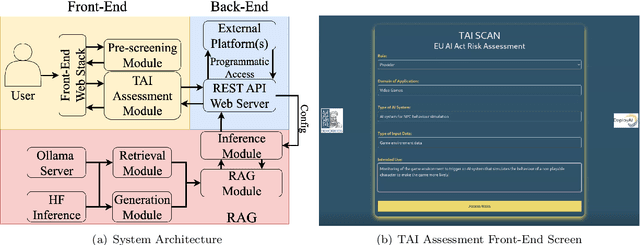
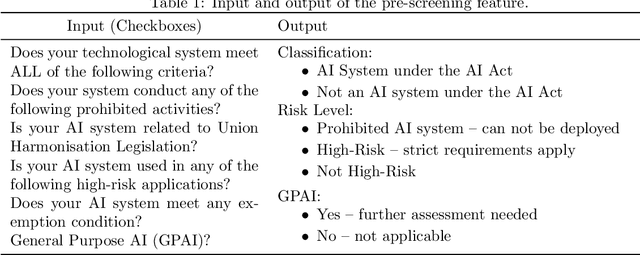
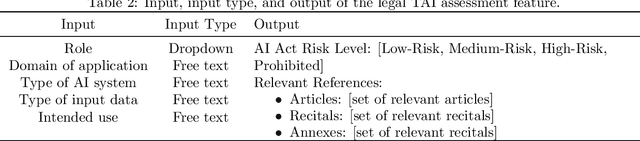
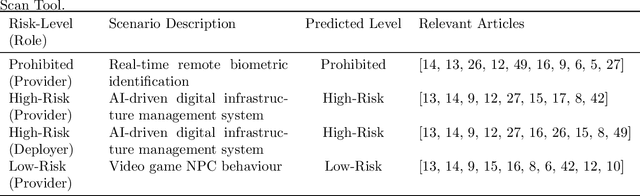
This paper introduces the TAI Scan Tool, a RAG-based TAI self-assessment tool with minimalistic input. The current version of the tool supports the legal TAI assessment, with a particular emphasis on facilitating compliance with the AI Act. It involves a two-step approach with a pre-screening and an assessment phase. The assessment output of the system includes insight regarding the risk-level of the AI system according to the AI Act, while at the same time retrieving relevant articles to aid with compliance and notify on their obligations. Our qualitative evaluation using use-case scenarios yields promising results, correctly predicting risk levels while retrieving relevant articles across three distinct semantic groups. Furthermore, interpretation of results shows that the tool's reasoning relies on comparison with the setting of high-risk systems, a behaviour attributed to their deployment requiring careful consideration, and therefore frequently presented within the AI Act.