 Add to Chrome
 Add to Firefox
 Add to Edge
Manifold-Guided Motion Planning for Tight Assemblies
Jul 20, 2026
Motion planning for rigid-body assembly poses a fundamental challenge in robotics due to tight geometric constraints. In such scenarios, feasible motions often require passing through (near-)zero clearance configurations in which the parts are tightly constrained by contact. In this work, we introduce Critical-Manifold Guided RRT (CMG-RRT), a sampling-based planner designed specifically for tight assembly problems. Our key observation is that in tight assemblies, valid solution paths lie on or near a critical manifold: the subset of configuration space consisting of poses with at least one contact point between parts. CMG-RRT guides exploration by adaptively biasing sampling toward neighborhoods of the critical manifold using a hierarchical subdivision of the configuration space. We prove that CMG-RRT is probabilistically complete under standard clearance assumptions. Empirical evaluation on challenging rotational assembly benchmarks demonstrates a 100% success rate across all tested instances, including, to the best of our knowledge, the first fully automatic solution of the Elk disentanglement puzzle. Our open source software is available through our project page: https://www.cgl.cs.tau.ac.il/projects/tight-assembly-planning.

Lifelong Localization in Dynamic Indoor Environments Combining Odometry with Sparse Distance Sampling
Jul 20, 2026Localization is a key task in robot navigation, and many techniques exist for it. In many plausible scenarios, a robot might face unforeseen, dynamic obstacles, rendering any pre-determined map inaccurate for localization. In this work, we propose a robust lifelong localization framework in dynamic planar indoor environments, using the robot's odometry and sparse distance sampling. We demonstrate how distance samples can be used to provide a robust prior on the robot's location. This technique can solve the kidnapped robot problem in real time, up to symmetries. Based on insights from real-world recorded data, we also account for dynamic obstacles. We then fuse this prior, over time, with the odometry to converge to the robot's location. A central property of our method is that it provably converges to the robot's ground truth pose even in large indoor environments when the environment is static. We further show that this guarantee also holds in dynamic environments, as long as the nature of those changes has been correctly learned. We demonstrate the effectiveness of our approach in different real-world indoor environments. In particular, we achieve a localization comparable to SLAM with merely a few (sixteen) distance samples, as opposed to the full LiDAR range. Sufficing with only sparse distance sampling is advantageous in terms of sensor cost, privacy, storage space, and transmission bandwidth.
Leveraging Two Robotic Arms for Tight Assembly Performance Gains
Jul 20, 2026We provide a novel end-to-end framework for the execution of an assembly operation by two robotic arms, given the digital CAD models of the parts and their desired relative placement in their assembled state. We analyze and demonstrate the advantages of using two robotic arms simultaneously in tight assembly operations, compared to single-arm systems. Our method is implemented in both simulation and using physical robots. It provides theoretical guarantees on execution time and trajectory accuracy, supported by empirical evidence. In particular, we show that coordinated movement of two arms reduces average execution time by more than 50% compared to using a single arm only, produces higher-quality trajectories, and accelerates the search for valid robot placements. Furthermore, we establish bounds on the required dimensions of the robotic cell. Our open source software together with real-life video demonstrations are available in our project page.
A Note on the Time Complexity of Using Subdivision Methods for the Approximation of Fibers
Mar 03, 2025Subdivision methods such as quadtrees, octrees, and higher-dimensional orthrees are standard practice in different domains of computer science. We can use these methods to represent given geometries, such as curves, meshes, or surfaces. This representation is achieved by splitting some bounding voxel recursively while further splitting only sub-voxels that intersect with the given geometry. It is fairly known that subdivision methods are more efficient than traversing a fine-grained voxel grid. In this short note, we propose another outlook on analyzing the construction time complexity of orthrees to represent implicitly defined geometries that are fibers (preimages) of some function. This complexity is indeed asymptotically better than traversing dense voxel grids, under certain conditions, which we specify in the note. In fact, the complexity is output sensitive, and is closely related to the Hausdorff measure and Hausdorff dimension of the resulting geometry.
Localization in Dynamic Planar Environments Using Few Distance Measurements
Jul 03, 2024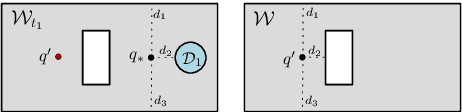
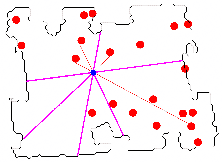
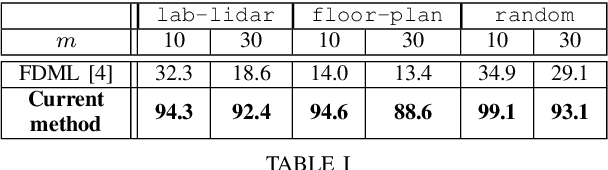
We present a method for determining the unknown location of a sensor placed in a known 2D environment in the presence of unknown dynamic obstacles, using only few distance measurements. We present guarantees on the quality of the localization, which are robust under mild assumptions on the density of the unknown/dynamic obstacles in the known environment. We demonstrate the effectiveness of our method in simulated experiments for different environments and varying dynamic-obstacle density. Our open source software is available at https://github.com/TAU-CGL/vb-fdml2-public.