 Add to Chrome
 Add to Firefox
 Add to Edge
A Generalized Converted Measurement Kalman Filter
Feb 12, 2025
This report derives a generalized, converted measurement Kalman filter for the class of filtering problems with a linear state equation and nonlinear measurement equation, for which a bijective mapping exists between the state and measurement coordinate systems. For these problems, a procedure is developed for mapping the observed measurements and their covariance matrices from measurement coordinates to state coordinates, such that the converted measurements are unbiased and the converted measurement covariance matrices are independent of the states and observed measurements. In cases where not all measurement coordinates are observed, predicted measurements of these coordinates are introduced as substitutes, and the impact of these measurements on the filter is mitigated by an information zeroing operation on the corresponding rows and columns of the converted measurement inverse-covariance matrix. Filter performance is demonstrated on two well-known target-tracking problems and is compared with the performance of the standard extended and unscented Kalman filters for these problems. These examples show the proposed filter obtains lower mean squared error, better consistency, and less track loss than either the extended Kalman filter or the unscented Kalman filter.

Investigating image-based fallow weed detection performance on Raphanus sativus and Avena sativa at speeds up to 30 km h$^{-1}$
May 17, 2023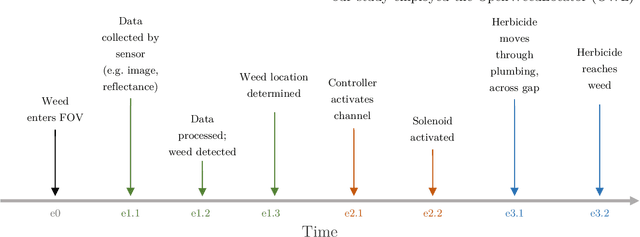
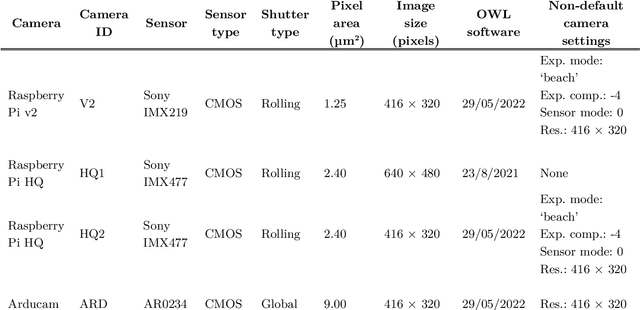
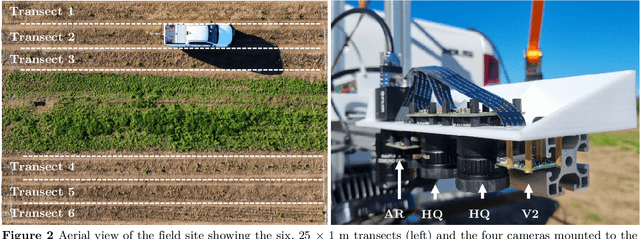
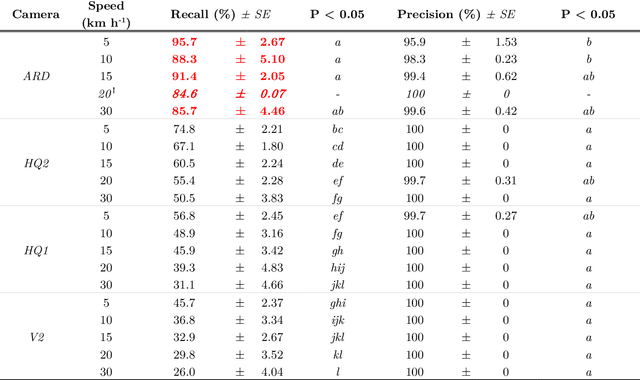
Site-specific weed control (SSWC) can provide considerable reductions in weed control costs and herbicide usage. Despite the promise of machine vision for SSWC systems and the importance of ground speed in weed control efficacy, there has been little investigation of the role of ground speed and camera characteristics on weed detection performance. Here, we compare the performance of four camera-software combinations using the open-source OpenWeedLocator platform - (1) default settings on a Raspberry Pi HQ camera, (2) optimised software settings on a HQ camera, (3) optimised software settings on the Raspberry Pi v2 camera, and (4) a global shutter Arducam AR0234 camera - at speeds ranging from 5 km h$^{-1}$ to 30 km h$^{-1}$. A combined excess green (ExG) and hue, saturation, value (HSV) thresholding algorithm was used for testing under fallow conditions using tillage radish (Raphanus sativus) and forage oats (Avena sativa) as representative broadleaf and grass weeds, respectively. ARD demonstrated the highest recall among camera systems, with up to 95.7% of weeds detected at 5 km h$^{-1}$ and 85.7% at 30 km h$^{-1}$. HQ1 and V2 cameras had the lowest recall of 31.1% and 26.0% at 30 km h$^{-1}$, respectively. All cameras experienced a decrease in recall as speed increased. The highest rate of decrease was observed for HQ1 with 1.12% and 0.90% reductions in recall for every km h$^{-1}$ increase in speed for tillage radish and forage oats, respectively. Detection of the grassy forage oats was worse (P<0.05) than the broadleaved tillage radish for all cameras. Despite the variations in recall, HQ1, HQ2, and V2 maintained near-perfect precision at all tested speeds. The variable effect of ground speed and camera system on detection performance of grass and broadleaf weeds, indicates that careful hardware and software considerations must be made when developing SSWC systems.