 Add to Chrome
 Add to Firefox
 Add to Edge
BavGround: A Benchmark for Regional Cultural Grounding and Dialect Competence in Bavarian
Aug 13, 2026
Cultural evaluation of large language models (LLMs) often focuses on high-resource standard languages, leaving regional culture and dialect communities underrepresented. We introduce BavGround, a benchmark for evaluating Bavarian regional cultural grounding and dialect competence across English, German and Bavarian. BavGround contains 206 multiple-choice source questions across eight cultural domains per language, yielding 618 multi-parallel instances, with items covering both broadly accessible cultural knowledge and source-grounded regional knowledge from journalism, historical sources, and specialist literature. We evaluate fifteen 7B-10B open-weight instruction-tuned models and one closed-model reference. Strong multilingual models perform best overall, but performance drops on Bavarian items and source-grounded questions, indicating persistent difficulty with dialectal and localized cultural knowledge. We further show that conclusions depend strongly on evaluation protocol: raw answer-letter scoring, shuffled-letter scoring, option-text likelihood, generated-answer parsing, and semantic matching can produce different absolute scores and rankings, especially for regionally adapted models. Finally, an exploratory analysis of GENBA-10B checkpoints suggests that continued pretraining improves answer-content likelihood unevenly across domains, while dialect competence remains comparatively weak. BavGround supports localized, protocol-aware evaluation of cultural representation in LLMs.

Designing and Evaluating Malinowski's Lens: An AI-Native Educational Game for Ethnographic Learning
Nov 10, 2025This study introduces 'Malinowski's Lens', the first AI-native educational game for anthropology that transforms Bronislaw Malinowski's 'Argonauts of the Western Pacific' (1922) into an interactive learning experience. The system combines Retrieval-Augmented Generation with DALL-E 3 text-to-image generation, creating consistent VGA-style visuals as players embody Malinowski during his Trobriand Islands fieldwork (1915-1918). To address ethical concerns, indigenous peoples appear as silhouettes while Malinowski is detailed, prompting reflection on anthropological representation. Two validation studies confirmed effectiveness: Study 1 with 10 non-specialists showed strong learning outcomes (average quiz score 7.5/10) and excellent usability (SUS: 83/100). Study 2 with 4 expert anthropologists confirmed pedagogical value, with one senior researcher discovering "new aspects" of Malinowski's work through gameplay. The findings demonstrate that AI-driven educational games can effectively convey complex anthropological concepts while sparking disciplinary curiosity. This study advances AI-native educational game design and provides a replicable model for transforming academic texts into engaging interactive experiences.
Report on the Conference on Ethical and Responsible Design in the National AI Institutes: A Summary of Challenges
Jul 18, 2024In May 2023, the Georgia Tech Ethics, Technology, and Human Interaction Center organized the Conference on Ethical and Responsible Design in the National AI Institutes. Representatives from the National AI Research Institutes that had been established as of January 2023 were invited to attend; researchers representing 14 Institutes attended and participated. The conference focused on three questions: What are the main challenges that the National AI Institutes are facing with regard to the responsible design of AI systems? What are promising lines of inquiry to address these challenges? What are possible points of collaboration? Over the course of the conference, a revised version of the first question became a focal point: What are the challenges that the Institutes face in identifying ethical and responsible design practices and in implementing them in the AI development process? This document summarizes the challenges that representatives from the Institutes in attendance highlighted.
Using Multi-Label Classification for Improved Question Answering
Oct 24, 2017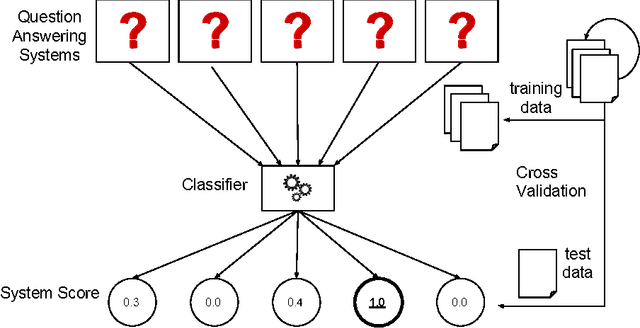
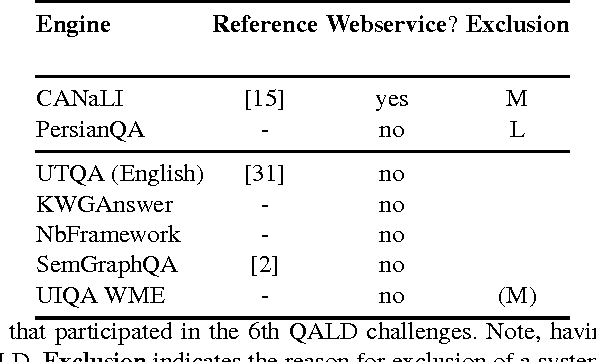
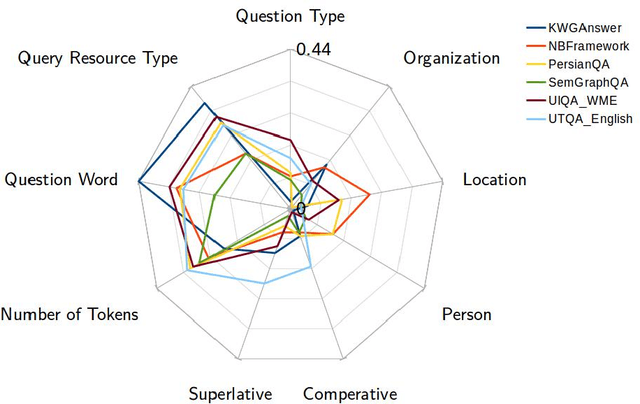
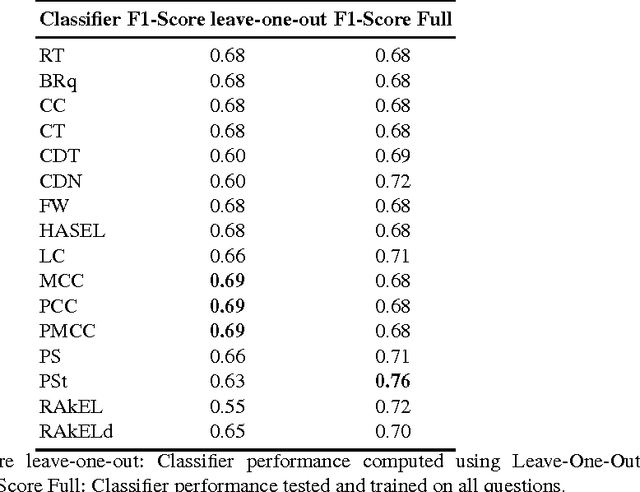
A plethora of diverse approaches for question answering over RDF data have been developed in recent years. While the accuracy of these systems has increased significantly over time, most systems still focus on particular types of questions or particular challenges in question answering. What is a curse for single systems is a blessing for the combination of these systems. We show in this paper how machine learning techniques can be applied to create a more accurate question answering metasystem by reusing existing systems. In particular, we develop a multi-label classification-based metasystem for question answering over 6 existing systems using an innovative set of 14 question features. The metasystem outperforms the best single system by 14% F-measure on the recent QALD-6 benchmark. Furthermore, we analyzed the influence and correlation of the underlying features on the metasystem quality.