 Add to Chrome
 Add to Firefox
 Add to Edge
Experimental Analysis of Microbubble Propagation for In-Body Data Transmission
Mar 19, 2026
In-body communication is an upcoming field with significant implications for medical diagnostics and therapeutic interventions. Microbubbles have gained attention due to their distinct physical properties, making them promising candidates to facilitate communication within the human body. This work explores the use of microbubbles as communication carriers, with a particular focus on their detection and the application of a modulation scheme. Through experimental analysis the feasibility and effectiveness of microbubble-based communication is tested. Filtering and peak detection methods are applied to accurately identify the presence of microbubbles despite noise, demonstrating the feasibility of microbubble-based communication systems for future biomedical applications. The results offer insights into signal integrity, noise challenges, and the optimization of detection algorithms, providing a foundation for future advancements in this field.

Computation Offloading at Field Level: Motivation and Break-Even Point Calculation
Jun 08, 2021


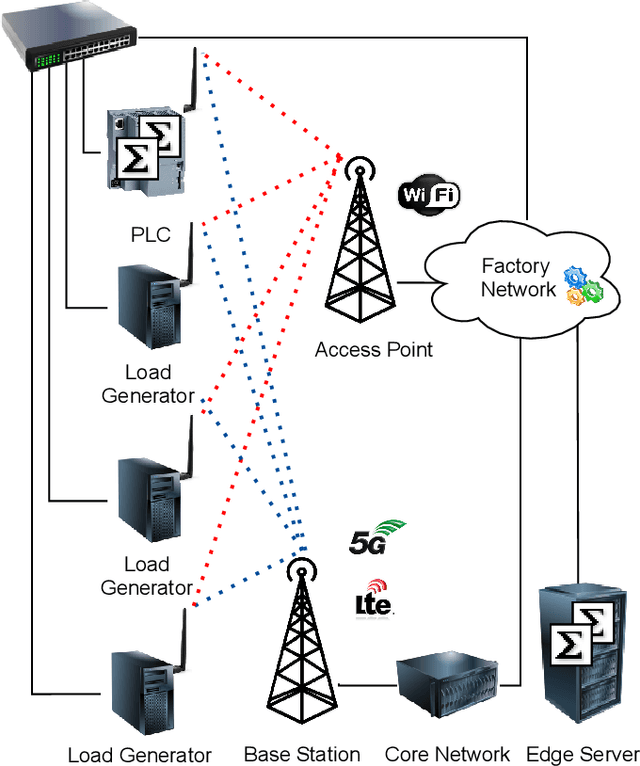
Smart manufacturing has the objective of creating highly flexible and resource optimized industrial plants. Furthermore, the improvement of product quality is another important target. These requirements implicate more complex control algo-rithms. Processing these algorithms may exceed the capabilities of resource constrained devices, such as programmable logic controllers (PLCs). In this case, the necessity for computation offloading is given. Due to the fact that industrial plants are currently designed for a life-cycle-time of more than ten years, in a realistic smart manufacturing scenario, these devices have to be considered. Therefore, we investigate the impact of complex algorithms on conventional PLCs by simulating them with a load generator. In addition, we propose a realistic factory scenario including benchmarks for both wireline and wireless communication systems. Thus, their round-trip time (RTT) is measured with and without additional load on the network. With the help of these investigations, break-even points for the application of computation offloading of two typical PLCs of Siemens S7 series can be calculated.