 Add to Chrome
 Add to Firefox
 Add to Edge
Subspace tracking: a novel measurement method to test the standard phase noise model of optical frequency combs
Dec 18, 2025
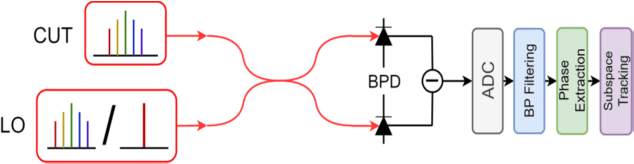
The introduction of digital signal processing (DSP) assisted coherent detection has been a cornerstone of modern fiber-optic communication systems. The ability to digitally, i.e. after analogue-to-digital converter, compensate for chromatic dispersion, polarization mode dispersion, and phase noise has rendered traditional analog feedback loops largely obsolete. While analog techniques remain prevalent for phase noise characterization of single-frequency lasers, the phase noise characterization of optical frequency combs presents a greater challenge. This complexity arises from different number of phase noise sources affecting an optical frequency comb. Here, we show how a phase noise measurement techniques method based on multi-heterodyne coherent detection and DSP-based subspace tracking can be used to identify, measure and quantify various phase noise sources associated with an optical frequency comb.

Spatial Distribution of Data Capacity for the Reduction of Number of Repeaters in Ultra Long-Haul Links
Jan 30, 2024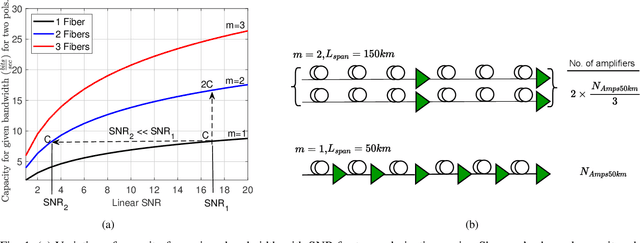
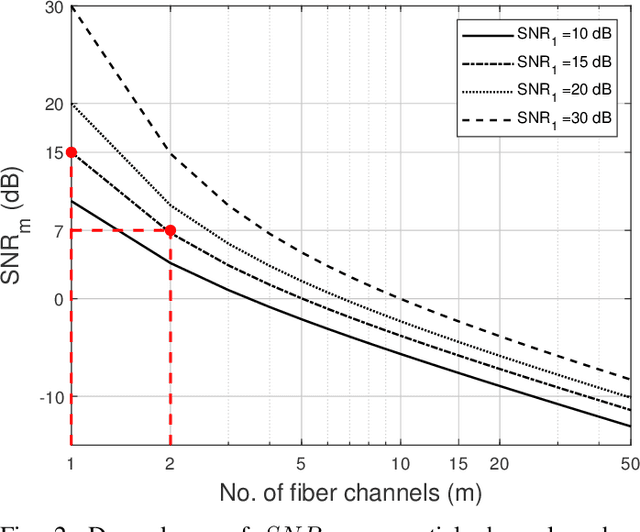
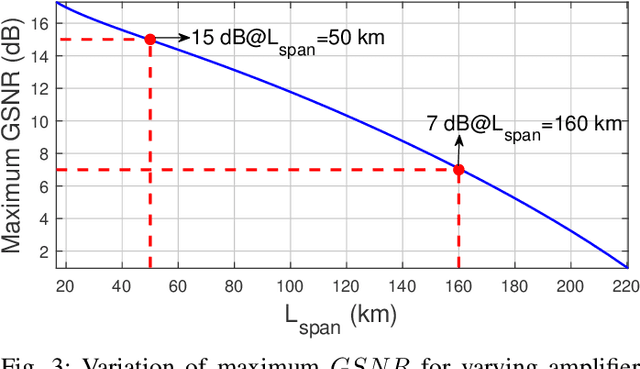
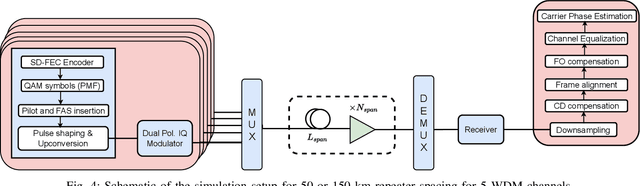
We present a novel method to reduce the number of repeaters and amplifiers in trans-oceanic links by distributing a given data capacity in spatial channels. We analytically, numerically and experimentally demonstrate the principle and show that about 40% of the repeaters can be omitted compared to a recently deployed cable. The method predicts that a single-fiber transmission link with 50 km amplifier spacing would be better off, repeater-wise, if the targeted single-fiber capacity is distributed in two fibers, each with an amplifier spacing of 150 km. In this scenario, one would thus only require 2/3 of the original number of amplifiers, and only 1/3 of the number of repeaters, housing the amplifiers. To test the principle of the proposed method, we experimentally and numerically investigate a 6900-km long link with amplifier spacing of 50 and 150 km using a recirculating fiber transmission loop,and find that the result supports the analytical model and thus the proposed method. We then use this concept to analytically investigate a realistic 12-fiber pair cable, and find that the same capacity could be distributed in 16 fiber pairs requiring only about 60% of the original number of repeaters.
All-Optical Nonlinear Pre-Compensation of Long-Reach Unrepeatered Systems
Jan 06, 2021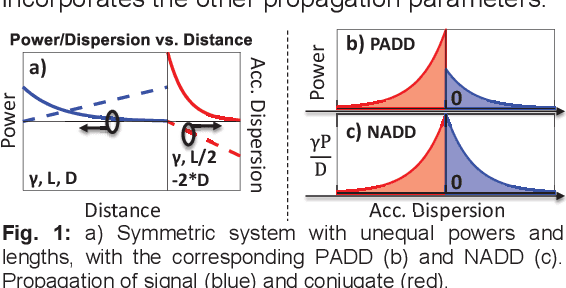
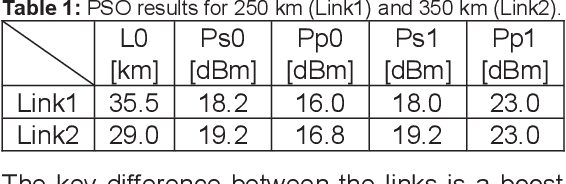
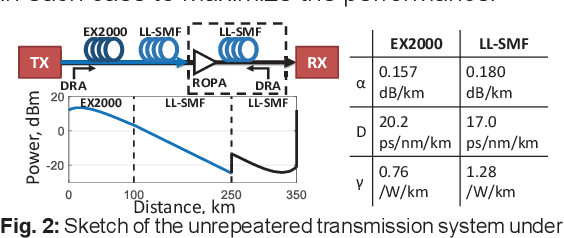

We numerically demonstrate an all-optical nonlinearity pre-compensation module for state-of-the-art long-reach Raman-amplified unrepeatered links. The compensator design is optimized in terms of propagation symmetry to maximize the performance gains under WDM transmission, achieving 4.0dB and 2.6dB of SNR improvement for 250-km and 350-km links.