 Add to Chrome
 Add to Firefox
 Add to Edge
Efficient coding along the visual hierarchy
May 18, 2026
Biological visual systems learn from limited experience, unlike deep learning models that rely on millions of training images. What learning principles make this possible? We tested whether efficient coding, the idea that neural representations capture the statistical structure of natural inputs, can build a hierarchy of human-aligned visual features from limited data. We developed an unsupervised learning procedure in which each layer of a deep network compresses its inputs onto the dominant modes of variation in natural images, using only local statistics and no labels, tasks, or backpropagation. This unsupervised procedure yields features that progress from edges and colors to textures and shapes. The features of this deep efficient coding model are readily recognized by human observers and are predictive of image-evoked fMRI responses in human visual cortex. Furthermore, a hybrid learning procedure that combines efficient coding with supervised fine-tuning yields better brain alignment in low-data settings and more rapid category learning. These findings suggest that efficient coding may shape representations across the entire visual hierarchy and help explain the data efficiency of biological vision.

Characterizing Universal Object Representations Across Vision Models
May 13, 2026Deep neural networks trained with different architectures, objectives, and datasets have been reported to converge on similar visual representations. However, what remains unknown is which visual properties models actually converge on and which factors may underlie this convergence. To address this, we decompose the object similarity structure of 162 diverse vision models into a small set of non-negative dimensions. To determine universal versus model-specific dimensions, we then estimate how often each dimension reappears across models. In contrast to model-specific dimensions, universal dimensions are more interpretable and more strongly driven by conceptual image properties, indicating the relevance of interpretability and semantic content as implicit factors driving universality across models. Differences in architecture, objective function, training data, model size, and model performance do not explain the emergence of universal dimensions. However, models with more universal dimensions also better predict macaque IT activity and human similarity judgments, suggesting that universality reflects representations relevant to biological vision. These findings have important implications for understanding the emergent representations underlying deep neural network models and their alignment with biological vision.
Universal dimensions of visual representation
Aug 23, 2024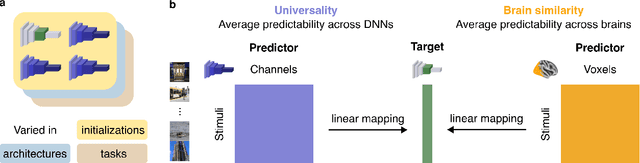
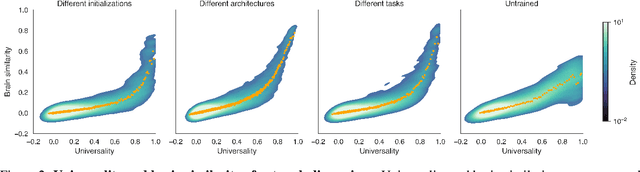

Do neural network models of vision learn brain-aligned representations because they share architectural constraints and task objectives with biological vision or because they learn universal features of natural image processing? We characterized the universality of hundreds of thousands of representational dimensions from visual neural networks with varied construction. We found that networks with varied architectures and task objectives learn to represent natural images using a shared set of latent dimensions, despite appearing highly distinct at a surface level. Next, by comparing these networks with human brain representations measured with fMRI, we found that the most brain-aligned representations in neural networks are those that are universal and independent of a network's specific characteristics. Remarkably, each network can be reduced to fewer than ten of its most universal dimensions with little impact on its representational similarity to the human brain. These results suggest that the underlying similarities between artificial and biological vision are primarily governed by a core set of universal image representations that are convergently learned by diverse systems.