 Add to Chrome
 Add to Firefox
 Add to Edge
Predicting Activity Cliffs for Autonomous Medicinal Chemistry
Apr 08, 2026
Activity cliff prediction - identifying positions where small structural changes cause large potency shifts - has been a persistent challenge in computational medicinal chemistry. This work focuses on a parsimonious definition: which small modifications, at which positions, confer the highest probability of an outcome change. Position-level sensitivity is calculated using 25 million matched molecular pairs from 50 ChEMBL targets across six protein families, revealing that two questions have fundamentally different answers. "Which positions vary most?" is answered by scaffold size alone (NDCG@3 = 0.966), requiring no machine learning. "Which are true activity cliffs?" - where small modifications cause disproportionately large effects, as captured by SALI normalization - requires an 11-feature model with 3D pharmacophore context (NDCG@3 = 0.910 vs. 0.839 random), generalizing across all six protein families, novel scaffolds (0.913), and temporal splits (0.878). The model identifies the cliff-prone position first 53% of the time (vs. 27% random - 2x lift), reducing positions a chemist must explore from 3.1 to 2.1 - a 31% reduction in first-round experiments. Predicting which modification to make is not tractable from structure alone (Spearman 0.268, collapsing to -0.31 on novel scaffolds). The system is released as open-source code and an interactive webapp.

Epistemic Blinding: An Inference-Time Protocol for Auditing Prior Contamination in LLM-Assisted Analysis
Apr 07, 2026This paper presents epistemic blinding in the context of an agentic system that uses large language models to reason across multiple biological datasets for drug target prioritization. During development, it became apparent that LLM outputs silently blend data-driven inference with memorized priors about named entities - and the blend is invisible: there is no way to determine, from a single output, how much came from the data on the page and how much came from the model's training memory. Epistemic blinding is a simple inference-time protocol that replaces entity identifiers with anonymous codes before prompting, then compares outputs against an unblinded control. The protocol does not make LLM reasoning deterministic, but it restores one critical axis of auditability: measuring how much of an output came from the supplied data versus the model's parametric knowledge. The complete target identification system is described - including LLM-guided evolutionary optimization of scoring functions and blinded agentic reasoning for target rationalization - with demonstration that both stages operate without access to entity identity. In oncology drug target prioritization across four cancer types, blinding changes 16% of top-20 predictions while preserving identical recovery of validated targets. The contamination problem is shown to generalize beyond biology: in S&P 500 equity screening, brand-recognition bias reshapes 30-40% of top-20 rankings across five random seeds. To lower the barrier to adoption, the protocol is released as an open-source tool and as a Claude Code skill that enables one-command epistemic blinding within agentic workflows. The claim is not that blinded analysis produces better results, but that without blinding, there is no way to know to what degree the agent is adhering to the analytical process the researcher designed.
Virtual Cells: Predict, Explain, Discover
May 20, 2025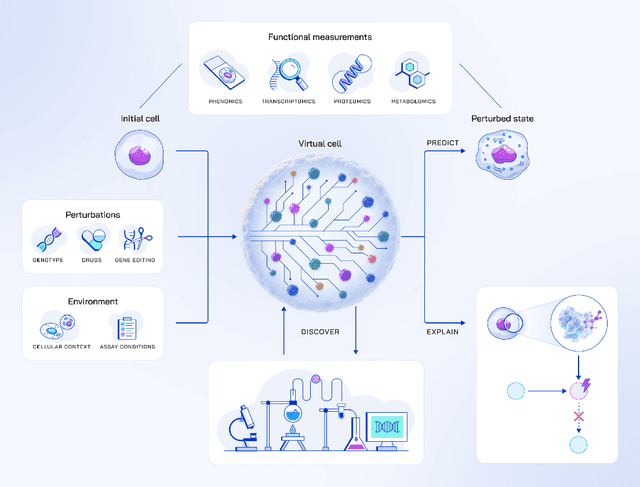
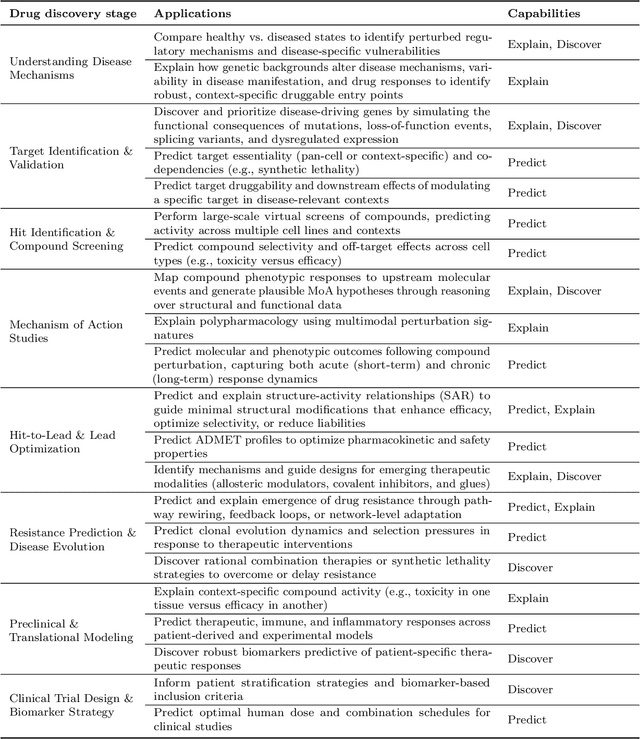
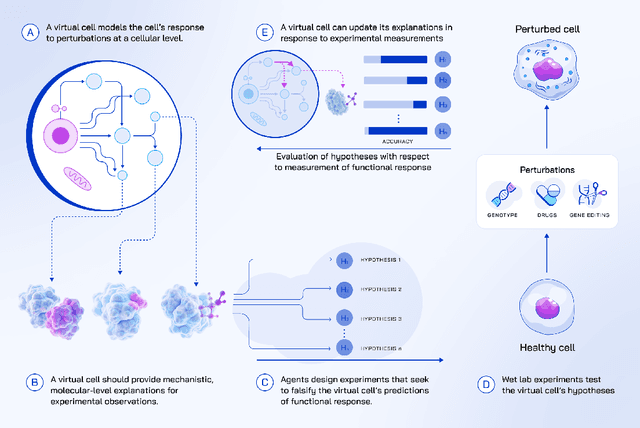
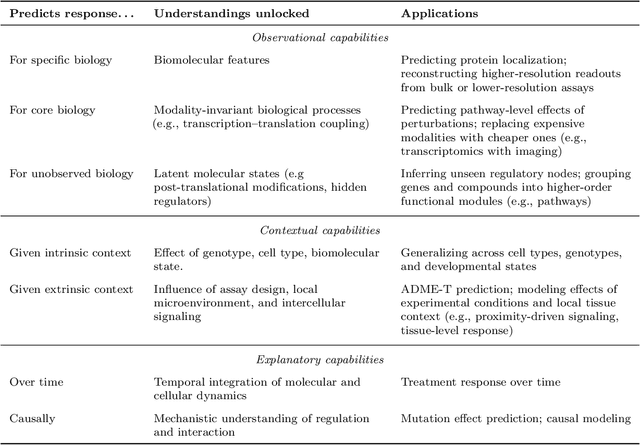
Drug discovery is fundamentally a process of inferring the effects of treatments on patients, and would therefore benefit immensely from computational models that can reliably simulate patient responses, enabling researchers to generate and test large numbers of therapeutic hypotheses safely and economically before initiating costly clinical trials. Even a more specific model that predicts the functional response of cells to a wide range of perturbations would be tremendously valuable for discovering safe and effective treatments that successfully translate to the clinic. Creating such virtual cells has long been a goal of the computational research community that unfortunately remains unachieved given the daunting complexity and scale of cellular biology. Nevertheless, recent advances in AI, computing power, lab automation, and high-throughput cellular profiling provide new opportunities for reaching this goal. In this perspective, we present a vision for developing and evaluating virtual cells that builds on our experience at Recursion. We argue that in order to be a useful tool to discover novel biology, virtual cells must accurately predict the functional response of a cell to perturbations and explain how the predicted response is a consequence of modifications to key biomolecular interactions. We then introduce key principles for designing therapeutically-relevant virtual cells, describe a lab-in-the-loop approach for generating novel insights with them, and advocate for biologically-grounded benchmarks to guide virtual cell development. Finally, we make the case that our approach to virtual cells provides a useful framework for building other models at higher levels of organization, including virtual patients. We hope that these directions prove useful to the research community in developing virtual models optimized for positive impact on drug discovery outcomes.