 Add to Chrome
 Add to Firefox
 Add to Edge
In Defense of OCTA: The Reconstruction-Utility Gap in OCT-to-OCTA Synthesis
Aug 16, 2026
Optical coherence tomography angiography (OCTA) images retinal blood flow, giving capillary-perfusion and foveal-avascular-zone biomarkers that grade diabetic-retinopathy ischemia. Because OCTA hardware is less common than structural OCT, recent work synthesizes it from OCT, reporting strong reconstruction (3D PSNR > 31 dB, SSIM > 0.9). We ask not whether the synthetic image looks similar, but whether it supports the measurements OCTA is acquired for. A frozen real-OCTA segmenter, applied as a probe to two synthesizers (XOCT, TransPro), shows downstream Dice falling with structural fineness: large vessels survive (0.862 -> 0.831) while the fine capillary network collapses (0.798 -> 0.635, five times the large-vessel loss; paired Wilcoxon p < 1e-3), TransPro worse throughout. A matched-blur control shows this detail is fabricated, not blurred. Retrained on a private Spectralis dataset, neither synthesizer reproduces the neovascular lesion (qualitative, n=3). Reconstruction fidelity is not clinical utility; we establish downstream-task fidelity as the evaluation OCT-to-OCTA synthesis needs.

Balancing Specialization, Generalization, and Compression for Detection and Tracking
Sep 25, 2019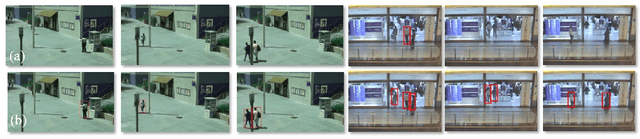
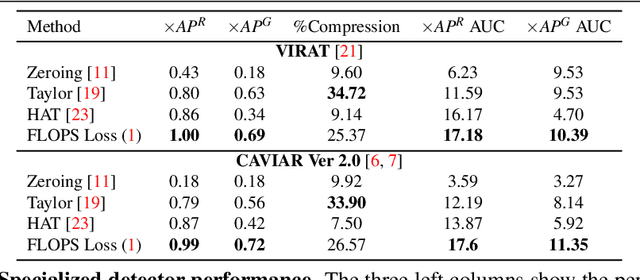
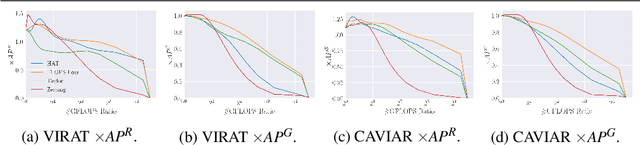
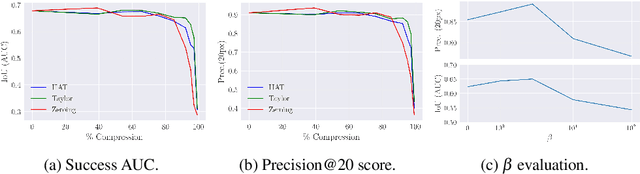
We propose a method for specializing deep detectors and trackers to restricted settings. Our approach is designed with the following goals in mind: (a) Improving accuracy in restricted domains; (b) preventing overfitting to new domains and forgetting of generalized capabilities; (c) aggressive model compression and acceleration. To this end, we propose a novel loss that balances compression and acceleration of a deep learning model vs. loss of generalization capabilities. We apply our method to the existing tracker and detector models. We report detection results on the VIRAT and CAVIAR data sets. These results show our method to offer unprecedented compression rates along with improved detection. We apply our loss for tracker compression at test time, as it processes each video. Our tests on the OTB2015 benchmark show that applying compression during test time actually improves tracking performance.