 Add to Chrome
 Add to Firefox
 Add to Edge
Eulerian Gaussian Splatting using Hashed Probability Pyramids
May 27, 2026
We introduce a probabilistic splat-based radiance field framework that retains the fast rasterization and test-time efficiency of 3D Gaussian Splatting (3DGS) while replacing heuristic primitive manipulation with gradient-based optimization of a volumetric probability density. Rather than relocating, splitting, or culling Gaussians via hand-tuned densification (e.g., ADC), we treat primitive locations as samples drawn from a persistent, learnable density. We instantiate this density using a novel, memory-efficient multi-scale hierarchical grid that enables end-to-end gradient-based optimization. To stabilize the optimization, we derive an unbiased gradient estimator with control variates that markedly reduces variance. By allowing probability mass to flow to where the loss demands, our framework eliminates brittle priors and naturally explores the volume, achieving state-of-the-art reconstruction quality on mip-NeRF 360 while preserving 3DGS-level rendering speed.

Boundary Attention: Learning to Find Faint Boundaries at Any Resolution
Jan 01, 2024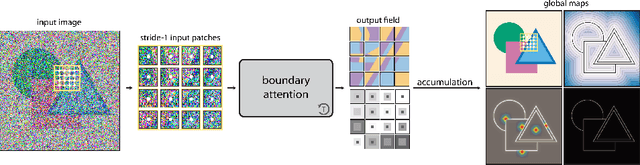

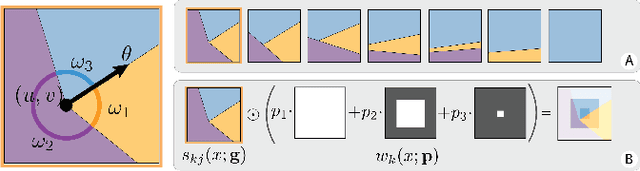
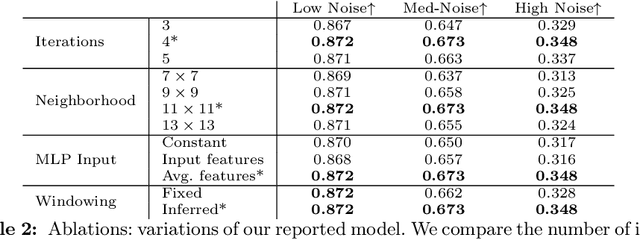
We present a differentiable model that explicitly models boundaries -- including contours, corners and junctions -- using a new mechanism that we call boundary attention. We show that our model provides accurate results even when the boundary signal is very weak or is swamped by noise. Compared to previous classical methods for finding faint boundaries, our model has the advantages of being differentiable; being scalable to larger images; and automatically adapting to an appropriate level of geometric detail in each part of an image. Compared to previous deep methods for finding boundaries via end-to-end training, it has the advantages of providing sub-pixel precision, being more resilient to noise, and being able to process any image at its native resolution and aspect ratio.