 Add to Chrome
 Add to Firefox
 Add to Edge
Towards Embodied AI with MuscleMimic: Unlocking full-body musculoskeletal motor learning at scale
Mar 26, 2026
Learning motor control for muscle-driven musculoskeletal models is hindered by the computational cost of biomechanically accurate simulation and the scarcity of validated, open full-body models. Here we present MuscleMimic, an open-source framework for scalable motion imitation learning with physiologically realistic, muscle-actuated humanoids. MuscleMimic provides two validated musculoskeletal embodiments - a fixed-root upper-body model (126 muscles) for bimanual manipulation and a full-body model (416 muscles) for locomotion - together with a retargeting pipeline that maps SMPL-format motion capture data onto musculoskeletal structures while preserving kinematic and dynamic consistency. Leveraging massively parallel GPU simulation, the framework achieves order-of-magnitude training speedups over prior CPU-based approaches while maintaining comprehensive collision handling, enabling a single generalist policy to be trained on hundreds of diverse motions within days. The resulting policy faithfully reproduces a broad repertoire of human movements under full muscular control and can be fine-tuned to novel motions within hours. Biomechanical validation against experimental walking and running data demonstrates strong agreement in joint kinematics (mean correlation r = 0.90), while muscle activation analysis reveals both the promise and fundamental challenges of achieving physiological fidelity through kinematic imitation alone. By lowering the computational and data barriers to musculoskeletal simulation, MuscleMimic enables systematic model validation across diverse dynamic movements and broader participation in neuromuscular control research. Code, models, checkpoints, and retargeted datasets are available at: https://github.com/amathislab/musclemimic

Arnold: a generalist muscle transformer policy
Aug 25, 2025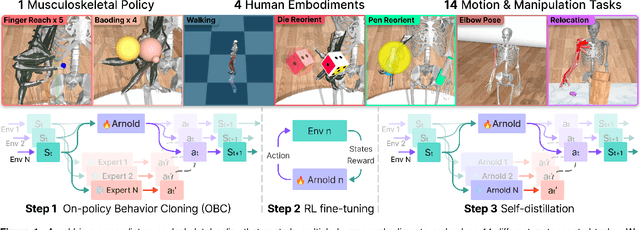

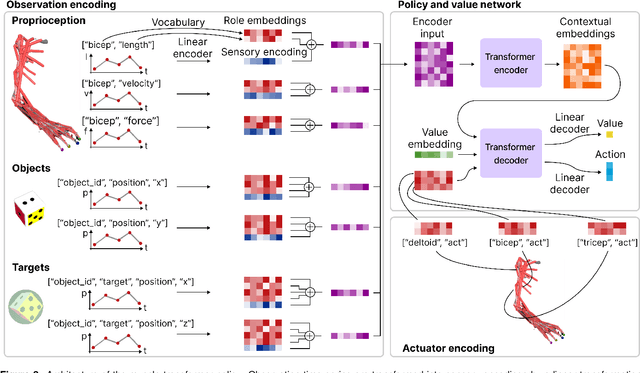
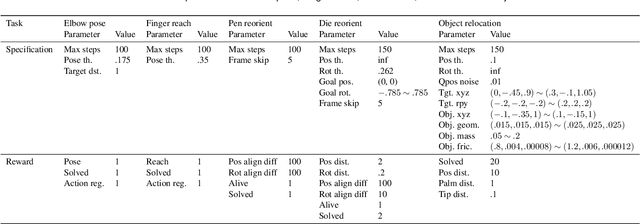
Controlling high-dimensional and nonlinear musculoskeletal models of the human body is a foundational scientific challenge. Recent machine learning breakthroughs have heralded policies that master individual skills like reaching, object manipulation and locomotion in musculoskeletal systems with many degrees of freedom. However, these agents are merely "specialists", achieving high performance for a single skill. In this work, we develop Arnold, a generalist policy that masters multiple tasks and embodiments. Arnold combines behavior cloning and fine-tuning with PPO to achieve expert or super-expert performance in 14 challenging control tasks from dexterous object manipulation to locomotion. A key innovation is Arnold's sensorimotor vocabulary, a compositional representation of the semantics of heterogeneous sensory modalities, objectives, and actuators. Arnold leverages this vocabulary via a transformer architecture to deal with the variable observation and action spaces of each task. This framework supports efficient multi-task, multi-embodiment learning and facilitates rapid adaptation to novel tasks. Finally, we analyze Arnold to provide insights into biological motor control, corroborating recent findings on the limited transferability of muscle synergies across tasks.
Reinforcement learning-based motion imitation for physiologically plausible musculoskeletal motor control
Mar 18, 2025How do humans move? The quest to understand human motion has broad applications in numerous fields, ranging from computer animation and motion synthesis to neuroscience, human prosthetics and rehabilitation. Although advances in reinforcement learning (RL) have produced impressive results in capturing human motion using simplified humanoids, controlling physiologically accurate models of the body remains an open challenge. In this work, we present a model-free motion imitation framework (KINESIS) to advance the understanding of muscle-based motor control. Using a musculoskeletal model of the lower body with 80 muscle actuators and 20 DoF, we demonstrate that KINESIS achieves strong imitation performance on 1.9 hours of motion capture data, is controllable by natural language through pre-trained text-to-motion generative models, and can be fine-tuned to carry out high-level tasks such as target goal reaching. Importantly, KINESIS generates muscle activity patterns that correlate well with human EMG activity. The physiological plausibility makes KINESIS a promising model for tackling challenging problems in human motor control theory, which we highlight by investigating Bernstein's redundancy problem in the context of locomotion. Code, videos and benchmarks will be available at https://github.com/amathislab/Kinesis.