 Add to Chrome
 Add to Firefox
 Add to Edge
Test-Time Hallucination Control in Large Vision-Language Models
Aug 11, 2026
Object Hallucination in large vision-language models (LVLMs), where models generate non-factual content about input images, remains a critical barrier to their reliability in real-world applications. Existing mitigation strategies can be categorized into training-based and training-free methods. Training-based methods often achieve strong performance but are costly, requiring extensive computational resources, large-scale data, and time-consuming fine-tuning. Training-free approaches are particularly appealing due to their efficiency. However, existing training-free methods either require multiple decoding rounds, which adds computational overhead, or modify internal states in a model-specific way that risks degrading pretrained knowledge. We propose Test-Time Hallucination Mitigation (TTH) method, a novel training-free method that addresses both limitations. TTH introduces a token-validator module, implemented as a zero-shot Multi-Modal Classifier (MMC), to generate auxiliary logits grounded in the input image. These logits are fused with the original LVLM outputs at the token level for object tokens selected from a candidate pool. An entropy-based weighting scheme is then applied to enable robust and accurate predictions. Extensive experiments across multiple LVLM families and diverse benchmarks demonstrate that TTH consistently improves accuracy and robustness, underscoring its generalizability and practical effectiveness. Code is released at https://github.com/Mehran-TAM/TTH

Adapt-As-You-Walk Through the Clouds: Training-Free Online Test-Time Adaptation of 3D Vision-Language Foundation Models
Nov 19, 2025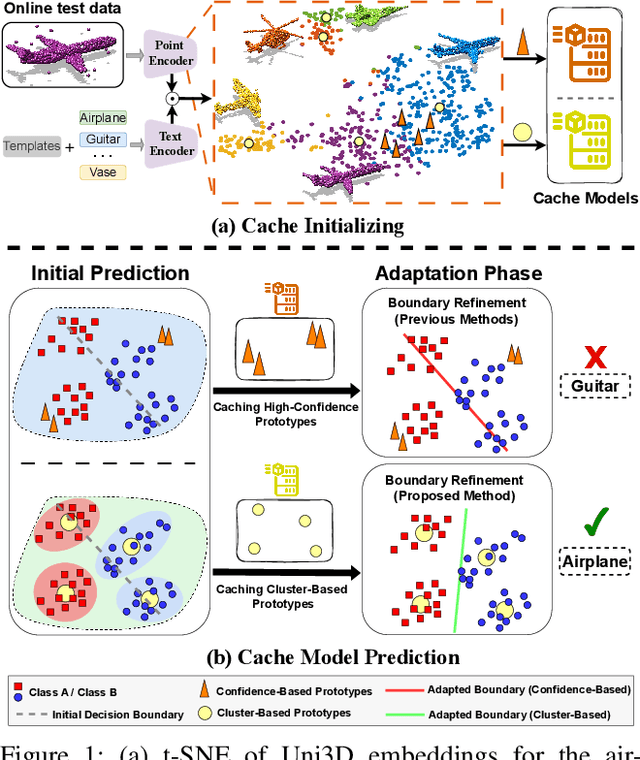
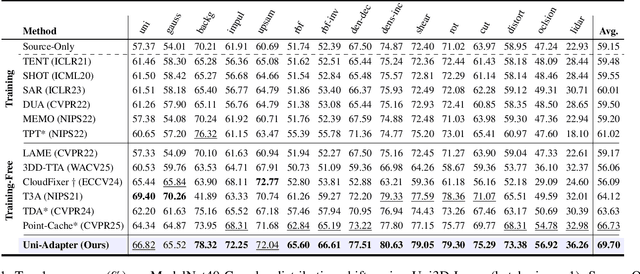
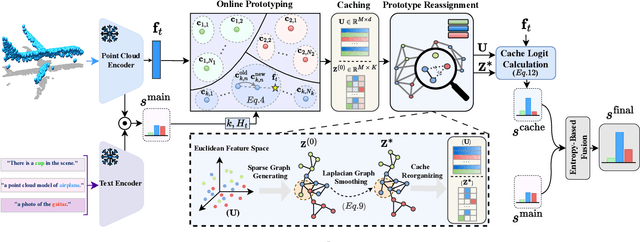
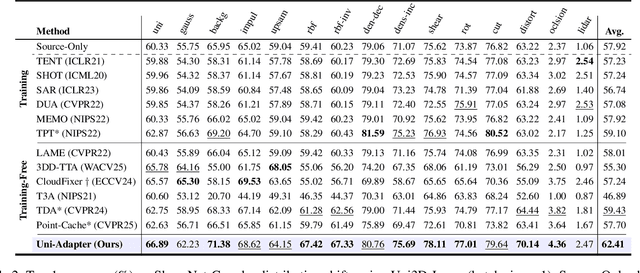
3D Vision-Language Foundation Models (VLFMs) have shown strong generalization and zero-shot recognition capabilities in open-world point cloud processing tasks. However, these models often underperform in practical scenarios where data are noisy, incomplete, or drawn from a different distribution than the training data. To address this, we propose Uni-Adapter, a novel training-free online test-time adaptation (TTA) strategy for 3D VLFMs based on dynamic prototype learning. We define a 3D cache to store class-specific cluster centers as prototypes, which are continuously updated to capture intra-class variability in heterogeneous data distributions. These dynamic prototypes serve as anchors for cache-based logit computation via similarity scoring. Simultaneously, a graph-based label smoothing module captures inter-prototype similarities to enforce label consistency among similar prototypes. Finally, we unify predictions from the original 3D VLFM and the refined 3D cache using entropy-weighted aggregation for reliable adaptation. Without retraining, Uni-Adapter effectively mitigates distribution shifts, achieving state-of-the-art performance on diverse 3D benchmarks over different 3D VLFMs, improving ModelNet-40C by 10.55%, ScanObjectNN-C by 8.26%, and ShapeNet-C by 4.49% over the source 3D VLFMs.