 Add to Chrome
 Add to Firefox
 Add to Edge
Look Once, Beam Twice: Camera-Primed Real-Time Double-Directional mmWave Beam Management for Vehicular Connectivity
May 06, 2026
Millimeter-wave (mmWave) frequencies promise multi-gigabit connectivity for vehicle-to-everything (V2X) networks, but face challenges in terms of severe path loss and mobility-related beam misalignment. Reliable V2X connectivity requires fast, double-directional beam alignment. However, existing methods suffer from high training overhead and limited generalization to unseen scenarios. This paper presents VIsion-based BEamforming(VIBE), a hybrid model-based, closed-loop, learning architecture for real-time double-directional mmWave beam management primed by camera sensing. VIBE fuses machine learning, model-based reasoning, and closed-loop RF feedback to balance beam-pair establishment latency with link quality. VIBE bypasses exhaustive training overhead and accelerates link establishment by leveraging camera observations to reduce the beam-search space. Lightweight beam refinement and offset tracking mechanisms adaptively refine beams in response to dynamic application requirements. VIBE is implemented and evaluated across online indoor/outdoor testbeds, public datasets, and real-time vehicular experiments, demonstrating strong generalization capabilities, making it suitable for real-time V2X communication. Comparisons with 5G NR hierarchical beamforming show that VIBE consistently maintains lower outage rates. Furthermore, VIBE outperforms state-of-the-art end-to-end ML models for beam selection when evaluated on public datasets and achieves outage rates as low as 1.1-1.4 %. The results show that a hybrid model-based, closed-loop learning architecture is better suited for real-world mmWave vehicular connectivity than end-to-end trained ML models. For reproducibility, we publish our code to https://github.com/UNL-CPN-Lab/Look-Once-Beam-Twice.

Cruising the Spectrum: Joint Spectrum Mobility and Antenna Array Management for Mobile (cm/mm)Wave Connectivity
Dec 24, 2025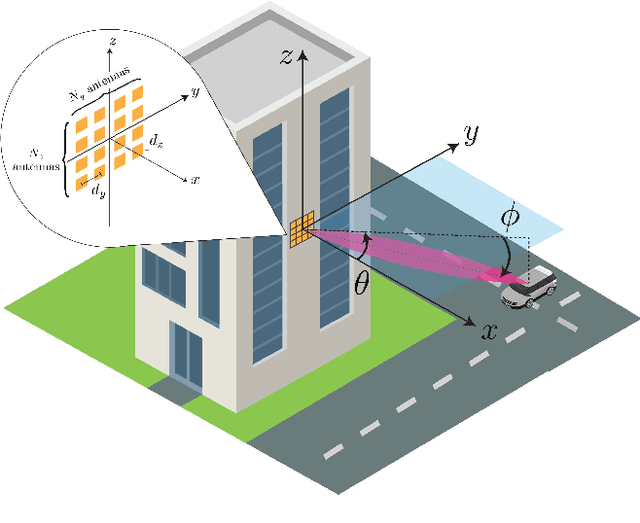
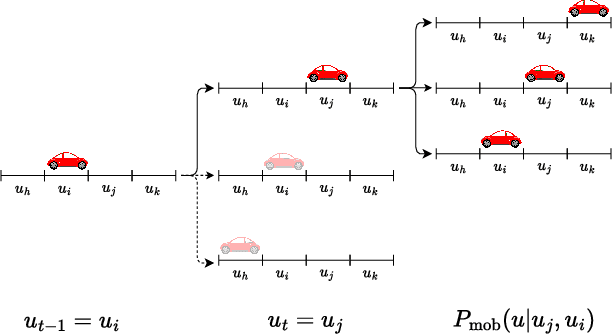
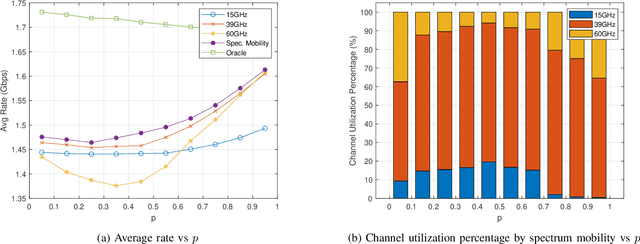
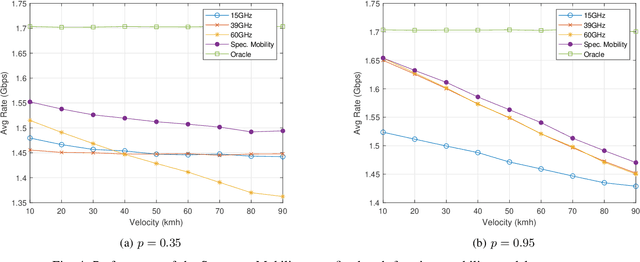
The large bandwidths available at millimeter wave (mmWave) FR2 bands (24-71 GHz) and the emerging FR3 bands (7-24 GHz) are essential for supporting high data rates. Highly directional beams utilized to overcome the attenuation in these frequencies necessitate robust and efficient beamforming schemes. Nevertheless, antenna and beam management approaches still face challenges in highly mobile solutions, such as vehicular connectivity, with increasing number of bands. In this work, the concepts of spectrum mobility is studied along with antenna array management in multiple frequencies to improve beamforming under mobility. The spectrum mobility problem aims to select the optimal channel frequency and beam direction in each time slot to maximize data rate. This problem is formulated as a Partially Observable Markov Decision Process (POMDP) and Point-Based Value Iteration (PBVI) algorithm is used to find a policy with performance guarantees. Numerical examples confirm the efficacy of the resulting policy for multiple available frequency bands, even when the user mobility significantly deviates from models assumed during policy generation.