 Add to Chrome
 Add to Firefox
 Add to Edge
Characterization of the basin of convexity for multi-snapshot spike deconvolution via variable projection
Jul 10, 2026
We study the problem of multi-snapshot spike deconvolution, where the goal is to recover the locations of sparse impulses from their noisy convolution with a known point spread function (PSF) across multiple snapshots. We adopt a variable-projection formulation that eliminates the amplitudes in closed form, reducing the task to a nonconvex least-squares problem over the spike locations alone, which we refer to as the variable-projection formulation of spike deconvolution (VarProSD). We provide an explicit characterization of the basin of convexity of the VarProSD objective in terms of key PSF properties, including its power spectral density and smoothness, revealing how sampling bandwidth and spike separation influence the local geometry. Within this basin, we establish that the estimator is consistent in the number of snapshots under stochastic noise, and provide a complementary, sharper error bound under adversarial noise via the local Lipschitz property of the inverse map. We further show local convergence guarantees for gradient descent when initialized within the basin. A central ingredient throughout is the use of Beurling--Selberg extremal approximations, which enable sharp, PSF-agnostic bounds on the conditioning of the structured matrices arising in the optimization landscape. Numerical experiments validate our theoretical findings and demonstrate the effectiveness of modified ESPRIT initialization followed by gradient-based refinement.

Global Convergence of ESPRIT with Preconditioned First-Order Methods for Spike Deconvolution
Feb 12, 2025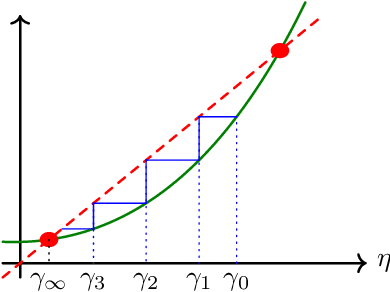

Spike deconvolution is the problem of recovering point sources from their convolution with a known point spread function, playing a fundamental role in many sensing and imaging applications. This paper proposes a novel approach combining ESPRIT with Preconditioned Gradient Descent (PGD) to estimate the amplitudes and locations of the point sources by a non-linear least squares. The preconditioning matrices are adaptively designed to account for variations in the learning process, ensuring a proven super-linear convergence rate. We provide local convergence guarantees for PGD and performance analysis of ESPRIT reconstruction, leading to global convergence guarantees for our method in one-dimensional settings with multiple snapshots, demonstrating its robustness and effectiveness. Numerical simulations corroborate the performance of the proposed approach for spike deconvolution.
Small-Noise Sensitivity Analysis of Locating Pulses in the Presence of Adversarial Perturbation
Mar 05, 2024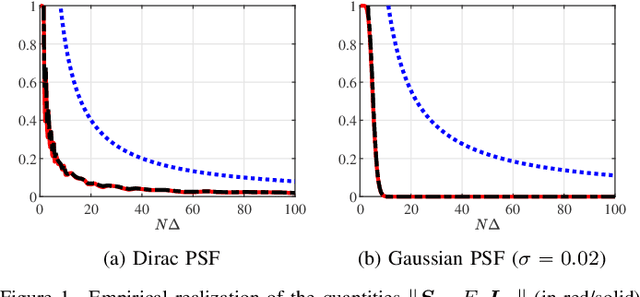
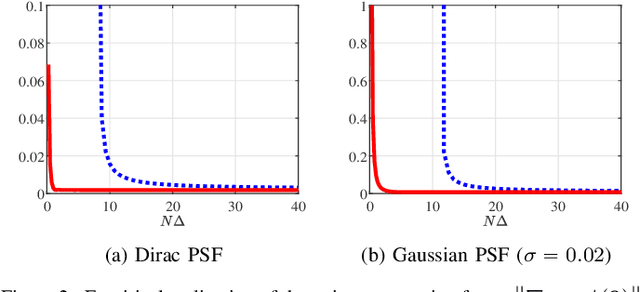
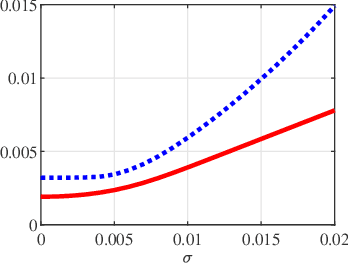
A fundamental small-noise sensitivity analysis of spike localization in the presence of adversarial perturbations and arbitrary point spread function (PSF) is presented. The analysis leverages the local Lipschitz property of the inverse map from measurement noise to parameter estimate. In the small noise regime, the local Lipschitz constant converges to the spectral norm of the noiseless Jacobian of the inverse map. An interpretable upper bound in terms of the minimum separation of spikes, norms, and flatness of the PSF and its derivative, and the distribution of spike amplitudes is provided. Numerical experiments highlighting the relevance of the theoretical bound as a proxy to the local Lipschitz constant and its dependence on the key attributes of the problem are presented.
Stable estimation of pulses of unknown shape from multiple snapshots via ESPRIT
Aug 30, 2023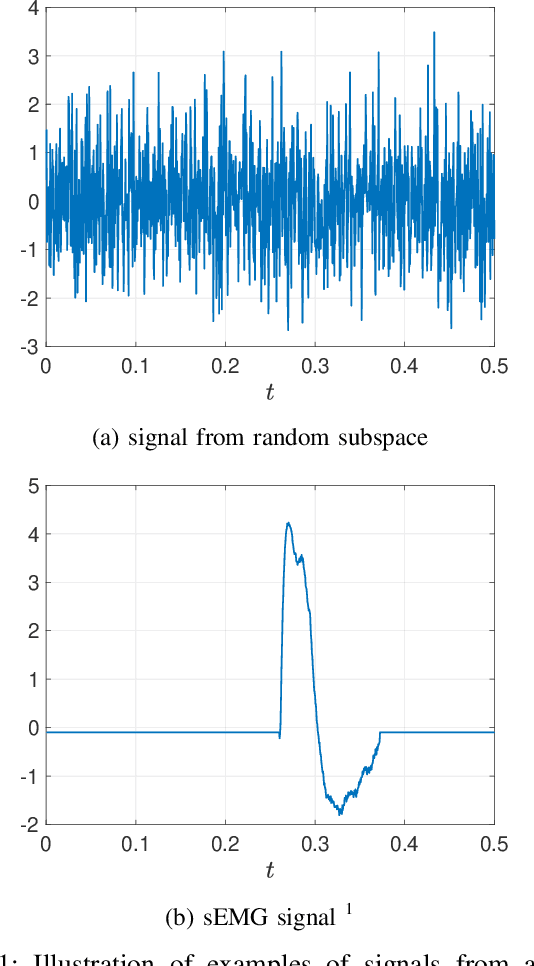
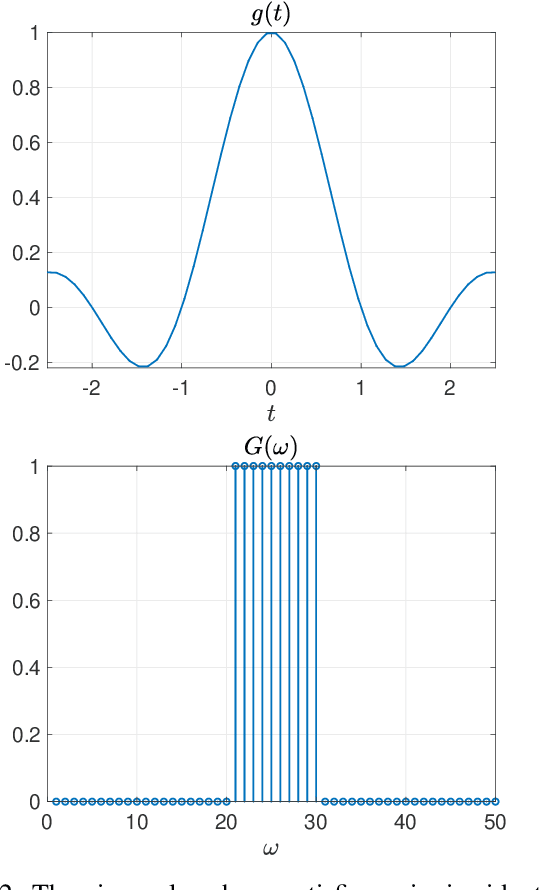
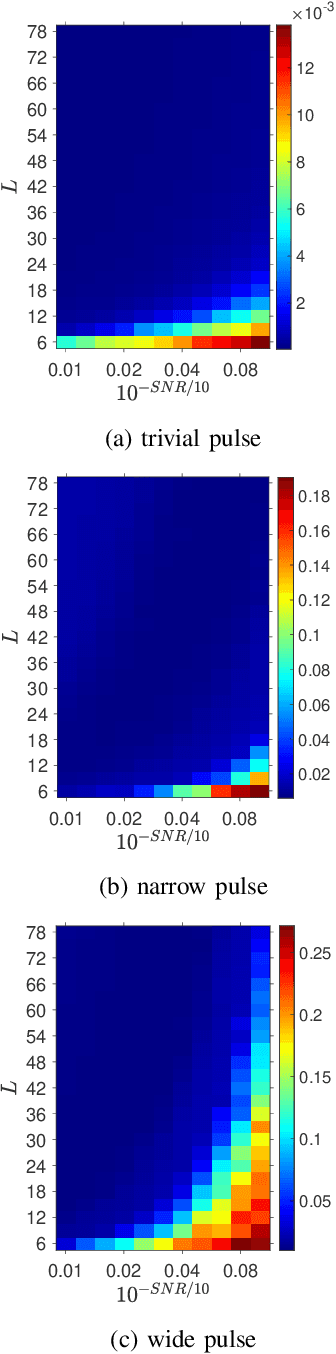
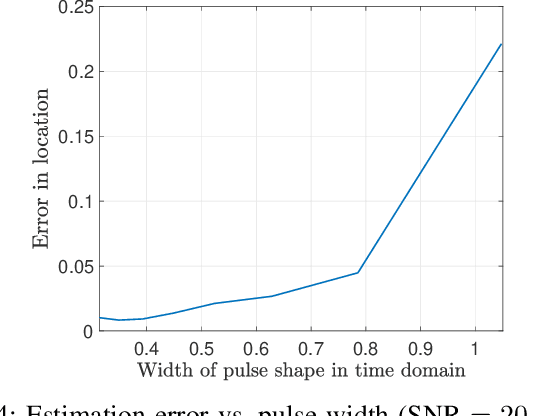
We consider the problem of resolving overlapping pulses from noisy multi-snapshot measurements, which has been a problem central to various applications including medical imaging and array signal processing. ESPRIT algorithm has been used to estimate the pulse locations. However, existing theoretical analysis is restricted to ideal assumptions on signal and measurement models. We present a novel perturbation analysis that overcomes the previous theoretical limitation, which is derived without a stringent assumption on the signal model. Our unifying analysis applies to various sub-array designs of the ESPRIT algorithm. We demonstrate the usefulness of the perturbation analysis by specifying the result in two practical scenarios. In the first scenario, we quantify how the number of snapshots for stable recovery scales when the number of Fourier measurements per snapshot is sufficiently large. In the second scenario, we propose compressive blind array calibration by ESPRIT with random sub-arrays and provide the corresponding non-asymptotic error bound. Furthermore, we demonstrate that the empirical performance of ESPRIT corroborates the theoretical analysis through extensive numerical results.