 Add to Chrome
 Add to Firefox
 Add to Edge
An Explainable Vision-Language Model Framework with Adaptive PID-Tversky Loss for Lumbar Spinal Stenosis Diagnosis
Apr 02, 2026
Lumbar Spinal Stenosis (LSS) diagnosis remains a critical clinical challenge, with diagnosis heavily dependent on labor-intensive manual interpretation of multi-view Magnetic Resonance Imaging (MRI), leading to substantial inter-observer variability and diagnostic delays. Existing vision-language models simultaneously fail to address the extreme class imbalance prevalent in clinical segmentation datasets while preserving spatial accuracy, primarily due to global pooling mechanisms that discard crucial anatomical hierarchies. We present an end-to-end Explainable Vision-Language Model framework designed to overcome these limitations, achieved through two principal objectives. We propose a Spatial Patch Cross-Attention module that enables precise, text-directed localization of spinal anomalies with spatial precision. A novel Adaptive PID-Tversky Loss function by integrating control theory principles dynamically further modifies training penalties to specifically address difficult, under-segmented minority instances. By incorporating foundational VLMs alongside an Automated Radiology Report Generation module, our framework demonstrates considerable performance: a diagnostic classification accuracy of 90.69%, a macro-averaged Dice score of 0.9512 for segmentation, and a CIDEr score of 92.80%. Furthermore, the framework shows explainability by converting complex segmentation predictions into radiologist-style clinical reports, thereby establishing a new benchmark for transparent, interpretable AI in clinical medical imaging that keeps essential human supervision while enhancing diagnostic capabilities.

FoundationalECGNet: A Lightweight Foundational Model for ECG-based Multitask Cardiac Analysis
Sep 10, 2025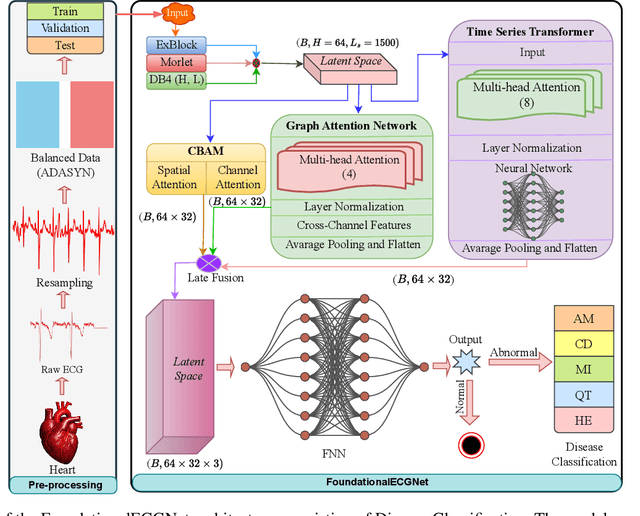
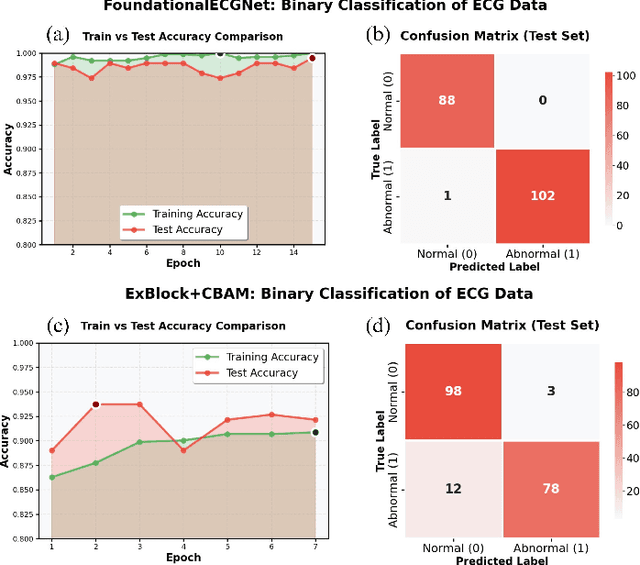
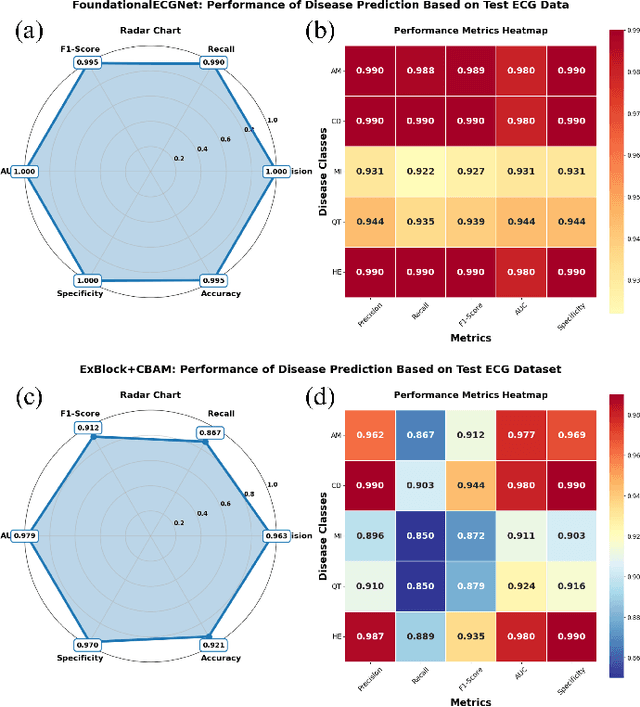
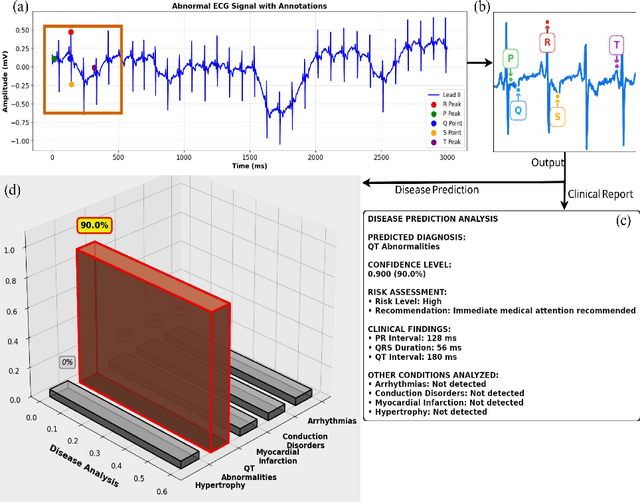
Cardiovascular diseases (CVDs) remain a leading cause of mortality worldwide, underscoring the importance of accurate and scalable diagnostic systems. Electrocardiogram (ECG) analysis is central to detecting cardiac abnormalities, yet challenges such as noise, class imbalance, and dataset heterogeneity limit current methods. To address these issues, we propose FoundationalECGNet, a foundational framework for automated ECG classification. The model integrates a dual-stage denoising by Morlet and Daubechies wavelets transformation, Convolutional Block Attention Module (CBAM), Graph Attention Networks (GAT), and Time Series Transformers (TST) to jointly capture spatial and temporal dependencies in multi-channel ECG signals. FoundationalECGNet first distinguishes between Normal and Abnormal ECG signals, and then classifies the Abnormal signals into one of five cardiac conditions: Arrhythmias, Conduction Disorders, Myocardial Infarction, QT Abnormalities, or Hypertrophy. Across multiple datasets, the model achieves a 99% F1-score for Normal vs. Abnormal classification and shows state-of-the-art performance in multi-class disease detection, including a 99% F1-score for Conduction Disorders and Hypertrophy, as well as a 98.9% F1-score for Arrhythmias. Additionally, the model provides risk level estimations to facilitate clinical decision-making. In conclusion, FoundationalECGNet represents a scalable, interpretable, and generalizable solution for automated ECG analysis, with the potential to improve diagnostic precision and patient outcomes in healthcare settings. We'll share the code after acceptance.