 Add to Chrome
 Add to Firefox
 Add to Edge
Polite on the Surface, Wrong in Practice: A Curated Dataset for Fixing Honorific Failures in Multilingual Bangla Generation
May 21, 2026
Recent advances in Multilingual Large Language Models (MLLMs) have significantly enhanced cross-lingual conversational capabilities, yet modeling culturally nuanced and context-dependent communication remains a critical bottleneck. Specifically, existing state-of-the-art models exhibit a severe pragmatic gap when handling structural variations, regional idioms, and honorific consistencies in low-resource contexts like Bangla. To address this limitation, we introduce a novel, culturally aligned instruction-tuning dataset for \textbf{BangLa Application and DialoguE generation - BLADE} and benchmarking framework comprising $4,196$ meticulously curated interaction pairs. We leverage this resource to systematically fine-tune and evaluate leading open-weight architectures, including DeepSeek-8B and LLaMA-3.2-3B, utilizing parameter-efficient fine-tuning via LoRA adapters in a 4-bit NormalFloat (NF4) quantization framework. Our empirical evaluations demonstrate that models fine-tuned on our dataset yield substantial improvements in structural fidelity and honorific alignment, providing a rigorous benchmark for bridging pragmatic disparities in low-resource multilingual text generation. Code and dataset: https://github.com/ashuvo25/Bangla_Application_LLM/tree/main

VisText-Mosquito: A Multimodal Dataset and Benchmark for AI-Based Mosquito Breeding Site Detection and Reasoning
Jun 17, 2025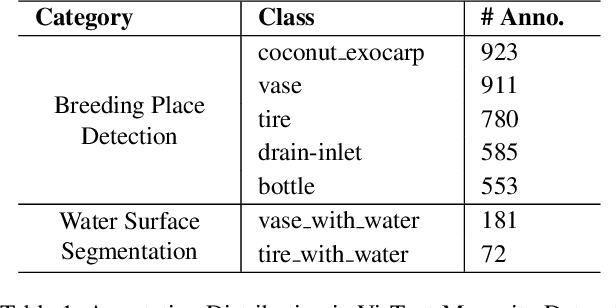
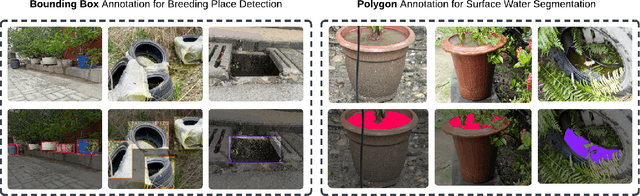
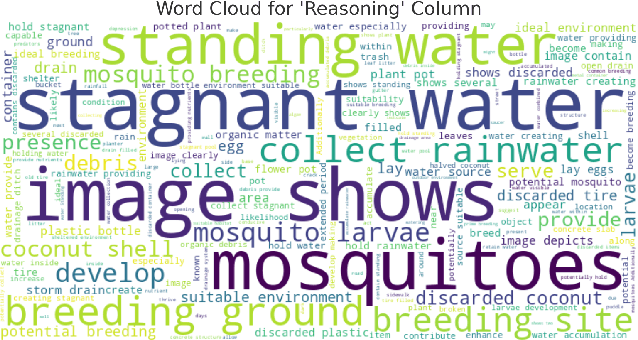
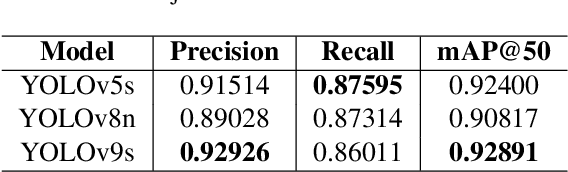
Mosquito-borne diseases pose a major global health risk, requiring early detection and proactive control of breeding sites to prevent outbreaks. In this paper, we present VisText-Mosquito, a multimodal dataset that integrates visual and textual data to support automated detection, segmentation, and reasoning for mosquito breeding site analysis. The dataset includes 1,828 annotated images for object detection, 142 images for water surface segmentation, and natural language reasoning texts linked to each image. The YOLOv9s model achieves the highest precision of 0.92926 and mAP@50 of 0.92891 for object detection, while YOLOv11n-Seg reaches a segmentation precision of 0.91587 and mAP@50 of 0.79795. For reasoning generation, our fine-tuned BLIP model achieves a final loss of 0.0028, with a BLEU score of 54.7, BERTScore of 0.91, and ROUGE-L of 0.87. This dataset and model framework emphasize the theme "Prevention is Better than Cure", showcasing how AI-based detection can proactively address mosquito-borne disease risks. The dataset and implementation code are publicly available at GitHub: https://github.com/adnanul-islam-jisun/VisText-Mosquito