 Add to Chrome
 Add to Firefox
 Add to Edge
A Dual-Domain Convolutional Network for Hyperspectral Single-Image Super-Resolution
Dec 10, 2025
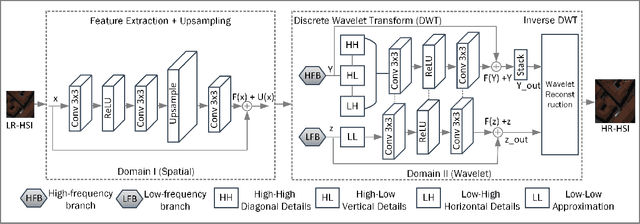
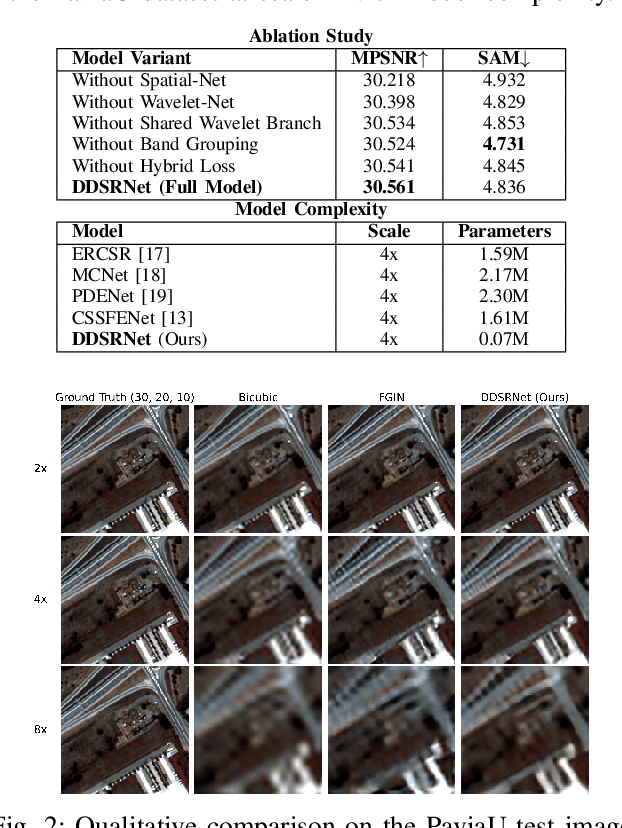
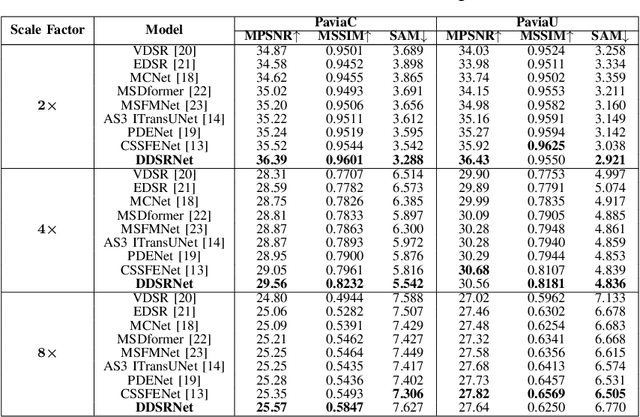
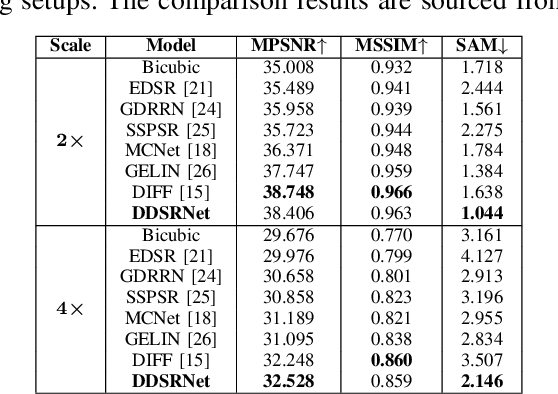
This study presents a lightweight dual-domain super-resolution network (DDSRNet) that combines Spatial-Net with the discrete wavelet transform (DWT). Specifically, our proposed model comprises three main components: (1) a shallow feature extraction module, termed Spatial-Net, which performs residual learning and bilinear interpolation; (2) a low-frequency enhancement branch based on the DWT that refines coarse image structures; and (3) a shared high-frequency refinement branch that simultaneously enhances the LH (horizontal), HL (vertical), and HH (diagonal) wavelet subbands using a single CNN with shared weights. As a result, the DWT enables subband decomposition, while the inverse DWT reconstructs the final high-resolution output. By doing so, the integration of spatial- and frequency-domain learning enables DDSRNet to achieve highly competitive performance with low computational cost on three hyperspectral image datasets, demonstrating its effectiveness for hyperspectral image super-resolution.

Saliency-based Video Summarization for Face Anti-spoofing
Aug 23, 2023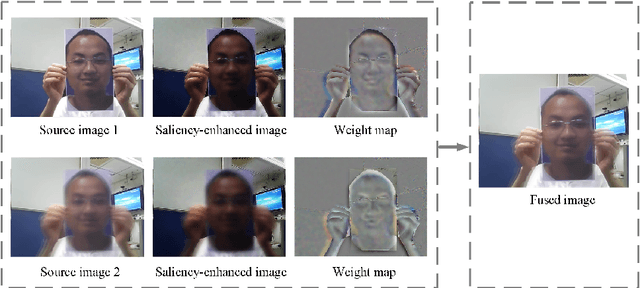
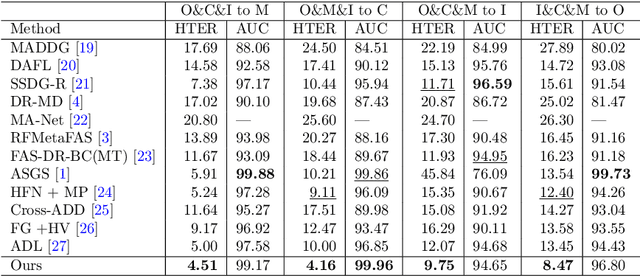
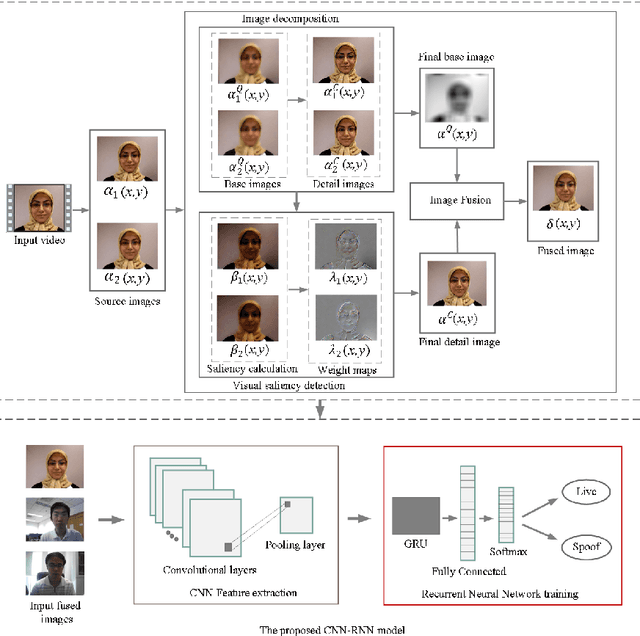
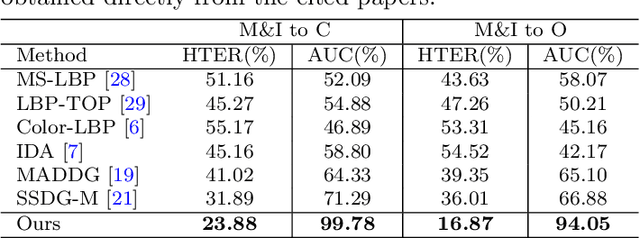
Due to the growing availability of face anti-spoofing databases, researchers are increasingly focusing on video-based methods that use hundreds to thousands of images to assess their impact on performance. However, there is no clear consensus on the exact number of frames in a video required to improve the performance of face anti-spoofing tasks. Inspired by the visual saliency theory, we present a video summarization method for face anti-spoofing tasks that aims to enhance the performance and efficiency of deep learning models by leveraging visual saliency. In particular, saliency information is extracted from the differences between the Laplacian and Wiener filter outputs of the source images, enabling identification of the most visually salient regions within each frame. Subsequently, the source images are decomposed into base and detail layers, enhancing representation of important information. The weighting maps are then computed based on the saliency information, indicating the importance of each pixel in the image. By linearly combining the base and detail layers using the weighting maps, the method fuses the source images to create a single representative image that summarizes the entire video. The key contribution of our proposed method lies in demonstrating how visual saliency can be used as a data-centric approach to improve the performance and efficiency of face presentation attack detection models. By focusing on the most salient images or regions within the images, a more representative and diverse training set can be created, potentially leading to more effective models. To validate the method's effectiveness, a simple deep learning architecture (CNN-RNN) was used, and the experimental results showcased state-of-the-art performance on five challenging face anti-spoofing datasets.
Deep Ensemble Learning with Frame Skipping for Face Anti-Spoofing
Jul 11, 2023Face presentation attacks (PA), also known as spoofing attacks, pose a substantial threat to biometric systems that rely on facial recognition systems, such as access control systems, mobile payments, and identity verification systems. To mitigate the spoofing risk, several video-based methods have been presented in the literature that analyze facial motion in successive video frames. However, estimating the motion between adjacent frames is a challenging task and requires high computational cost. In this paper, we rephrase the face anti-spoofing task as a motion prediction problem and introduce a deep ensemble learning model with a frame skipping mechanism. In particular, the proposed frame skipping adopts a uniform sampling approach by dividing the original video into video clips of fixed size. By doing so, every nth frame of the clip is selected to ensure that the temporal patterns can easily be perceived during the training of three different recurrent neural networks (RNNs). Motivated by the performance of individual RNNs, a meta-model is developed to improve the overall detection performance by combining the prediction of individual RNNs. Extensive experiments were performed on four datasets, and state-of-the-art performance is reported on MSU-MFSD (3.12%), Replay-Attack (11.19%), and OULU-NPU (12.23%) databases by using half total error rates (HTERs) in the most challenging cross-dataset testing scenario.