 Add to Chrome
 Add to Firefox
 Add to Edge
InstructNet: A Novel Approach for Multi-Label Instruction Classification through Advanced Deep Learning
Dec 20, 2025
People use search engines for various topics and items, from daily essentials to more aspirational and specialized objects. Therefore, search engines have taken over as peoples preferred resource. The How To prefix has become familiar and widely used in various search styles to find solutions to particular problems. This search allows people to find sequential instructions by providing detailed guidelines to accomplish specific tasks. Categorizing instructional text is also essential for task-oriented learning and creating knowledge bases. This study uses the How To articles to determine the multi-label instruction category. We have brought this work with a dataset comprising 11,121 observations from wikiHow, where each record has multiple categories. To find out the multi-label category meticulously, we employ some transformer-based deep neural architectures, such as Generalized Autoregressive Pretraining for Language Understanding (XLNet), Bidirectional Encoder Representation from Transformers (BERT), etc. In our multi-label instruction classification process, we have reckoned our proposed architectures using accuracy and macro f1-score as the performance metrics. This thorough evaluation showed us much about our strategys strengths and drawbacks. Specifically, our implementation of the XLNet architecture has demonstrated unprecedented performance, achieving an accuracy of 97.30% and micro and macro average scores of 89.02% and 93%, a noteworthy accomplishment in multi-label classification. This high level of accuracy and macro average score is a testament to the effectiveness of the XLNet architecture in our proposed InstructNet approach. By employing a multi-level strategy in our evaluation process, we have gained a more comprehensive knowledge of the effectiveness of our proposed architectures and identified areas for forthcoming improvement and refinement.

A Survey on the Application of Generative Adversarial Networks in Cybersecurity: Prospective, Direction and Open Research Scopes
Jul 11, 2024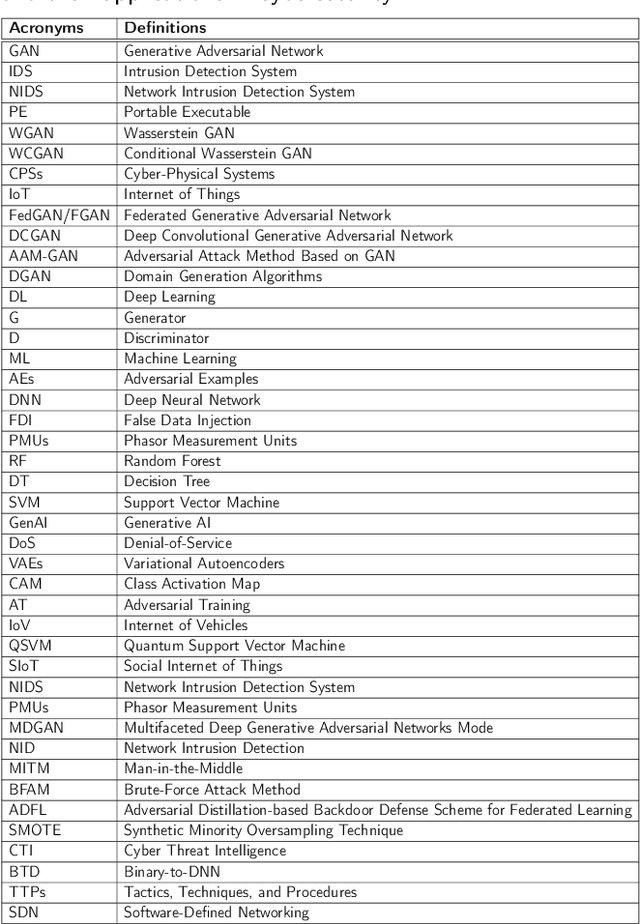
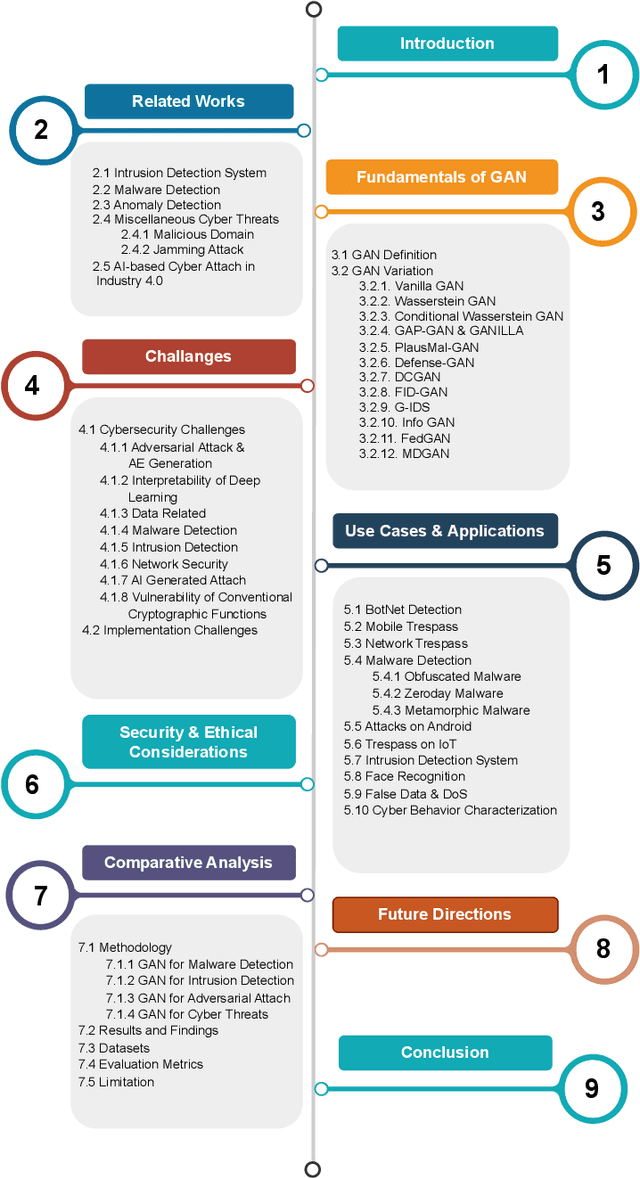
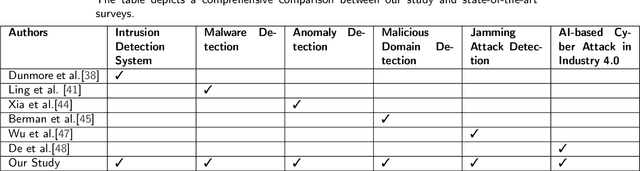
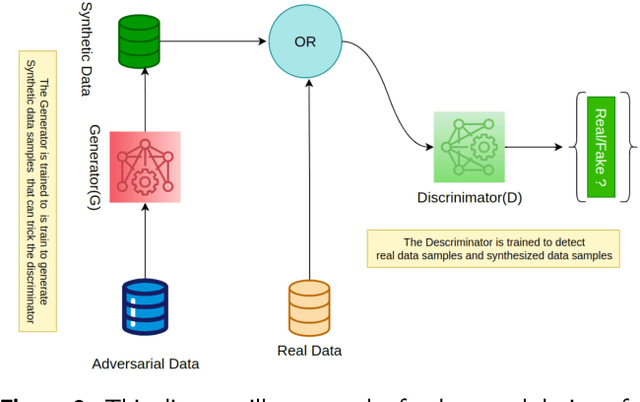
With the proliferation of Artificial Intelligence, there has been a massive increase in the amount of data required to be accumulated and disseminated digitally. As the data are available online in digital landscapes with complex and sophisticated infrastructures, it is crucial to implement various defense mechanisms based on cybersecurity. Generative Adversarial Networks (GANs), which are deep learning models, have emerged as powerful solutions for addressing the constantly changing security issues. This survey studies the significance of the deep learning model, precisely on GANs, in strengthening cybersecurity defenses. Our survey aims to explore the various works completed in GANs, such as Intrusion Detection Systems (IDS), Mobile and Network Trespass, BotNet Detection, and Malware Detection. The focus is to examine how GANs can be influential tools to strengthen cybersecurity defenses in these domains. Further, the paper discusses the challenges and constraints of using GANs in these areas and suggests future research directions. Overall, the paper highlights the potential of GANs in enhancing cybersecurity measures and addresses the need for further exploration in this field.
Fish Disease Detection Using Image Based Machine Learning Technique in Aquaculture
May 09, 2021Fish diseases in aquaculture constitute a significant hazard to nutriment security. Identification of infected fishes in aquaculture remains challenging to find out at the early stage due to the dearth of necessary infrastructure. The identification of infected fish timely is an obligatory step to thwart from spreading disease. In this work, we want to find out the salmon fish disease in aquaculture, as salmon aquaculture is the fastest-growing food production system globally, accounting for 70 percent (2.5 million tons) of the market. In the alliance of flawless image processing and machine learning mechanism, we identify the infected fishes caused by the various pathogen. This work divides into two portions. In the rudimentary portion, image pre-processing and segmentation have been applied to reduce noise and exaggerate the image, respectively. In the second portion, we extract the involved features to classify the diseases with the help of the Support Vector Machine (SVM) algorithm of machine learning with a kernel function. The processed images of the first portion have passed through this (SVM) model. Then we harmonize a comprehensive experiment with the proposed combination of techniques on the salmon fish image dataset used to examine the fish disease. We have conveyed this work on a novel dataset compromising with and without image augmentation. The results have bought a judgment of our applied SVM performs notably with 91.42 and 94.12 percent of accuracy, respectively, with and without augmentation.