 Add to Chrome
 Add to Firefox
 Add to Edge
GST-VLA: Structured Gaussian Spatial Tokens for 3D Depth-Aware Vision-Language-Action Models
Mar 10, 2026
VLA models encode visual observations as 2D patch tokens with no intrinsic geometric structure. We introduce GST-VLA with two contributions. First, the Gaussian Spatial Tokenizer (GST) converts frozen dense depth and frozen semantic patch features into $N_g{=}128$ anisotropic 3D Gaussian primitives, each parameterized by a metric residual mean $μ\in \mathbb{R}^3$, log-scale covariance $\log σ\in \mathbb{R}^3$, and learned opacity $α\in (0,1)$. The covariance eigenstructure encodes local surface orientation, and opacity provides per-primitive geometric confidence, both inaccessible from scalar depth. Spatial attention pooling with learned queries concentrates the fixed token budget on geometrically salient regions rather than distributing uniformly. Second, 3D Depth-Aware Chain-of-Thought (DA-CoT) reasoning supervises four structured intermediate spatial thoughts, covering 3D object grounding, grasp affordance contact geometry, pairwise metric distances, and coarse SE(3) waypoints, as explicit generation targets in the training loss. A cross-attention sublayer at every VLM transformer block provides direct access to the raw 256-primitive Gaussian field during DA-CoT generation. A 300M-parameter flow-matching action expert with mixture-of-experts feedforward sublayers decodes 7-DoF delta action chunks via conditional ODE integration, conditioned on both VLM hidden states and DA-CoT outputs through dual cross-attention. Trained with composite $\mathcal{L}_\mathrm{flow} + \mathcal{L}_\mathrm{CoT} + \mathcal{L}_\mathrm{depth}$ across three progressive stages, GST-VLA achieves 96.4% on LIBERO (+2.0%), and 80.2% on SimplerEnv (+5.4%). Ablations isolate the contribution of each GST component, each DA-CoT thought, and each training stage, confirming independent and synergistic gains concentrated on precision demanding tasks.

VFM-VLM: Vision Foundation Model and Vision Language Model based Visual Comparison for 3D Pose Estimation
Dec 09, 2025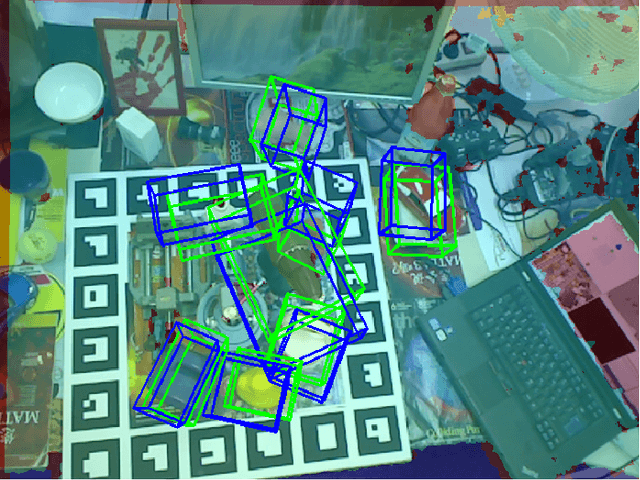
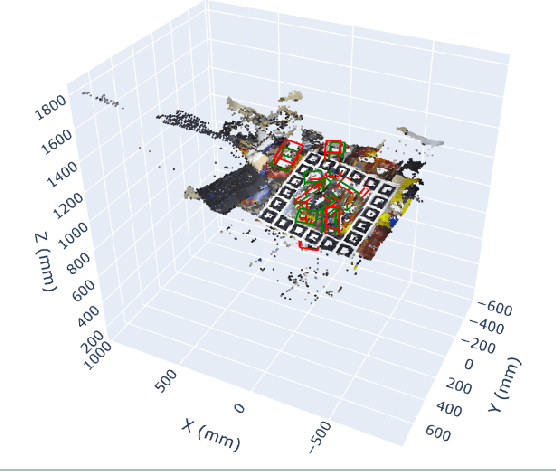
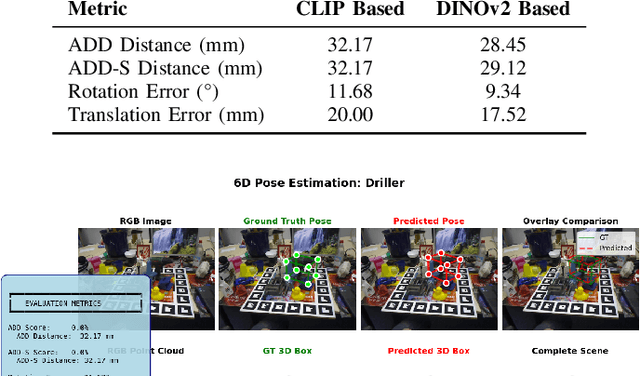
Vision Foundation Models (VFMs) and Vision Language Models (VLMs) have revolutionized computer vision by providing rich semantic and geometric representations. This paper presents a comprehensive visual comparison between CLIP based and DINOv2 based approaches for 3D pose estimation in hand object grasping scenarios. We evaluate both models on the task of 6D object pose estimation and demonstrate their complementary strengths: CLIP excels in semantic understanding through language grounding, while DINOv2 provides superior dense geometric features. Through extensive experiments on benchmark datasets, we show that CLIP based methods achieve better semantic consistency, while DINOv2 based approaches demonstrate competitive performance with enhanced geometric precision. Our analysis provides insights for selecting appropriate vision models for robotic manipulation and grasping, picking applications.