 Add to Chrome
 Add to Firefox
 Add to Edge
FALAT: Tracing Failures in LLM Agent Trajectories via Dependency-Guided Search
May 30, 2026
LLM-based agents increasingly solve complex tasks through long trajectories involving reasoning steps, tool calls, and inter-agent communication. However, when these agents fail, it is often unclear which agent caused the failure and which step introduced the decisive error. This attribution problem is challenging because mistakes can propagate across the trajectory: later actions may appear incorrect, but only because they depend on an earlier corrupted state. Therefore, failure attribution cannot be treated as independent step-level classification. We propose FALAT, a diagnostic framework for failure attribution in LLM agent trajectories. FALAT frames attribution as a dependency-guided search problem. It first constructs an expectation of how the task should be solved and uses this expectation to identify suspicious regions in the trajectory. It then traces dependencies among decisions, tool outputs, and agent messages to distinguish error-introducing steps from steps that merely inherit or propagate prior mistakes. Finally, FALAT evaluates whether correcting a candidate step would be sufficient to recover the expected outcome, allowing it to identify both the responsible agent and the decisive failure step. We evaluate FALAT on the Who&When benchmark, which includes both algorithm-generated and hand-crafted multi-agent failure trajectories. The results show that FALAT consistently improves responsible-agent and decisive-step attribution. Its best configurations achieve 46.0% step-level accuracy on algorithm-generated trajectories and 29.1% on the more challenging hand-crafted trajectories, outperforming specialized attribution baselines and direct prompting with standalone LLMs. These findings suggest that dependency-aware reasoning is essential for reliable failure diagnosis in LLM agent systems.

The Impact of Input Order Bias on Large Language Models for Software Fault Localization
Dec 25, 2024


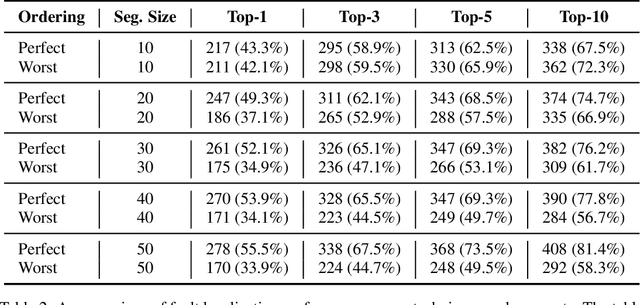
Large Language Models (LLMs) show great promise in software engineering tasks like Fault Localization (FL) and Automatic Program Repair (APR). This study examines how input order and context size affect LLM performance in FL, a key step for many downstream software engineering tasks. We test different orders for methods using Kendall Tau distances, including "perfect" (where ground truths come first) and "worst" (where ground truths come last). Our results show a strong bias in order, with Top-1 accuracy falling from 57\% to 20\% when we reverse the code order. Breaking down inputs into smaller contexts helps reduce this bias, narrowing the performance gap between perfect and worst orders from 22\% to just 1\%. We also look at ordering methods based on traditional FL techniques and metrics. Ordering using DepGraph's ranking achieves 48\% Top-1 accuracy, better than more straightforward ordering approaches like CallGraph. These findings underscore the importance of how we structure inputs, manage contexts, and choose ordering methods to improve LLM performance in FL and other software engineering tasks.