 Add to Chrome
 Add to Firefox
 Add to Edge
A Hybrid LLM-Based Framework for Automated Security Annotation Generation in Business Process Models
Aug 14, 2026
The modelling and analysis of secure business processes require the incorporation of security annotations into process models. Although BPMN extensions, including SecBPMN2, exist for this purpose, the derivation of accurate and complete security annotations from natural-language specifications remains a manual, expert-intensive, and error-prone task. This paper presents a hybrid framework that takes a BPMN process model and a security requirements document as input and automatically generates security annotations adhering to the SecBPMN2 specification. The approach combines Large Language Model (LLM)--based semantic extraction with schema-constrained mapping, rule-based normalization, and deterministic validation. The framework is evaluated comprehensively on a curated dataset of 27 process models from various domains. The results indicate that it consistently produces structurally valid SecBPMN2 annotations with high schema completeness. Compared to human security analysts, the system achieves substantially higher precision (0.58 vs. 0.29) while maintaining comparable recall (0.52 vs. 0.50) and reduces erroneous or misplaced annotations by nearly 50%. In addition, annotation generation is significantly faster than manual annotation. These findings demonstrate that hybrid LLM- and rule-based automation can reduce modeling effort while improving consistency and reliability, thereby providing a scalable foundation for security-by-design BPM.

A comparative study of similarity-based and GNN-based link prediction approaches
Aug 20, 2020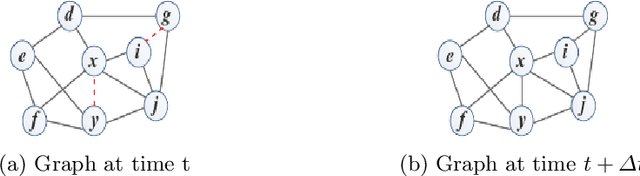
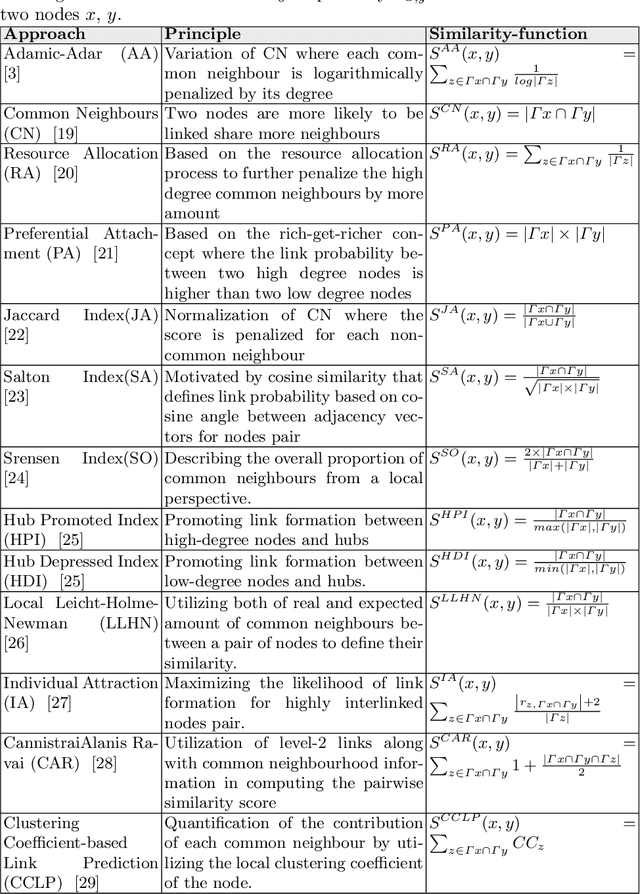
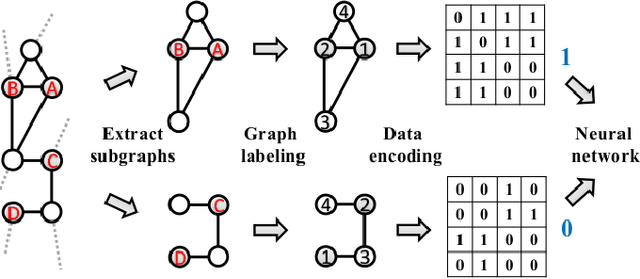
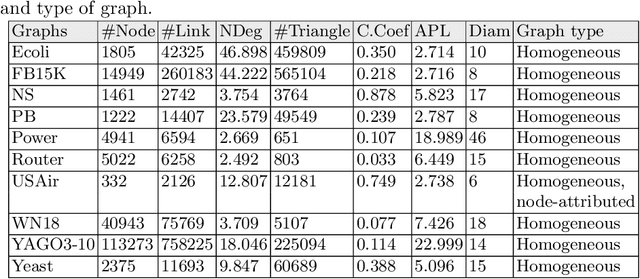
The task of inferring the missing links in a graph based on its current structure is referred to as link prediction. Link prediction methods that are based on pairwise node similarity are well-established approaches in the literature. They show good prediction performance in many real-world graphs though they are heuristics and lack of universal applicability. On the other hand, the success of neural networks for classification tasks in various domains leads researchers to study them in graphs. When a neural network can operate directly on the graph, then it is termed as the graph neural network (GNN). GNN is able to learn hidden features from graphs which can be used for link prediction task in graphs. Link predictions based on GNNs have gained much attention of researchers due to their convincing high performance in many real-world graphs. This appraisal paper studies some similarity and GNN-based link prediction approaches in the domain of homogeneous graphs that consists of a single type of (attributed) nodes and single type of pairwise links. We evaluate the studied approaches against several benchmark graphs with different properties from various domains.