 Add to Chrome
 Add to Firefox
 Add to Edge
Data Leakage in Automotive Perception: Practitioners' Insights
Apr 08, 2026
Data leakage is the inadvertent transfer of information between training and evaluation datasets that poses a subtle, yet critical, risk to the reliability of machine learning (ML) models in safety-critical systems such as automotive perception. While leakage is widely recognized in research, little is known about how industrial practitioners actually perceive and manage it in practice. This study investigates practitioners' knowledge, experiences, and mitigation strategies around data leakage through ten semi-structured interviews with system design, development, and verification engineers working on automotive perception functions development. Using reflexive thematic analysis, we identify that knowledge of data leakage is widespread and fragmented along role boundaries: ML engineers conceptualize it as a data-splitting or validation issue, whereas design and verification roles interpret it in terms of representativeness and scenario coverage. Detection commonly arises through generic considerations and observed performance anomalies rather than implying specific tools. However, data leakage prevention is more commonly practiced, which depends mostly on experience and knowledge sharing. These findings suggest that leakage control is a socio-technical coordination problem distributed across roles and workflows. We discuss implications for ML reliability engineering, highlighting the need for shared definitions, traceable data practices, and continuous cross-role communication to institutionalize data leakage awareness within automotive ML development.

Improving Image Data Leakage Detection in Automotive Software
Oct 29, 2024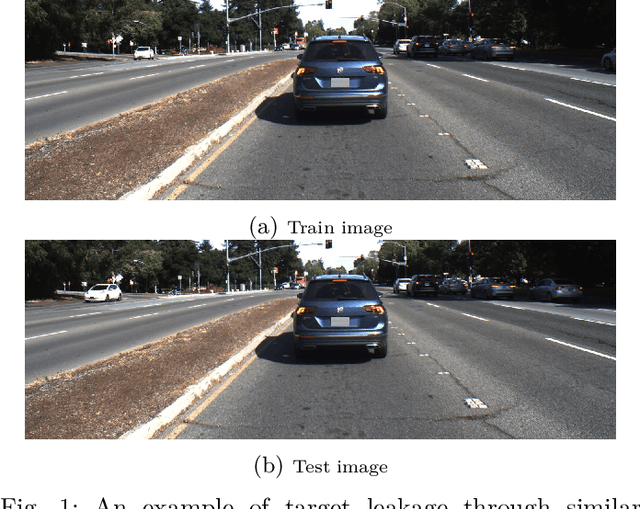
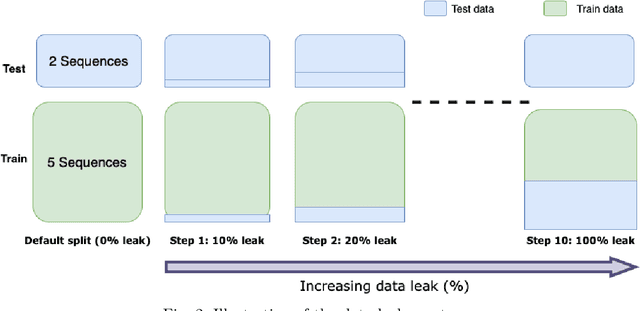
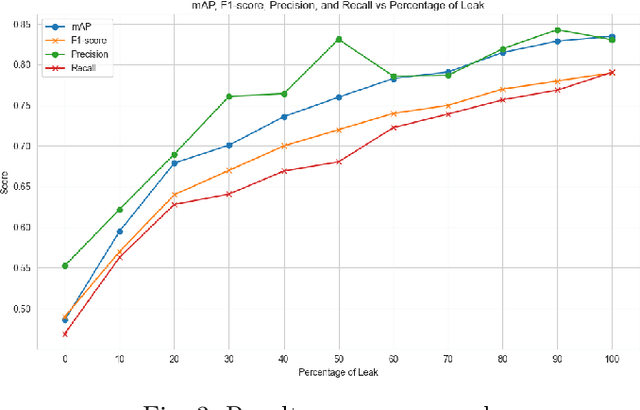
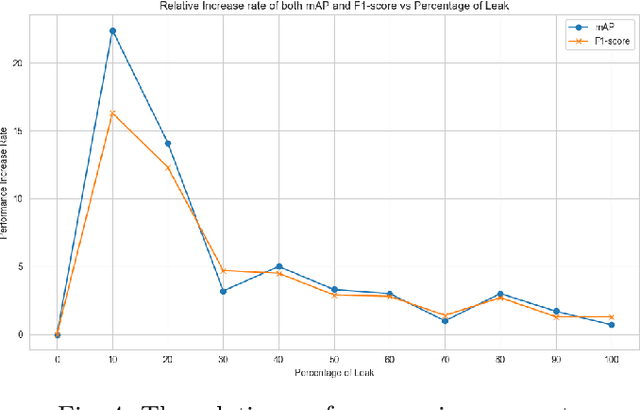
Data leakage is a very common problem that is often overlooked during splitting data into train and test sets before training any ML/DL model. The model performance gets artificially inflated with the presence of data leakage during the evaluation phase which often leads the model to erroneous prediction on real-time deployment. However, detecting the presence of such leakage is challenging, particularly in the object detection context of perception systems where the model needs to be supplied with image data for training. In this study, we conduct a computational experiment on the Cirrus dataset from our industrial partner Volvo Cars to develop a method for detecting data leakage. We then evaluate the method on another public dataset, Kitti, which is a popular and widely accepted benchmark dataset in the automotive domain. The results show that thanks to our proposed method we are able to detect data leakage in the Kitti dataset, which was previously unknown.