 Add to Chrome
 Add to Firefox
 Add to Edge
Multi-Kernel Gated Decoder Adapters for Robust Multi-Task Thyroid Ultrasound under Cross-Center Shift
Mar 09, 2026
Thyroid ultrasound (US) automation couples two competing requirements: global, geometry-driven reasoning for nodule delineation and local, texture-driven reasoning for malignancy risk assessment. Under cross-center domain shift, these cues degrade asymmetrically, yet most multi-task pipelines rely on a single shared backbone, often inducing negative transfer. In this paper, we characterize this interference across CNN (ResNet34) and medical ViT (MedSAM) backbones, and observe a consistent trend: ViTs transfer geometric priors that benefit segmentation, whereas CNNs more reliably preserve texture cues for malignancy discrimination under strong shift and artifacts. Motivated by this failure mode, we propose a lightweight family of decoder-side adapters, the Multi-Kernel Gated Adapter (MKGA) and a residual variant (ResMKGA), which refine multi-scale skip features using complementary receptive fields and apply semantic, context-conditioned gating to suppress artifact-prone content before fusion. Across two US benchmarks, the proposed adapters improve cross-center robustness: they strengthen out-of-domain segmentation and, in the CNN setting, yield clear gains in clinical TI-RADS diagnostic accuracy compared to standard multi-task baselines. Code and models will be released.

Thyroidiomics: An Automated Pipeline for Segmentation and Classification of Thyroid Pathologies from Scintigraphy Images
Jul 14, 2024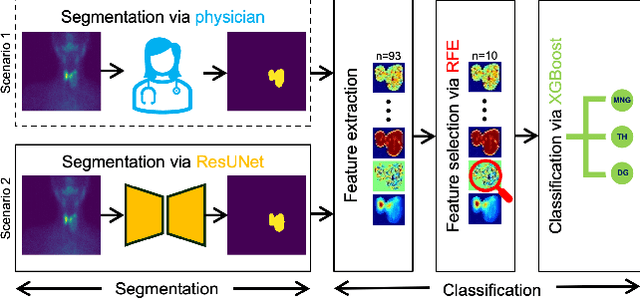
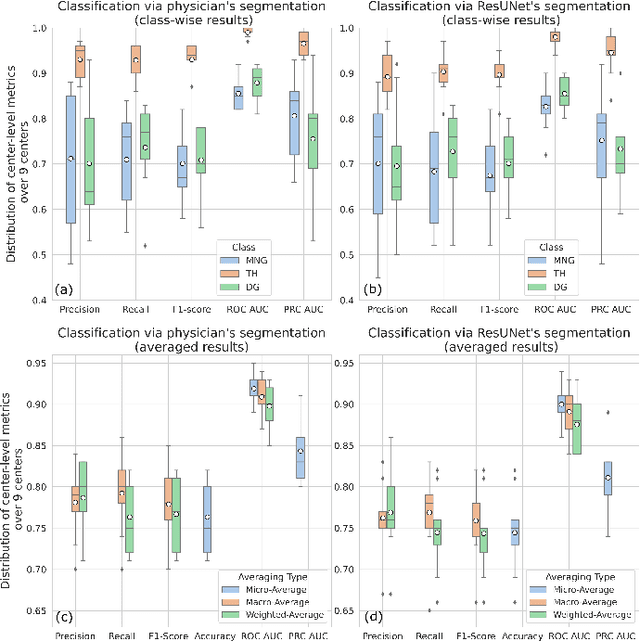
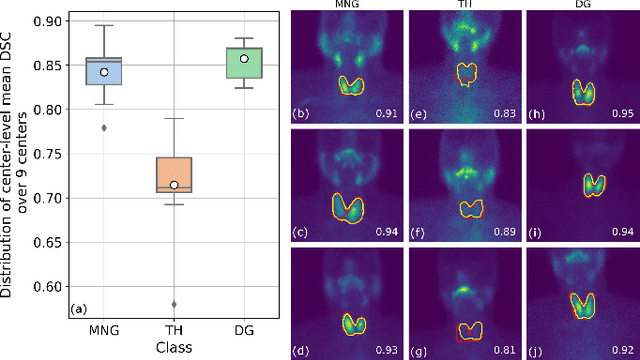
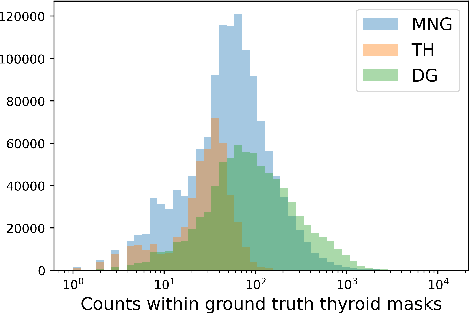
The objective of this study was to develop an automated pipeline that enhances thyroid disease classification using thyroid scintigraphy images, aiming to decrease assessment time and increase diagnostic accuracy. Anterior thyroid scintigraphy images from 2,643 patients were collected and categorized into diffuse goiter (DG), multinodal goiter (MNG), and thyroiditis (TH) based on clinical reports, and then segmented by an expert. A ResUNet model was trained to perform auto-segmentation. Radiomic features were extracted from both physician (scenario 1) and ResUNet segmentations (scenario 2), followed by omitting highly correlated features using Spearman's correlation, and feature selection using Recursive Feature Elimination (RFE) with XGBoost as the core. All models were trained under leave-one-center-out cross-validation (LOCOCV) scheme, where nine instances of algorithms were iteratively trained and validated on data from eight centers and tested on the ninth for both scenarios separately. Segmentation performance was assessed using the Dice similarity coefficient (DSC), while classification performance was assessed using metrics, such as precision, recall, F1-score, accuracy, area under the Receiver Operating Characteristic (ROC AUC), and area under the precision-recall curve (PRC AUC). ResUNet achieved DSC values of 0.84$\pm$0.03, 0.71$\pm$0.06, and 0.86$\pm$0.02 for MNG, TH, and DG, respectively. Classification in scenario 1 achieved an accuracy of 0.76$\pm$0.04 and a ROC AUC of 0.92$\pm$0.02 while in scenario 2, classification yielded an accuracy of 0.74$\pm$0.05 and a ROC AUC of 0.90$\pm$0.02. The automated pipeline demonstrated comparable performance to physician segmentations on several classification metrics across different classes, effectively reducing assessment time while maintaining high diagnostic accuracy. Code available at: https://github.com/ahxmeds/thyroidiomics.git.