 Add to Chrome
 Add to Firefox
 Add to Edge
TaxonRL: Reinforcement Learning with Intermediate Rewards for Interpretable Fine-Grained Visual Reasoning
Mar 04, 2026
Traditional vision-language models struggle with contrastive fine-grained taxonomic reasoning, particularly when distinguishing between visually similar species within the same genus or family. We introduce TaxonRL, a reinforcement learning approach using Group Relative Policy Optimization with intermediate rewards that decomposes the reasoning process into hierarchical taxonomic predictions. Our method incentivizes models to explicitly reason about species-level, genus-level, and family-level features before making final classifications. This structured approach is designed not only to boost accuracy but also to yield a transparent, verifiable decision-making process. On the challenging Birds-to-Words dataset, TaxonRL achieves 91.7\% average accuracy, exceeding human performance (77.3\%) while generating interpretable reasoning traces. We demonstrate strong cross-domain generalization, showing substantial gains in primate and marine species verification. Our results establish that enforcing structured, hierarchical reasoning provides a powerful and transferable framework for fine-grained visual discrimination.

GorillaWatch: An Automated System for In-the-Wild Gorilla Re-Identification and Population Monitoring
Dec 08, 2025
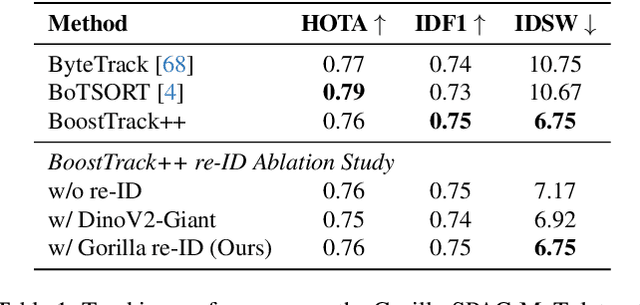
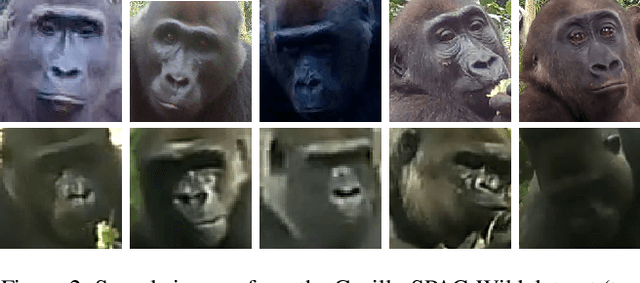
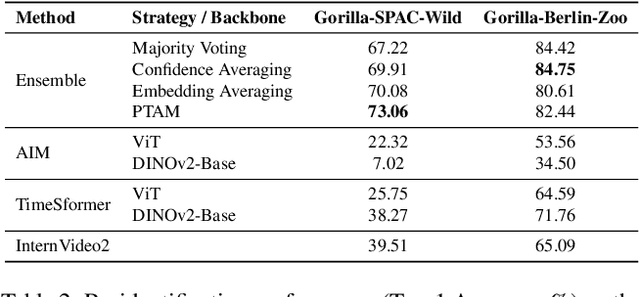
Monitoring critically endangered western lowland gorillas is currently hampered by the immense manual effort required to re-identify individuals from vast archives of camera trap footage. The primary obstacle to automating this process has been the lack of large-scale, "in-the-wild" video datasets suitable for training robust deep learning models. To address this gap, we introduce a comprehensive benchmark with three novel datasets: Gorilla-SPAC-Wild, the largest video dataset for wild primate re-identification to date; Gorilla-Berlin-Zoo, for assessing cross-domain re-identification generalization; and Gorilla-SPAC-MoT, for evaluating multi-object tracking in camera trap footage. Building on these datasets, we present GorillaWatch, an end-to-end pipeline integrating detection, tracking, and re-identification. To exploit temporal information, we introduce a multi-frame self-supervised pretraining strategy that leverages consistency in tracklets to learn domain-specific features without manual labels. To ensure scientific validity, a differentiable adaptation of AttnLRP verifies that our model relies on discriminative biometric traits rather than background correlations. Extensive benchmarking subsequently demonstrates that aggregating features from large-scale image backbones outperforms specialized video architectures. Finally, we address unsupervised population counting by integrating spatiotemporal constraints into standard clustering to mitigate over-segmentation. We publicly release all code and datasets to facilitate scalable, non-invasive monitoring of endangered species